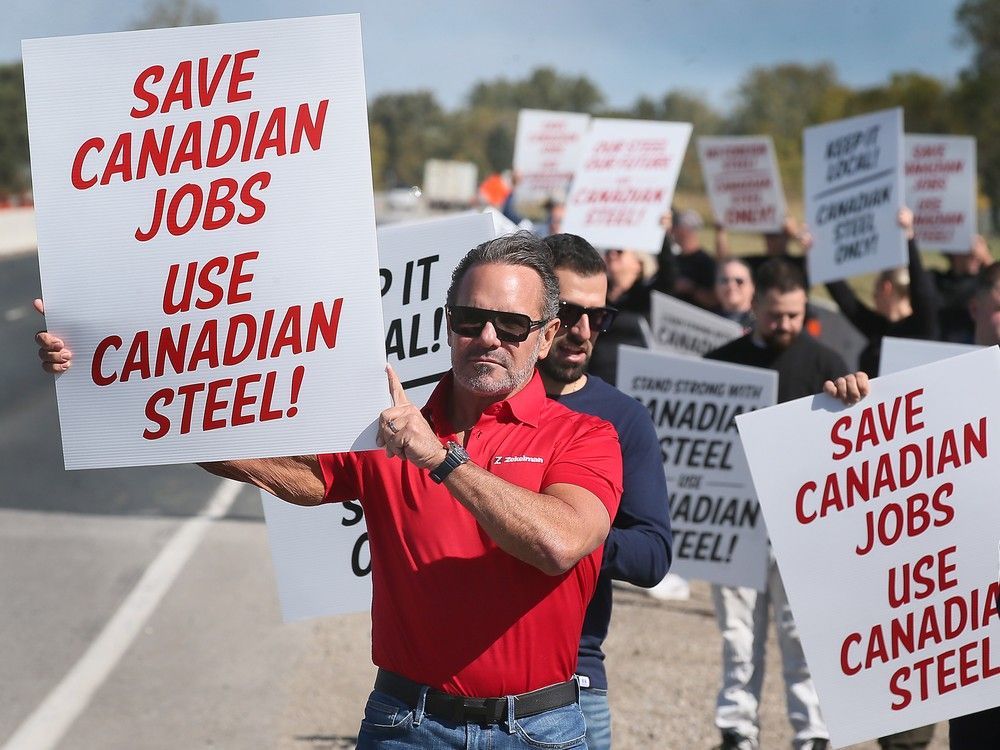
As Ottawa looks to intensify its trade relationship with Beijing after a meeting between Prime Minister Mark Carney and Chinese President Xi Jinping, Canada’s auto industry is sounding the alarm over the question of whether those talks could open the door to Chinese “knock-down kits” or “kit cars,” warning of their impact on domestic jobs.
“We see no evidence in markets around the world that China will do anything but knock-down kits,” said Brian Kingston, president and CEO of the Canadian Vehicle Manufacturers’ Association President.
uncertain
Kingston → look → President
A “knock-down kit” or a “kit car” is part of China’s strategy to quickly boost its auto exports, whereby car parts are quickly and cheaply manufactured in China, packed in boxes and shipped only to be assembled overseas.
asserted
parts → knock → boxes
“It’s like those toy models that you build at home.
asserted
you → ’ → home
It comes in a box, and all the parts are there and then you get to assemble it,” said
asserted
you → come → it
“The worry about the idea of the kit cars is that all the parts would be manufactured in China.
asserted
parts → manufacture → China
They would then be shipped to North America and then they would just be assembled into cars,” he added.
asserted
he → ship → cars
While most kit cars still require assembly, it is a significantly scaled back operation compared to traditional vehicle manufacturing and has spurred concerns from representatives of the auto industry that the “kit car” model would employ fewer workers.
asserted
model → require → workers
“There would be an assembly line that employs workers, but much of the auto sector in North America and in Canada and in Southern Ontario, is not assembly of cars, it’s the manufacturing of the parts,” Mang said.
Chinese manufacturers use “lower labor standards, weak environmental laws, coal-fired electricity” to undercut global competition, Kingston said, adding that allowing Chinese EVs into the market has already cost job losses in Europe.
asserted
allowing → employ → Europe
“This will destroy Canada’s auto industry.
asserted
This → destroy → industry
It will destroy our manufacturing base if we open our market to China,” said Kingston, who represents the operations of Ford Motor Company, General Motors and Stellantis in Canada.
asserted
who → destroy → Canada
Canada’s auto sector directly employs 125,000 people and is indirectly supported by 427,000 jobs, according to Statistics Canada, and contributed $16.8 billion to Canada’s GDP in 2024.
uncertain
sector → employ → 2024
When asked about concerns around kit cars, Carney said on Sunday that any manufacturing deal with China would have to involve “significant value added” in Canada.
asserted
deal → ask → Canada
Ottawa would not accept a deal where only the final stage of automobile assembly is done in Canada, Carney said in Cambodia.
asserted
Carney → accept → Cambodia
However, some experts say there has been no evidence that China has set up substantial automobile local supply chains anywhere outside its own borders.
asserted
China → say → borders
“There’s been no public evidence of a Chinese manufacturing plant being set up in another country and then localization happening.
asserted
localization → set → country
Local domestic parts are not being integrated at a reasonable scale into the Chinese company’s operations,” said Elizabeth Donkervoort, senior advisor for China programs at the Asia Pacific Foundation of Canada.
asserted
Donkervoort → integrate → Canada
“Canada really doesn’t have a model for how they’re going to enforce this,” she added.
asserted
she → have → this
Carney also stressed the importance of vehicles made in Canada using Canadian critical minerals.
asserted
Carney → stress → minerals
However, some experts say that can be hard to enforce.
asserted
that → say → ?
“They have a holistic and an entire comprehensive ecosystem within China, where everything from the processing of the critical minerals that are used in developing the technologies to the hardware for EVs are processed in China,” Donkervoort said.
asserted
Donkervoort → have → China
Thailand has been an example of a country that has tried and failed to get China to build local supply chains instead of using knock-down kits.
asserted
China → try → kits
“Thailand has been trying to do that.
asserted
Thailand → try → that
But Chinese companies, from my understanding, have not reached the same level of localization as Japanese and South Korean automakers in Thailand,” Donkervoort said.
asserted
Donkervoort → reach → Thailand
Europe, particularly Germany, is an example of “what not to do,” Kingston said.
asserted
Kingston → do → what
“They’ve allowed the Chinese into the market.
asserted
They → allow → market
They’re on route to get 20 per cent market share.
asserted
They → ’re → share
We’re seeing massive job loss across the European automotive sector, 104,000 jobs in the past two years.
asserted
We → see → years
Germany (alone) has shed over 40,000 jobs in the past six months,” he said.
asserted
he → shed → months
Setting up domestic supply chains would mean Chinese companies lose their price advantage, Kingston said.
asserted
Kingston → set → advantage
“There is no world in which a Chinese company comes to Canada and builds a domestic supply chain,” he said.
asserted
he → be → chain
In Cambodia, Carney said U.S. President Donald Trump’s tariffs against Canada’s auto sector and Canada’s growing closeness with Beijing on trade were “all connected.”
asserted
tariffs → say → trade
“We have the best auto workers in the world, and we want them fully deployed (with) full opportunity in an integrated North American market.
asserted
them → have → market
That market has become less integrated because of U.S.,” Carney said.
asserted
Carney → become → U.S.
After decades of ever-deepening supply chains between Canada and the U.S., a trade deal with Washington is still the best bet for Canada’s auto industry, Kingston said.
asserted
Kingston → deepen → industry
“Diversification is not an option for the auto industry,” Kingston said.
asserted
Kingston → say → industry
 The Aporia