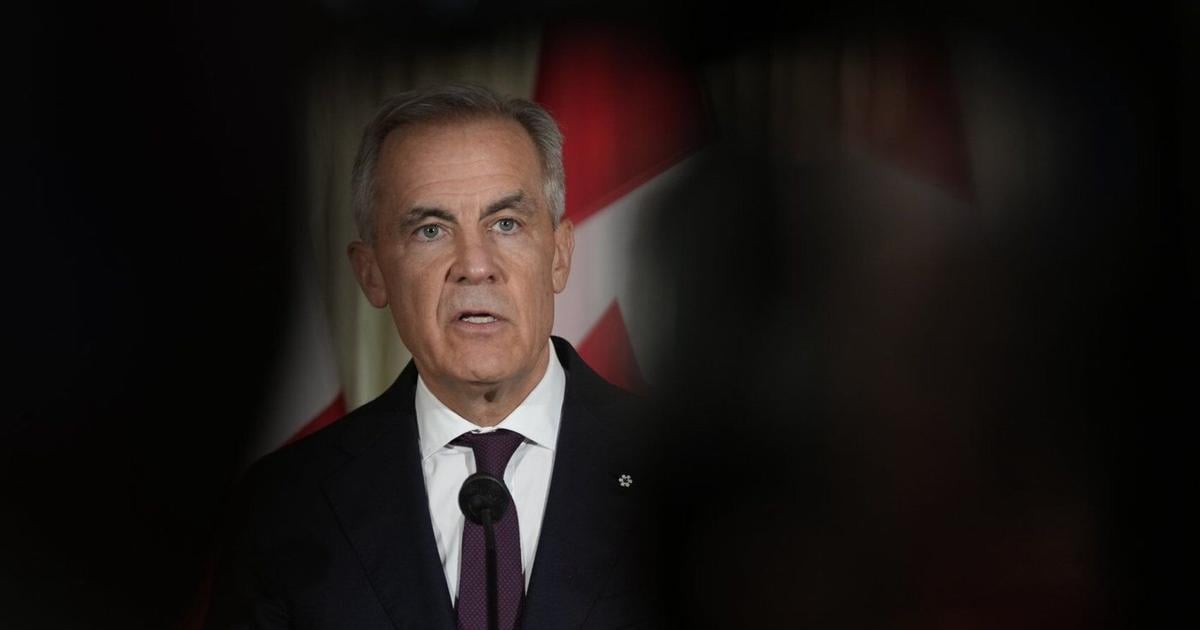
Prime Minister Mark Carney says how far Canada opens its auto sector to Chinese investment will depend on where tariff talks with Washington land.
asserted
talks → say → Washington
He set out conditions for Chinese automakers a day before meeting President Xi Jinping in Shenzhen, where the two leaders agreed Tuesday on new tariff cuts.
asserted
leaders → set → cuts
Speaking to reporters Monday in Phnom Penh, Cambodia, where he attended the Francophonie summit, Carney said an integrated North American industry remains his first choice.
asserted
industry → speak → summit
“We have the best auto workers in the world, and we want them fully deployed, full opportunity, in an integrated North American market,” he said.
asserted
he → have → market
“That market has become less integrated because of U.S. trade actions.”
asserted
market → become → actions
Whether Canadian plants stay integrated with U.S. production is part of the negotiations with Washington, Carney said.
asserted
Carney → stay → Washington
“Depending on where that settles, and it’s part of the trade negotiations…there’ll be other options: European options; Asian options, of course—Chinese, Japanese.”
asserted
it → depend → course
Any Chinese automaker would have to do substantial manufacturing in Canada, meet proper labour standards and build domestic supply chains that grow over time, including Canadian critical minerals for electric vehicles, he said.
asserted
he → have → vehicles
Ottawa remains opposed to “kit cars,” vehicles shipped as sets of parts to be assembled locally.
asserted
Ottawa → remain → parts
“It’s not just about kit cars,” Carney said.
asserted
Carney → ’ → cars
Asked whether the prospect of Chinese investment was meant as leverage against Washington, he replied: “It’s not leverage.
asserted
It → ask → Washington
He added: “Canada is going to move forward either way.”
asserted
Canada → add → ?
Carney did not attach figures to any of the conditions.
asserted
Carney → attach → conditions
A 50 percent deadline
Canadian-built vehicles face a 25 percent U.S. tariff under Section 232.
asserted
vehicles → build → Section
For models that meet CUSMA’s rules of origin, the duty excludes the value of U.S.-made parts.
asserted
duty → meet → parts
After talks collapsed in August, U.S. President Donald Trump said the rate on Canadian vehicles, auto parts and steel would rise to 50 percent on Jan. 1, 2027.
asserted
rate → collapse → Jan.
According to the Prime Minister’s Office, more than 90 percent of Canadian-made vehicles are exported to the U.S.
uncertain
percent → accord → U.S.
In Manila on Nov. 14, Carney said: “This government will not settle for a deal with the United States that is not consistent with a viable Canadian auto sector.”
asserted
that → say → sector
His comments in Phnom Penh drew a sharp response from Trump trade adviser Peter Navarro.
asserted
comments → draw → Navarro
“Are u [sic] really threatening to play China off the U.S,” Navarro posted on X.
asserted
Navarro → threaten → X.
What came out of Shenzhen
Carney and Xi met for about 25 minutes Tuesday, ahead of the Asia-Pacific Economic Cooperation leaders’ meeting, which runs Wednesday and Thursday.
asserted
which → come → meeting
China agreed to lift its 25 percent tariff on Canadian frozen pork cuts and frozen cold-water shrimp, covering about $400 million in annual exports, according to Carney’s spokesperson.
uncertain
China → agree → spokesperson
Beijing also extended tariff relief on certain Canadian products until at least Dec. 31, 2028.
asserted
Beijing → extend → Dec.
In return, Canada will extend by two years remission measures on some Chinese steel and aluminum products that were set to expire at the end of 2026.
asserted
that → extend → 2026
Before the meeting, The Globe and Mail reported, citing a person familiar with the negotiations, that Beijing was insisting any tariff cut be matched dollar for dollar by Ottawa.
asserted
cut → report → Ottawa
Since Carney’s January visit to Beijing, Canadian exports to China have risen 40 percent, led by oil, canola and peas, The Canadian Press reported.
asserted
Press → rise → oil
Guardrails and the January deal
That January agreement, which launched what Ottawa calls a strategic partnership, cut Canada’s 100 percent tariff on Chinese electric vehicles to 6.1 percent for up to 49,000 vehicles a year.
asserted
Ottawa → launch → vehicles
In exchange, China lowered tariffs on Canadian canola.
asserted
China → lower → canola
At the time, the government said it expected significant Chinese auto investment in Canada “within three years.”
asserted
it → say → years
In June, Industry Minister Mélanie Joly met with BYD, Chery, Geely and Shanghai Launch Automotive Technology in China about building electric vehicles in Canada.
asserted
Joly → meet → Canada
Ottawa has already ruled out kit-car assembly as an option for the shuttered Stellantis plant in Brampton, Ont.
asserted
Ottawa → rule → Brampton
Carney said “guardrails” still restrict Chinese investment in some sectors.
asserted
guardrails → say → sectors
He has previously identified those as defence-related industries, artificial intelligence and critical minerals.
asserted
He → identify → industries
He sees room for more agricultural and energy exports, “some elements of financial services” and clean-energy partnerships.
asserted
He → see → services
The weight of the U.S. market
As The Hub reported in June, Trump said he would not renew CUSMA ahead of its July 1 review milestone, leaving the pact subject to rolling annual reviews.
asserted
he → report → reviews
The U.S. still accounted for close to 70 percent of Canadian exports at the time, according to RBC.
uncertain
U.S. → account → RBC
Toyota and Honda together build more than 75 percent of vehicles made in Canada.
asserted
Toyota → build → Canada
Federal lobbying records show both companies raised CUSMA in most of their contacts with Ottawa in the first half of the year.
asserted
companies → show → year
The case for patience, revisited
Writing in The Hub in August 2025, the Macdonald-Laurier Institute’s Tim Sargent argued that Canada had reason to play for time rather than concede early.
asserted
Canada → revisit → time
Canadian-built vehicles typically contain about 50 percent U.S. content, he noted, so disrupting continental supply chains would raise costs on both sides of the border.
asserted
disrupting → build → border
…and 9 more, not listed.

 The Aporia