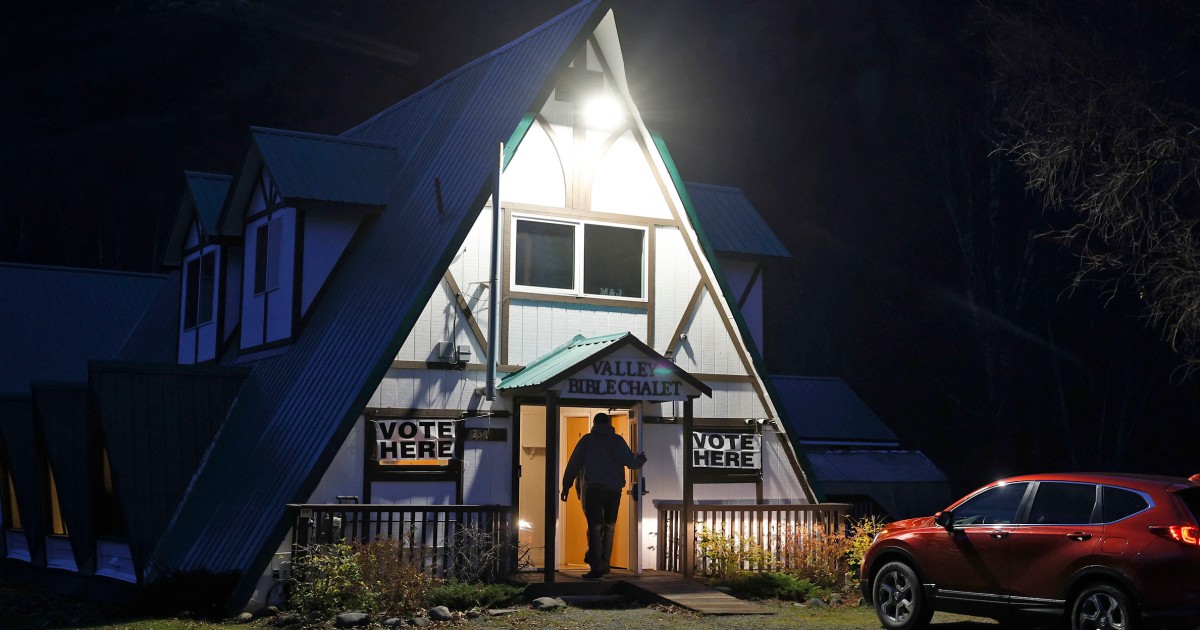
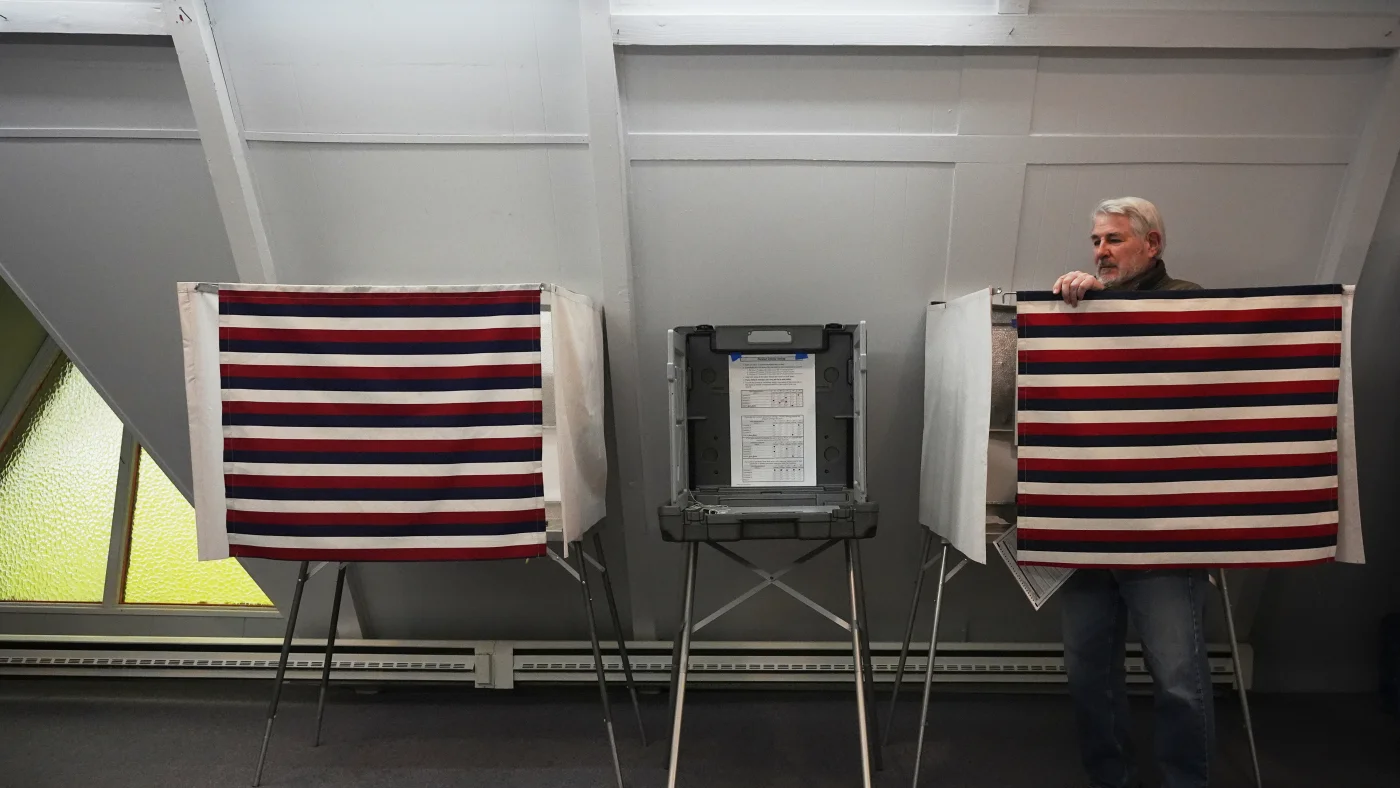
Photo via Reason

Alaska (Once Again) Votes To Keep Ranked Choice Voting

Read the original at Reason ↗
Cite

Lancaster, J. (2026, November 16). Alaska (Once Again) Votes To Keep Ranked Choice Voting. Reason. https://reason.com/2026/11/16/alaska-once-again-votes-to-keep-ranked-choice-voting/

Dated from the outlet's own feed. Check the original for its byline.

Reason · collected 2026-11-16 · by Joe Lancaster

Quick Summary

Alaska voters have decided to retain their ranked choice voting system, with over 95% of votes counted showing a majority in favor. This is the third time in six years that Alaskans have voted to keep the system, and the most decisive result yet. The article highlights that despite initial controversy and criticism from figures like former Governor Sarah Palin, the majority of Alaskans prefer the current voting method, suggesting that candidates should adapt to the system rather than attempt to repeal it.
Written by AI on 2026-11-17, from this article's own text only (the story summary below draws on all the coverage).
See how they differ ↓

AI analysis

Story summary

Alaskans have voted to retain their ranked choice voting system, rejecting a ballot measure that aimed to repeal it. The decision comes after intense scrutiny following a controversy involving two Senate candidates with the same name. In Alaska's unique election process, candidates from all parties compete on a single primary ballot, with the top four advancing to the general election. Voters then rank these candidates, and if no one surpasses the 50% threshold initially, the system redistributes votes from the least popular candidate until a winner is determined. This is the third time in six years that Alaskans have upheld this voting method, with the latest result being the most decisive. The system was previously narrowly adopted in 2020, and it has been praised for giving voters more choice and criticized for causing confusion.

Written for “Alaska Votes To Keep Ranked Choice Voting” on 2026-11-18, grounded in this article and the 3 other(s) covering the same event.

How they differ

4 outlets covered “Alaska Votes To Keep Ranked Choice Voting”.

What each outlet says

One AI summary per outlet of its latest article on this story, written from that article alone and checked against it. Open the article for the outlet's own words.

ReasonThis outlet16 Nov

Alaska voters have decided to retain their ranked choice voting system, with over 95% of votes counted showing a majority in favor. This is the third time in six years that Alaskans have voted to keep the system, and the most decisive result yet. The article highlights that despite initial controversy and criticism from figures like former Governor Sarah Palin, the majority of Alaskans prefer the current voting…

Alaska (Once Again) Votes To Keep Ranked Choice Voting (this article)
Toronto Star14 Nov

Alaska voters have once again rejected a ballot measure aimed at repealing the state’s open primary system and ranked choice voting in general elections. The measure, which would have also altered campaign disclosure rules, was part of the November 3 election. This is the second consecutive year that voters have refused to revert to traditional partisan primaries and a single-candidate selection process in general…

Alaska voters reject ballot measure seeking to repeal open primaries, ranked voting system →
NBC News14 Nov

Alaskans have voted to retain their ranked choice voting system, according to NBC News projections. This decision comes despite controversy over a potential spoiler candidate in the state’s Senate race. The system, implemented in 2022 following voter approval in 2020, allows voters to rank candidates, ensuring that the winning candidate receives a majority. This method is used only in Alaska and Maine for statewide…

Alaskans opt to stick with ranked choice voting →
NPR14 Nov

Alaska voters have rejected a ballot measure that would have repealed the state’s nonpartisan primary system and ranked choice voting, with the Associated Press calling the race. This marks the second time in three years that Alaskans have voted to keep this unique election system, which allows the top four candidates to advance to the general election. The system was under scrutiny due to confusion in a U.S. Senate…

Alaska voters aren't ditching ranked choice voting, top-four primaries →

Compared with similar articles

This article reads unscored and hedges 8% of its claims. Each row says how that neighbour differs.
Toronto Star
Hedges 0 of 3 claims Outlet record 64/100
NBC News
Leans left Hedges 0 of 15 claims Outlet record 78/100
NPR
Hedges 2 of 19 claims Outlet record 60/100
Daily Mail
Leans left Hedges 5 of 23 claims Outlet record 70/100
“Article A discusses Mary Peltola's declared victory in the Senate race against Dan Sullivan, while Article B focuses on the voter decision to keep ranked choice voting in Alaska.”
CBS News
Hedges 0 of 2 claims Outlet record 67/100
“Article A describes the outcome of a ballot measure on ranked choice voting, while Article B focuses on the ongoing race for the U.S. Senate seat.”
BBC News
Hedges 7 of 36 claims Outlet record 66/100
“The articles cover different aspects of the election: Article A focuses on the vote to keep ranked choice voting, while Article B discusses the confusion around the Senate race due to another candidate with a similar name.”
NBC News
Hedges 1 of 10 claims Outlet record 78/100
“Both articles discuss Mary Peltola's likely victory in Alaska's Senate race, but Article A focuses on the ranked choice voting system, while Article B emphasizes the ongoing vote count and NBC News' projection.”
The Guardian
Hedges 7 of 24 claims Outlet record 64/100
“While both articles discuss the same Senate race and ranked choice voting, they focus on different aspects of the event: one on the outcome of the ranked choice voting referendum, and the other on the progress and results of the Senate race itself.”

Story

Alaska Votes To Keep Ranked Choice Voting
Politics · 4 article(s) covering the same event. See how they differ ↑
How this article was measured signals, leaning charts, publisher record, byline, topics and claims

Signals How these are calculated →

Claims extracted
38
sentences that state something as happening or true
Uncertain
8%
3 of 38 hedged ("reportedly", "may", "according to")
Leaning
withheld
no quote in the article backed the model's score
Publisher signals
67/100
Reason's corrections and hedging, across everything collected from it. Not a measure of accuracy.
Outlets on this story
4
Politics
Same framing elsewhere
1
articles that frame the event the way this one does
Analyzed 2026-11-17 · how these are computed

How this is being covered How these are calculated →

Article leaning vs. publisher reliability
Source leaning vs. consistency

Publisher

Reason · 1375 article(s) · 4 correction(s) detected
Running correction rate · 4 correction(s)

Who wrote this

Joe Lancaster
17 article(s) here · 1 carrying a prediction
With more than 95 percent of votes tallied, it seems that former Democratic Rep. Mary Peltola will win Alaska's U.S. Senate seat, defeating the incumbent, Republican Sen. Dan Sullivan.
2026-11-16 · assertive framing · Alaska (Once Again) Votes To Keep Ranked Choice Voting
This week, a White House official suggested that conducting investigations, or even threatening to do so, could be illegal.
"Mr. Sullivan might not even claw back half of a point in ranked-choice tabulation, which would not be enough to overcome Ms. Peltola's expected advantage," reports The New York Times.
Even if given a choice between Hitler and Mao as major-party candidates and saints running on third-party or independent tickets, voters will almost always confine their votes to one or the other incarnation of evil.
Granted, a president's party is expected to lose seats in the midterms.
But along with Republican Sen. Dan Sullivan and Democratic challenger Mary Peltola, the ballot will include two other candidates, including a second Dan Sullivan—retired schoolteacher Daniel J. Sullivan.
"If the Republicans win the House of Representatives and the United States Senate, both of them," Trump pledged in September, "I will issue a dividend to every adult citizen in the United States of America for $5,000."
Then earlier this year, Rogers again got the feeling that he could be doing something beneficial with his talents.
Even if the complaint were valid, it would be difficult to enforce without violating the First Amendment.
"This is why MAGA, and REAL Patriots, will never like Fox!
Also by Joe Lancaster
Nothing else under this byline is closely related to this article, so these are simply their most recent.
All 17 articles by Joe Lancaster →

Topics

Alaska Alaskans Democratic Republican U.S. Senate

Subjects

Alaskans NORP · 4× Palin PERSON · 4× Republican NORP · 4× Alaska GPE · 3× Peltola PERSON · 3× Dan Sullivan PERSON · 1× Democratic NORP · 1× Mary Peltola PERSON · 1× U.S. Senate ORG · 1× the Alaska Division of Elections ORG · 1×

Narrative

After Peltola won the special election, Palin complained it was a result of voter confusion, that ranked choice voting was an "experiment" that was "crazy, convoluted," and "confusing," and she hoped Alaskans would "learn from this voting system mistake and correct it in the next election.
framing: assertive · carried by 1 article(s) · first seen 2026-11-17
With more than 95 percent of votes tallied, it seems that former Democratic Rep. Mary Peltola will win Alaska's U.S. Senate seat, defeating the incumbent, Republican Sen. Dan Sullivan.
2026-11-17 · Reason
Alaska (Once Again) Votes To Keep Ranked Choice Voting · assertive framing

Claims (38 extracted, 3 hedged)

With more than 95 percent of votes tallied, it seems that former Democratic Rep. Mary Peltola will win Alaska's U.S. Senate seat, defeating the incumbent, Republican Sen. Dan Sullivan. asserted
Peltola → tally → incumbent
But by an even more convincing margin, the state's voters chose to keep its ranked choice voting system. asserted
voters → choose → system
According to the Alaska Division of Elections, with 100 percent of precincts reporting as of November 14, those who favor keeping it trounced their opponents by more than 7 percentage points. uncertain
who → accord → points
This is the third time in six years that Alaskans have been asked to consider ranked choice voting. asserted
Alaskans → ask → voting
Each time, they have voted in the affirmative, though this is notably the most decisive result. asserted
this → vote → affirmative
The results suggest that Alaska likes ranked choice voting, and any candidates who compete in the 49th state should work within it and not keep trying to repeal it. asserted
who → suggest → it
In November 2020, Alaska narrowly adopted Ballot Measure 2, which instituted two major changes to future elections. asserted
which → adopt → elections
First, it replaced partisan primaries, with all candidates for office instead running in a single primary and the top four advancing to the general election. asserted
four → replace → election
There, in the second major change, voters would rank the four candidates in order of preference; if nobody won an outright majority, then the lowest performer would be eliminated, and each of their votes would be recounted and assigned to their second choices. asserted
each → rank → choices
This would continue until one candidate passed 50 percent. asserted
candidate → continue → percent
There was controversy right away: The right-of-center Alaskan Independence Party sued, saying the end of traditional primaries deprived the parties of selecting their own candidates. asserted
end → be → candidates
The Alaska Supreme Court upheld the law. asserted
Court → uphold → law
"The nonpartisan open primary does not burden a party's ability to choose its standard bearer," wrote Justice Dario Borghesan, and besides, "political parties do not have a right to a State-run nominating process." asserted
parties → burden → process
The new law's first test came in 2022: Republican Rep. Don Young died in March of that year, vacating the state's sole U.S. House seat for the first time since 1973. asserted
Young → come → 1973
As a result, dozens of candidates ran for the open seat, including Peltola and Republican former Gov. Sarah Palin. asserted
dozens → run → Peltola
But instead of embracing the new rules, Republicans complained. asserted
Republicans → embrace → rules
"It's bizarre, it's convoluted, it's confusing, and it results in voter suppression," Palin told the crowd at CPAC Texas that year. asserted
Palin → result → Texas
"It results in a lack of voter enthusiasm because it's so weird." asserted
it → result → enthusiasm
"Ranked-choice voting is a scheme to rig our elections," Sen. Tom Cotton (R–Ark.) wrote in 2020, suggesting its primary goal was to trick Republican voters into electing Democrats. asserted
goal → rank → Democrats
After Peltola won the special election, Palin complained it was a result of voter confusion, that ranked choice voting was an "experiment" that was "crazy, convoluted," and "confusing," and she hoped Alaskans would "learn from this voting system mistake and correct it in the next election. asserted
Alaskans → win → election
In fact, after losing a second election to Peltola, Palin was the first to sign a petition to put a repeal of ranked choice voting on the ballot. asserted
Palin → lose → ballot
"We stand for the Alaskans who felt misled, for those who found the [ranked choice] ballot confusing, and for everyone who believes in the sanctity of the straightforward voting process," said Phil Izon, head of Alaskans for Honest Elections, the group behind the repeal effort. asserted
Izon → stand → effort
In 2024, Alaskans defeated the repeal, but by the slimmest of margins—50.1 percent to 49.9 percent, even narrower than the vote to adopt it in the first place. asserted
Alaskans → defeat → place
Apparently emboldened by the new system's seeming loss of support, opponents tried yet again, this time with considerably more high-profile backers. asserted
opponents → embolden → backers
President Donald Trump called ranked choice voting "corrupt" and said it "shouldn't be allowed in our Country and will, hopefully, be repealed in the November Vote!" "It is time to bring back a system that puts the voter first. asserted
that → call → voter
The candidate with the most votes wins. asserted
candidate → win → votes
That's how our democracy was designed to work," wrote Alaska Gov. Mike Dunleavy. asserted
Dunleavy → design → ?
"I believe when given the chance, we will return to a system that is fair, understandable, and grounded in trust. asserted
that → believe → trust
The Alaska Republican Party adopted a resolution in favor of the initiative. asserted
Party → adopt → initiative
Elon Musk, as part of the $446 million or so that he spent during this election cycle, kicked in $1.5 million to a group supporting the repeal campaign. asserted
he → spend → campaign
Yet despite increased support for repeal, the measure failed by a wide margin, which suggests that ranked choice is here to stay in Alaska. uncertain
choice → increase → Alaska
If anything, Republicans should learn to embrace it: After all, despite Cotton's claim that its purpose is to disenfranchise Republicans, Lisa Murkowski won reelection to the U.S. Senate in the same year that Palin lost her race for House. uncertain
Palin → learn → House
And in 2024, Peltola lost her seat to Republican candidate Nick Begich III, the third-place finisher in 2022. asserted
Peltola → lose → 2022
While the race will go to ranked choice, Begich looks likely to win reelection this year as well. asserted
Begich → go → reelection
"Alaska's election system has won three times in a row. asserted
system → win → row
The message from voters is clear: it's here to stay," Meredith Sumpter, president and CEO of FairVote, which supports ranked choice voting, said in an emailed statement. asserted
which → stay → statement
"That's because ranked choice voting and open primaries are delivering for Alaska. asserted
voting → rank → Alaska
Voters get more choice, elections are more competitive, and candidates need majority support to win elections." asserted
candidates → get → elections
Give feedback · no sign-in needed

No sign-in needed for now. Your note is sent without a name, so it cannot be answered.

History Support