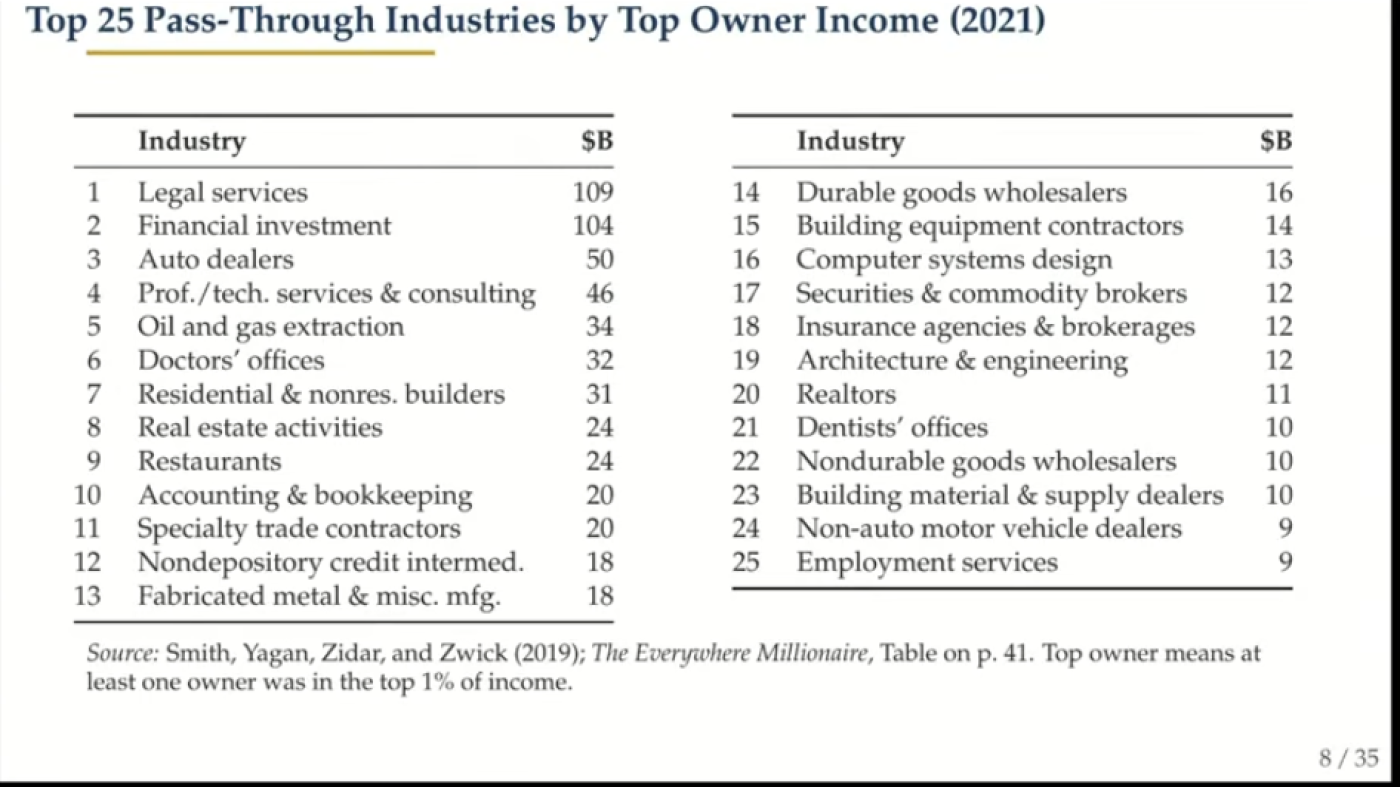
More likely, it's the dentist who runs six offices or the HVAC contractor whose trucks you see everywhere, according to economists Owen Zidar and Eric Zwick.
uncertain
you → run → Zidar
These "stealthy wealthy," as the duo describes them in their new book, "The Everywhere Millionaire," typically get rich the old-fashioned way — through hard work over many years.
asserted
duo → describe → years
And there are plenty of them in the U.S., with roughly 5 million households worth at least $5 million and holding combined wealth exceeding 13 times that of the Forbes 400, their research shows.
asserted
research → be → Forbes
The findings, based on the economists' deep dive into Treasury and IRS data that matched tax records to individual businesses and their owners, show that the path to great wealth in the U.S. typically isn't through a regular paycheck.
asserted
path → base → paycheck
Instead, it's through ordinary enterprises that often benefit from the same tax breaks and structures — "pass-through" businesses such as sole proprietorships and partnerships.
asserted
that → benefit → proprietorships
"This is not just a story about wealth being on the coast, Silicon Valley and finance," Zwick, an economics professor at the University of Chicago Booth School of Business, told CBS News.
asserted
Zwick → tell → News
To be sure, the stock market boom has also minted a
, but Zwick and Zidar are focused on people who have amassed wealth far beyond what even dedicated savers have been able to sock away.
asserted
savers → mint → what
These "everywhere millionaires" include 3 million owners of private businesses, with an average wealth of about $25 million, they found.
asserted
they → include → million
"Elon [Musk] is very rich, but the Forbes 400 is 3% to 5% of total household wealth in the U.S., and this group is just so much bigger, and that's consequential for understanding the economy," Zwick said.
asserted
Zwick → understand → economy
The new research is reminiscent of the 1990s bestseller "The Millionaire Next Door" by Thomas Stanley and William Danko, which found that many millionaires were average Americans who built their wealth through careful saving and investing.
asserted
who → find → saving
These millionaires were more likely to drive a used car than a flashy luxury car, and were less likely to live on Park Avenue than on Main Street, according to the book.
uncertain
millionaires → drive → book
The millionaires who are the subject of Zwick's and Zidar's research aren't generally as unassuming as those studied by Stanley and Danko, with the economists finding that many of these wealthy business owners aren't shy about enjoying the fruits of their prosperity.
asserted
many → study → prosperity
Yachts, large houses and other extravagances are common, they found.
asserted
they → find → ?
At the same time, their businesses are of the typical brick-and-mortar variety, rather than the headline-grabbing wealth associated with Silicon Valley and Wall Street.
asserted
businesses → grab → Valley
"You're walking down the street, you look at a truck that's delivering beer, and if you look on the door, you see the name of the beer distributor, and then you go look them up, and you're like, 'Oh, that's an everywhere millionaire,'" Zwick said.
asserted
Zwick → walk → them
"And you start to see them everywhere like that.
asserted
you → start → that
Who are America's everywhere millionaires
The research also examined the traits of the typical millionaire, tracking whether they inherited their businesses or wealth, for instance, or if they were more likely to have college degrees.
asserted
they → examine → degrees
The pair found that about three-quarters of these millionaires started their own businesses, while the vast majority didn't inherit money.
asserted
majority → find → money
"The typical everywhere millionaire is 62, married," Zwick said.
asserted
Zwick → say → ?
Their business is also their day job, and they're not necessarily retired even though they're in their 50s, 60s or older, he added.
asserted
he → retire → 50s
"Often they're still quite obsessed with what they're doing," he said.
asserted
he → obsess → what
One typical millionaire profiled by the economists is Dick Portillo, who grew up poor in a Chicago housing project and started a hot dog stand in 1963 with a $1,100 investment.
asserted
who → profile → investment
Portillo grew the business into a large regional chain, eventually selling it to Berkshire Partners for $1 billion.
asserted
Portillo → grow → billion
Many of these business owners are driven chiefly by a desire to be their own bosses rather than to become rich, Zwick said.
asserted
Zwick → drive → desire
"Freedom, independence, is almost more important to a lot of them when they're starting — Portillo similarly — than 'Oh, this is going to make me hugely rich,'" Zwick said.
Pass-through businesses
One common characteristic of many such millionaires is their use of pass-through businesses, such as LLCs or sole proprietorships, that provide a lucrative tax benefit to their owners.
asserted
that → start → owners
The tax code allows profits from these businesses to flow to the owner's personal tax return, avoiding the double taxation of corporate taxes.
asserted
profits → allow → taxes
Such arrangements also allow pass-through businesses to deduct 20% of that income from their taxes, allowing owners to avoid paying income taxes on a portion of their earnings.
asserted
owners → allow → earnings
Those benefits help owners accumulate wealth in ways most W-2 employees can't emulate.
asserted
employees → help → ways
"You pay lower tax if you're getting your income through one of these businesses, even if your labor is going into running the business," Zwick told CBS News.
asserted
Zwick → pay → News
"It has made them richer than they otherwise would have been, and it's an important part of the story of their growth over the last 40 years.
asserted
it → make → years
"
Will AI change this path to wealth?
asserted
AI → change → wealth
Zwick said he believes his findings show that the American Dream "is more alive than most people think."
asserted
people → say → ?
He added, "The prevailing narrative is very pessimistic relative to our reading of the data, but it's not necessarily where people are looking."
asserted
people → add → data
With artificial intelligence prompting speculation about the future of work, Zwick thinks opportunities to build wealth will continue to abound in the U.S.
"The problems that these people are solving are tactile, they're tangible — they're problems that people experience every day," he said.
asserted
he → prompt → that
"Technology will change what these businesses look like, but these tactile, real-world problems are still going to be there.
asserted
problems → change → what
HVAC is still going to be a need."
asserted
HVAC → go → ?
He added, "There's a lot of room for people to take new technology but solve these old problems."
asserted
people → add → problems
 The Aporia