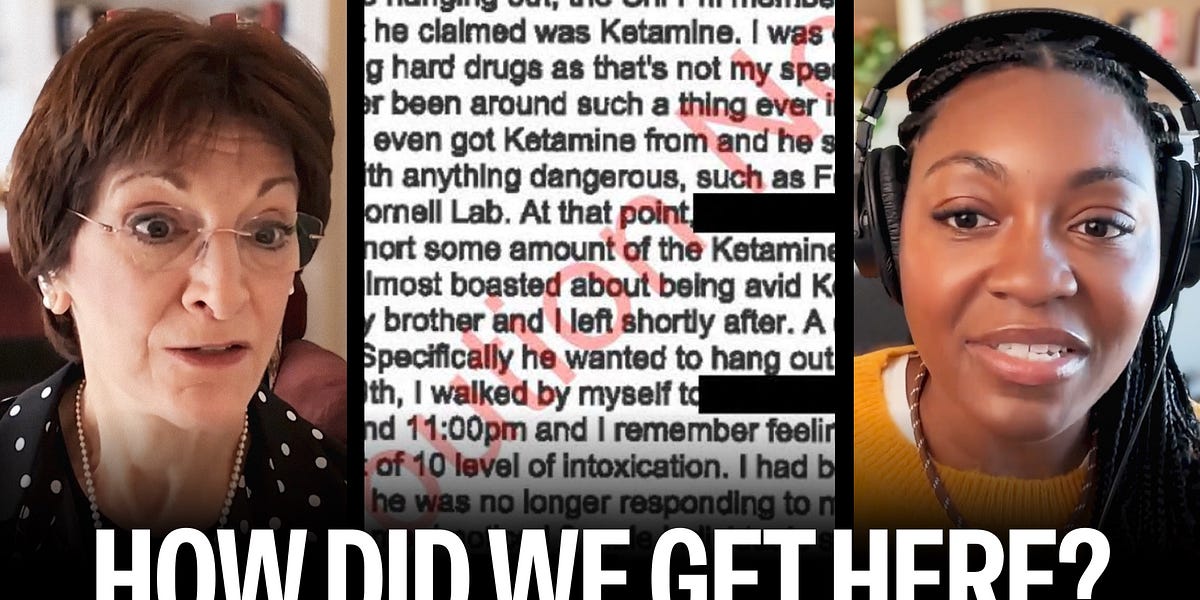
The following piece contains explicit and graphic descriptions of sexual content.
asserted
piece → follow → content
There is new evidence, in the form of text messages, suggesting that the “Cornell 7” — the male Cornell students accused of heinous crimes in a now-infamous lawsuit, two years after the fact, and had their lives destroyed in the process — were the victims of a false narrative that originated with the accuser’s sorority sisters, desperate to protect the reputation of their sorority.
asserted
that → be → sorority
We’re going to discuss that evidence and what it means for the case — and the rule of law in this country.
But first — on the subject of how the system is stacked against male defendants in cases like this — there was a moment during Russell Brand’s sentencing that we didn’t discuss earlier that really should be getting a lot more attention.
asserted
that → go → attention
It’s a perfect illustration of how the legal system — both in the UK and the U.S. — has become a complete farce, where kangaroo courts are operating right out in the open.
asserted
courts → ’ → open
Particularly when they want to send a conservative to prison, they will simply forget about basic principles of due process and fairness.
asserted
they → want → process
Instead, they will berate you for even attempting to defend yourself against their onslaught of allegations.
asserted
they → berate → allegations
This is footage of the judge — Justice Bennathan — right before he sentenced Russell Brand.
asserted
he → sentence → Brand
Listen to what he says:
asserted
he → listen → what
I don’t think I’ve ever heard a judge lecture a defendant for presenting a defense, but that’s what happened.
asserted
what → think → defense
He’s attacking Russell Brand for telling his lawyers to cross-examine the women accusing him of serious, horrific crimes.
asserted
He → attack → crimes
We’re supposed to feel bad that these women had to answer questions on the witness stand, with their credibility called into question, as if they’re somehow being “re-victimized” again or whatever.
asserted
they → suppose → question
In other words, he’s telling Russell Brand that he should’ve just pleaded guilty.
asserted
he → tell → Brand
How dare he point out that there’s zero evidence whatsoever, aside from these women’s claims, to corroborate any of the charges?
uncertain
he → point → charges
How dare he point out that these alleged crimes all occurred nearly two decades ago, and none of these women told the police at the time?
asserted
none → point → time
How dare he point out that the supposedly incriminating text messages sent by Russell Brand, which were introduced into evidence, were simply recounted from memory by his accuser — because the phone company lost the text messages since this all happened so long ago?
asserted
this → point → messages
How dare his lawyers observe that the main accuser consented to degenerate sexual activity with Brand on multiple occasions 17 years ago and, therefore, we really have no way of knowing whether she’s telling the truth about one specific sex act that occurred as part of a larger sexual encounter that she did consent to?
asserted
she → observe → that
He should’ve just accepted his fate the moment the British government decided to destroy him for becoming a conservative.
asserted
government → accept → him
That’s what the judge is saying.
asserted
judge → ’ → what
Keep in mind — the jury acquitted Russell Brand on several of the charges that were brought against him.
asserted
that → keep → him
What happened is that the jury dismissed the charges where the women’s story changed, where she didn’t report it at the time, or where the details were hazy.
asserted
details → happen → time
But they convicted Brand on the charges where the women mostly kept their story straight or told other people at the time about what had happened (So basically, in every case, the convictions were based solely on the women’s testimony — it’s just a question of whether the woman repeated her claim to other people or not).
uncertain
woman → convict → people
If the judge had his way, Brand would’ve simply pleaded guilty to all the charges and accepted a much longer sentence.
asserted
Brand → have → sentence
The judge thinks that would be appropriate to spare these brave women he wants to pay “tribute” to.
asserted
he → think → tribute
Perhaps he wanted Brand to present evidence of his own guilt and then plead for a longer sentence.
asserted
Brand → want → sentence
At least the judge claims he didn’t increase Brand’s sentence because he exercised his right to defend himself.
uncertain
he → claim → himself
So that’s something.
asserted
that → ’ → ?
Begrudgingly, he won’t tack on 5 years to the sentence because the concept of “cross-examination” exists.
asserted
concept → tack → examination
Of course, if cross-examination was not a factor in sentencing, then there’s no reason for the judge to mention it at all.
asserted
judge → ’ → it
The mere fact that the judge said this, as we all know, is a pretty clear indication that he harbors resentment toward Russell Brand for daring to stand up to the inquisition.
asserted
he → say → inquisition
There’s no way he didn’t sentence him to a longer sentence because of it.
asserted
he → ’ → it
After all, Brand got a much harsher sentence than murderers and child predators.
asserted
Brand → get → murderers
You can kill someone in Britain and get 5 years in prison.
asserted
You → kill → prison
The judge will make excuses for you, saying you “momentarily lost control” — especially if you’re a Muslim, a woman, or identify as transgender.
asserted
you → make → control
Meanwhile, Russell Brand got 10 years plus a lecture from the judge about how he’s a horrible person for even attempting to defend himself.
asserted
he → get → himself
The foundational legal principle that a defendant is allowed to defend himself — it’s right there in the name, actually — was held against Brand.
asserted
it → allow → Brand
The other foundational legal principle of “beyond a reasonable doubt” was suspended entirely in order to get Brand into a prison cell.
asserted
principle → suspend → cell
You may believe he is guilty because, in your mind, he seems like the kind of guy who would do what he’s accused of doing.
uncertain
he → believe → guy
You may subjectively determine that, in the game of he said/she said, you tend to believe the “she” instead of the “he.”
uncertain
you → determine → she
I wouldn’t agree with it, but you can have whatever opinion you want.
asserted
you → agree → opinion
But in no universe — at least not in this one, and especially not in the West where we’re supposed to have a fair and sophisticated judicial system — can it be claimed that this subjective opinion about the credibility of the accusers and the presumed moral failings of the defendant amounts to guilt beyond a reasonable doubt.
asserted
opinion → suppose → doubt
…and 246 more, not listed.
 The Aporia