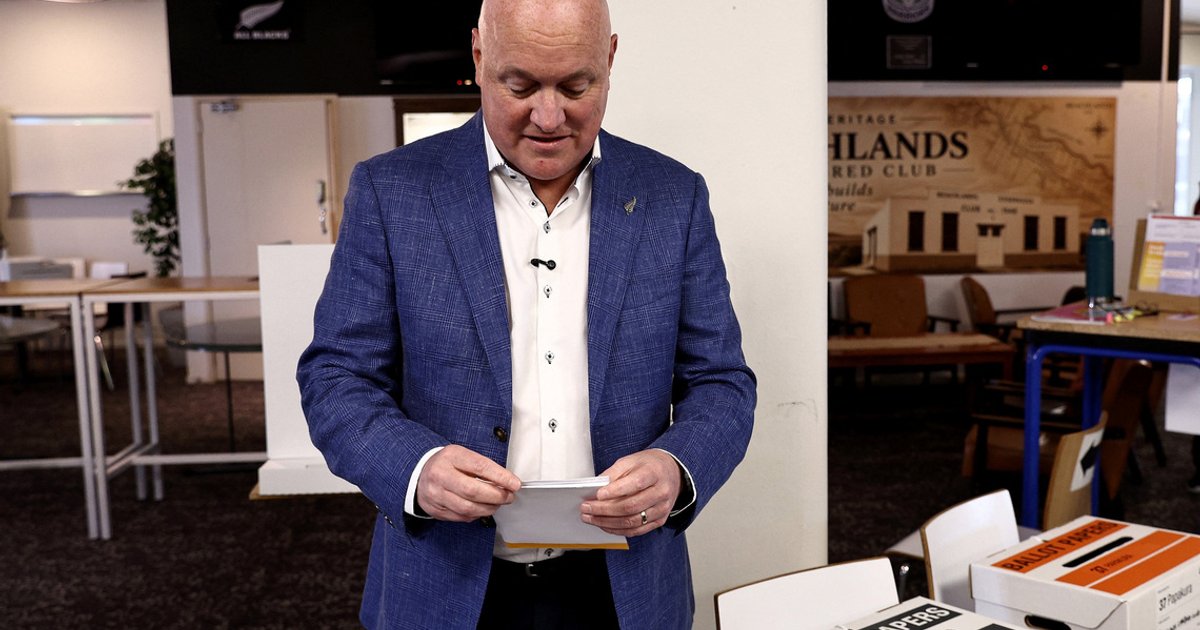
New Zealanders go to the polls tomorrow as a tightly fought and sometimes tense election campaign winds to a close.
asserted
campaign → go → close
It is a high-stakes contest for Christopher Luxon, who is desperate to hold on to power and avoid the ignominy of becoming the first conservative prime minister to be ousted after just one term in office.
asserted
who → hold → office
His challenger, Christopher Hipkins, is hoping he can seize back the job he held for 10 months in 2023 when Jacinda Ardern resigned — even though it has only been three years since the Labour Party was unceremoniously turfed by voters.
asserted
Party → hop → voters
History might suggest that Mr Luxon will sneak back over the line, given Kiwis tend to give almost all their governments a second chance.
uncertain
Kiwis → suggest → chance
But the prime minister will have to overcome some formidable challenges.
asserted
minister → have → challenges
He is not just facing a fragmented and increasingly disenchanted electorate: he is also struggling to infuse New Zealand with a sense of optimism as it grapples with global uncertainty, an exodus of young people, high inflation and a sluggish economy.
Gloom in the suburbs
When you talk to people on the streets of New Zealand, it is immediately obvious their key preoccupation is the economy and cost of living.
asserted
preoccupation → face → living
Public polling backs this up.
asserted
polling → back → this
Almost two-thirds of voters nominate the cost of living or inflation as one of their three top issues.
asserted
thirds → nominate → issues
Almost one in three also nominate the economy or petrol prices.
asserted
three → nominate → economy
The reasons are obvious: New Zealand might not be in recession, but its economy is anaemic and sickly, with inflation outstripping wage growth.
uncertain
inflation → outstrip → growth
Everyone has stories of everyday families — including ones on middle-class incomes and heavy mortgages — turning to foodbanks and charities to stay afloat.
asserted
families → have → foodbanks
This malaise is hardly unique to New Zealand, but unsurprisingly, it is fuelling anger and frustration in the suburbs, with some voters giving up hope in politics altogether.
asserted
voters → fuel → politics
The ABC meets Kevin at a bus stop near the Queensgate Mall, in the heart of the electorate of Lower Hutt — a key swing seat north of Wellington held by one of Mr Luxon's top ministers, Chris Bishop.
asserted
ABC → meet → ministers
Kevin is struggling to find work after spending decades as a truck driver.
asserted
Kevin → struggle → driver
He thinks the economy has gone to pieces.
asserted
economy → think → pieces
"He promised all this stuff three years ago," he says.
asserted
he → promise → stuff
"It didn't happen, bro.
asserted
It → happen → ?
There's no work, everyone's rent has gone up.
asserted
rent → be → ?
He says politicians are all out for themselves, and he cannot remember the name of the "other chick running it" when Labour was last in power.
asserted
Labour → say → power
When asked if he means Jacinda Ardern, his contempt is obvious.
asserted
contempt → ask → Ardern
"Is that her name?" he asks.
asserted
he → ask → ?
"
Gloom in the city
A sense of gloom is not limited to middle suburbia — in the heart of Wellington's downtown, not that far from parliament, business owner Mike Ny sits in his beautifully appointed café and wine bar, Glou Glou.
asserted
Ny → limit → café
He is much less despairing than Kevin, but says business in Wellington has been hard for years.
asserted
business → say → years
"We had COVID, then we had a recession.
asserted
we → have → recession
Then we had the public service cuts.
asserted
we → have → cuts
It's been tough," he tells the ABC.
asserted
he → tell → ABC
The price of everything is going up: "Produce, beans, labour, fuel."
asserted
price → go → everything
His younger staff members are also bearing the brunt of rising rent and grocery prices, and are asking him to help out by hiking their wages.
asserted
members → bear → wages
Mike says he sympathises and would love to help out — but the business simply cannot afford it.
asserted
business → say → it
"I'm getting almost every month a team member asking for a wage increase, and I completely understand that," he says.
"
asserted
he → get → that
But we just don't have the margin to do it — we can only push up our prices so much."
Faced with grim economic prospects, many Kiwis have also been voting with their feet — with significant numbers flocking across the ditch to Australia, drawn by higher wages and a rosier economic outlook.
asserted
numbers → have → wages
This has not gone unnoticed by those who choose to stay.
asserted
who → go → those
Mikey Venimore, 28, meets the ABC at her central Wellington store, Preloved Charlies, a funky retail space where she sells vintage clothing to young women.
asserted
she → meet → women
Her online sales are growing, even though she is worried that the city has lost its spark and has got more of a "sad aura" as young people lose spending power and stay at home more often.
asserted
people → grow → home
She has also seen a lot of her customers leave the country, lured by the promise of bigger salaries and economic opportunity.
asserted
lot → see → salaries
"As soon as they graduate, they are off to Australia, or Europe," she says.
"
asserted
she → graduate → Australia
They don't really see a future here sometimes."
asserted
They → see → future
She says young people talk about moving to Australia and doubling their salaries — and admits the thought of leaving has floated across her mind as well.
asserted
thought → say → mind
"I'm happy that I'm in Wellington, my life here is great … but I do sometimes have thoughts (that) maybe I should have gone to Australia
asserted
I → have → Australia
," she says.
"I'm not going to!
asserted
I → say → ?
…and 34 more, not listed.
 The Aporia