One of the most famous opening lines in literature comes from Charles Dickens’
A Tale of Two Cities: “It was the best of times, it was the worst of times, it was the age of wisdom, it was the age of foolishness, it was the epoch of belief, it was the epoch of incredulity, it was the season of Light, it was the season of Darkness, it was the spring of hope, it was the winter of despair,
asserted
it → come → despair
we had everything before us, we had nothing before us, we were all going direct to Heaven, we were all going direct the other way—in short, the period was so far like the present period, that some of its noisiest authorities insisted on its being received, for good or for evil, in the superlative degree of comparison only.
asserted
its → have → comparison
”
And that’s as apt a description as one can have for Republicans and Democrats after the midterms.
asserted
one → ’ → midterms
For Dems, it’s the best of times, the age of wisdom has returned and it’s the season of light.
asserted
it → ’ → light
For the MAGA-cannibalised GOP, it’s the worst of times, a winter of despair.
asserted
it → cannibalise → despair
It’s the happiest Dems – and their global surrogates across the world – have been since a man with the middle name Hussein declared “Yes We Can”.
asserted
We → ’ → name
For Republicans, it’s the most devastating loss in decades, with
Kansas waving goodbye for the first time since 1932 while the Texas Senate seat flipped after 38 years.
In the Lone Star State – the online memes have already labelled it the Lone Saar State – the Republicans’ bilious anti-Indian rhetoric ensured that the Texas House would now have a
Pooja in its midst, a befitting reply to the slogan: “Don’t Pooja my Texas.”
asserted
House → ’ → slogan
Much like the 2024 US election, which was billed as an internecine
desi fight thanks to Kamala Harris’ Tamil Brahmin ancestry and Usha Vance’s Telugu roots, Indian-American representation in the midterms was off the charts.
asserted
representation → bill → charts
Now, just to be clear, Indian-Americans make up roughly 1.5% of the US population and 1% of its eligible electorate, and even Texas – where
Bo French’s anti-India rant will live on in history as the most famous political upheaval since a Gujarati man was asked to deboard a train in South Africa for being brown – has an Indian population of only 2%, with just 1% being voters.
asserted
% → make → %
Now, in both cases, we flirt with what logicians call
post hoc ergo propter hoc, but we digress.
asserted
we → flirt → what
While Trump made historic gains among numerous groups in Texas (and the US) in 2024,
including Indian-Americans, those gains were largely eroded by the time the midterms came around.
asserted
midterms → make → time
And all elections can always be summed up by one simple line from Bill Clinton’s former adviser Jim Carville: “It’s the economy, stupid.”
asserted
It → sum → adviser
But from an Indian-American lens, and from a broader Republican vs Democrat debate, the midterms can be viewed through the journeys of two Indian-American politicians: one who was on the ballot during the midterms and one who wasn’t.
asserted
who → view → midterms
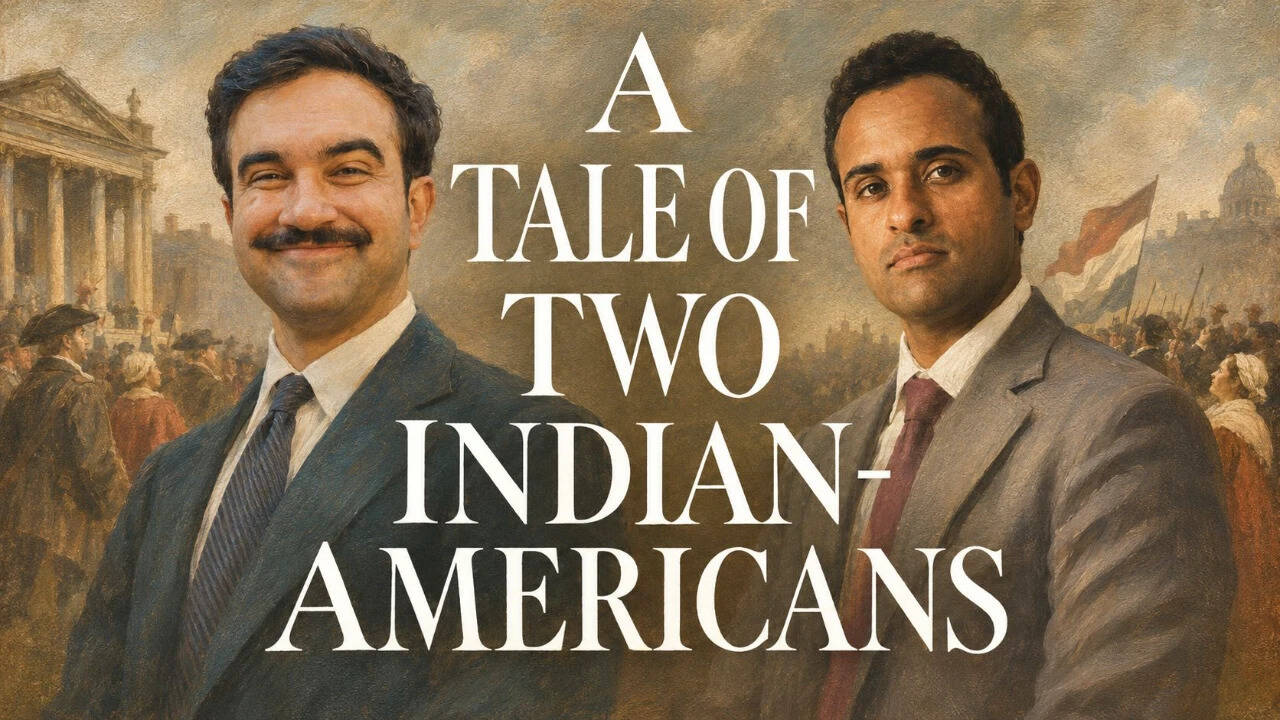
A Tale of Two Indian-AmericansNow, New York Mayor
Zohran Mamdani and Ohio's losing gubernatorial candidate
Vivek Ramaswamy are like chalk and cheese, and before they got into politics, the average
desi family would happily adopt Ramaswamy and be reluctant to even acknowledge Mamdani as a cousin.
asserted
family → lose → cousin
Mamdani was a rapper who didn’t get into Columbia – despite
claiming to be African-American as well as Asian-American – while Ramaswamy was a high-school valedictorian who got into Ivy League schools and sold his company for a billion dollars.
But while what is sauce for the goose might be sauce for the gander in real life, in politics, chalk can morph into cheese.
uncertain
chalk → get → cheese
Today, Mamdani is one of the three
desi mayors of what can be called the Dard-E-Disco cities (New York, LA, London, Paris, San Francisco), along with Sadiq Khan (London) and Nithya Raman (LA), while Ramaswamy is a losing gubernatorial candidate in Ohio, a contest that he looked bang on to win before Trump went full Trump.
asserted
Trump → call → that
Mamdani, in particular, might have thrilled his teachers with his academic brilliance, but he has a certain
je ne sais quoi about him as a politician that can warm the cockles of his harshest critic.
uncertain
that → thrill → critic
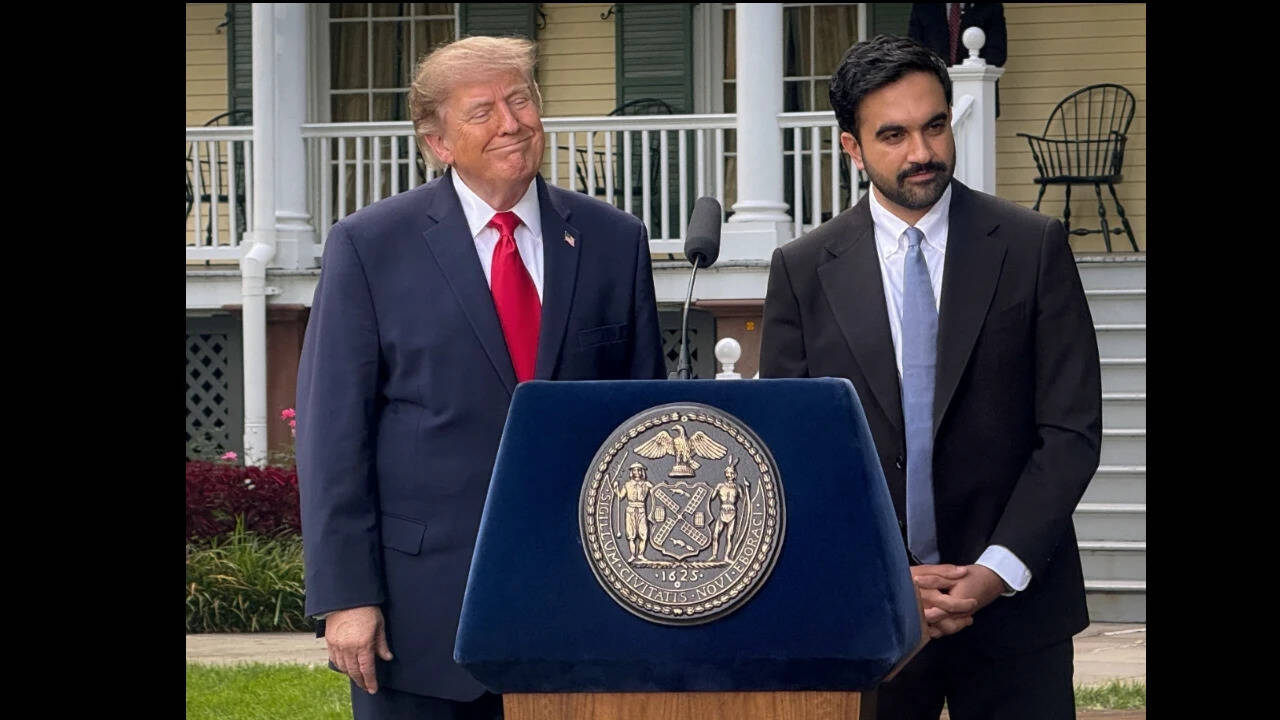
Just ask Trump, who has had a
stronger man crush on Mamdani than he has had on any Republican of note.
asserted
he → ask → note
On the other hand, there’s a similar negative
je ne sais quoi about Ramaswamy, aptly summed up by Indian-American comedian Nimesh Patel in a 2023 stand-up act in which he says all Indians know a guy like Ramaswamy, who “lucked into a bunch of money” and now thinks he is – one is paraphrasing here to keep it publication-friendly – the biggest stick on the planet.
asserted
it → ’ → planet
And both their political trajectories make for interesting reading.
asserted
trajectories → make → reading
To understand these trajectories, however, we must first understand the two very different versions of postcolonial Indian privilege that these men inherited.
asserted
men → understand → that
His mother, Mira Nair, grew up in the household of an IAS officer in post-Independence India, studied at Delhi University and Harvard.
asserted
mother → grow → University
Her films might not pack theatres to the rafters in India, but their exploration of migration, identity and class makes people who go to art festivals that hand out laurel wreaths feel smug about themselves.
uncertain
that → pack → themselves
His father, Mahmood Mamdani, was born in Bombay, grew up in Uganda, was expelled under Idi Amin and went on to become one of the world's foremost scholars of colonialism, citizenship and political identity.
asserted
father → bear → colonialism
A Harvard PhD and Columbia professor, Mahmood spent much of his academic career interrogating the structures of power that colonialism had left behind.
asserted
colonialism → spend → that
Ergo, Mamdani grew up in a house where Edward Said and Rashid Khalidi dropped in as dinner guests, where one assumes discussions about colonialism, imperialism and identity were as commonplace as discussions of IIT preparations are in Indian middle-class households.
asserted
discussions → grow → households
One could argue that even though Mamdani couldn't get into Columbia, Columbia came home to him.
uncertain
Columbia → argue → him
Ramaswamy inherited a different version of the Indian Dream though he too was a fan of rapping.
asserted
he → inherit → rapping
Born in Cincinnati to Tamil-speaking Palakkad Iyer Brahmin parents, Ramaswamy was raised by an engineer who became a patent lawyer at General Electric and a mother who worked as a geriatric psychiatrist.
asserted
who → bear → psychiatrist
His parents belonged to that extraordinary generation of highly educated Indian professionals who migrated to America and discovered that their qualifications, discipline and willingness to work extraordinarily hard could propel them into the upper reaches of American society.
uncertain
qualifications → belong → society
And Ramaswamy followed the script almost perfectly: valedictorian, Harvard, Yale Law School, hedge funds, biotechnology and eventually selling his company for a cool billion dollars before deciding to become America’s corporate mascot against wokeism and social justice.
asserted
Ramaswamy → follow → wokeism
His infamous Boxing Day rant in 2024 was practically an Indian parent-teacher meeting masquerading as an American political manifesto.
asserted
rant → masquerade → manifesto
As
the ensuing MAGA civil war demonstrated, Americans weren't particularly interested in being told by a billionaire of Indian origin that they should have spent less time watching sitcoms and more time solving quadratic equations.
asserted
they → ensue → equations
Therein lies the split between the two: one came from the intellectual tradition of questioning inequality while being steeped in social capital, while the other came from a professional tradition that believes excellence, discipline and individual achievement can trump any system.
Products of PrivilegeBoth are products of privilege.
asserted
Products → lie → privilege
Of course, both are products of privilege, but the fascinating contrast saw Mamdani become a socialist insurgent against the economic establishment while Ramaswamy became the capitalist insurgent looking to restore the meritocratic American Dream that made his extraordinary ascent possible.
asserted
ascent → see → Dream
But what makes the contrast fascinating is how differently they translated those inheritances into American politics.
asserted
they → make → politics
Now, an asinine argument would be to boil down their contrasting political fortunes to their respective religions, particularly when both men have been rather open about their faith, albeit in very different ways.
asserted
men → boil → ways
Ramaswamy, while proudly identifying as Hindu, has often presented his faith in a language that makes it sound like a crypto-Christian religion, emphasising one true God and the Judeo-Christian values supposedly underpinning American civilisation.
asserted
it → identify → civilisation
His attempts to make Hinduism palatable to evangelical conservatives have sometimes resembled a theological translation exercise.
Mamdani, meanwhile, has been unabashedly Muslim, whether campaigning among New York's diverse communities or turning up for
Eid prayers in an Arsenal-themed kurta, demonstrating that one could combine religious devotion, cultural identity and the considerably more serious business of supporting a football club.
But the idea that Mamdani succeeded because he was Muslim while Ramaswamy lost because he was Hindu would be particularly asinine.
uncertain
he → make → club
The Carnegie survey of Indian-Americans found that enthusiasm for Mamdani's victory was driven far more by his ideology than his religious identity.
asserted
enthusiasm → find → identity
…and 42 more, not listed.
 The Aporia