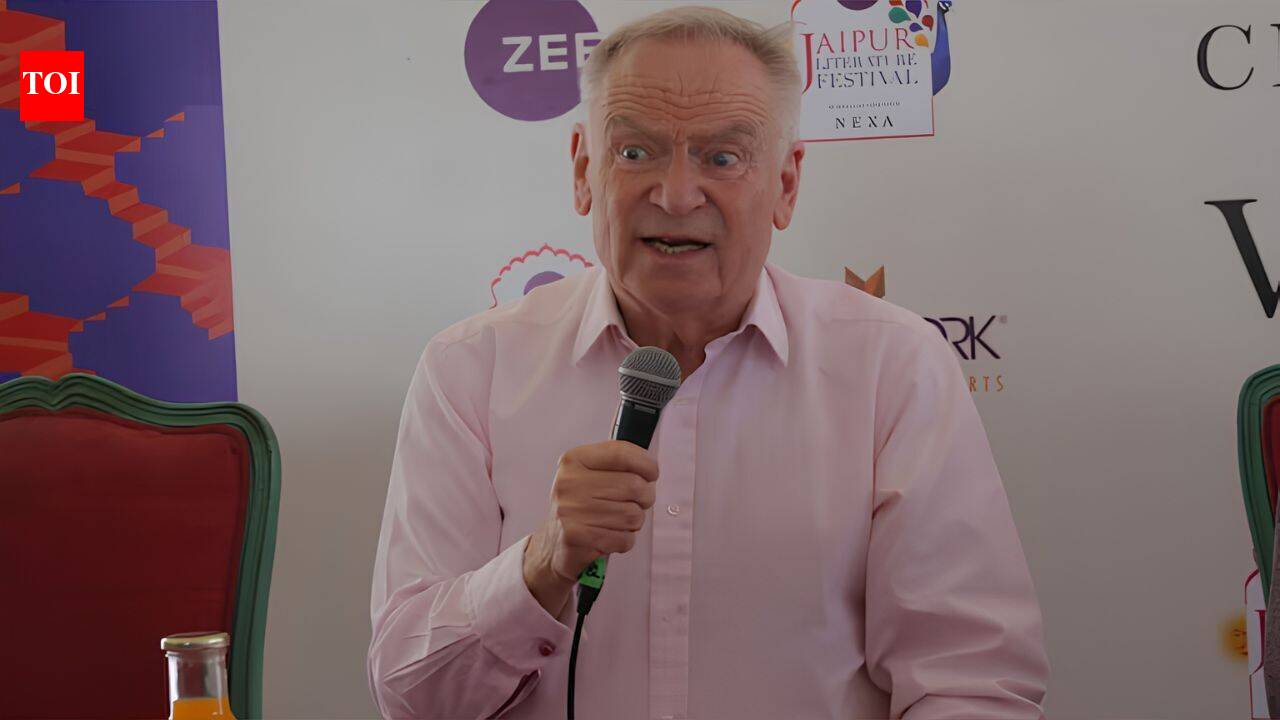
In 2019, the only year that he attended the Jaipur Literature Festival, he shared an anecdote that encapsulated the unique position he occupies among Indian readers of English.
asserted
he → attend → English
Archer recalled that a young urchin came up to him with pirated books and asked: “Sir, do you want the latest Jeffrey Archer?”
asserted
you → recall → Archer
To this, the author replied: “I am the latest Jeffrey Archer.”
asserted
I → reply → this
In that same interaction, he argued that RK Narayan should have won a Nobel Prize and congratulated the Indian team for beating the Aussies Down Under, which came after a session on stage that was filled to the rafters with about 8,000 people.
asserted
that → argue → people
Archer was a prolific writer and one who was more celebrated in India than in his native UK, where his public life often sullied his prowess as a scribe, though even legal misfortune would turn out to be a blessing in literary disguise as he churned out the utterly delightful
Prison Diaries about his time navigating Britain’s penal system.
asserted
he → sully → system
As the
New York Times lede read: “…a best-selling British author, politician, philanthropist, athlete and one-time jailbird whose résumé seesawed between achievement and disgrace, and who inspired abiding public fascination with headline-grabbing accounts, both fictional and personal, of ambition, self-promotion, misbehaviour and scandal….”
asserted
who → read → ambition
In his lifetime, he published 59 works, including 31 novels, 7 short-story collections and numerous other works.
asserted
he → publish → novels
Archer’s later novels – perhaps the cut-off date is 2008 – would become a tad too reductive and formulaic.
asserted
date → cut → ?
The good characters were, to borrow John Lennon’s lines, classless and free.
asserted
characters → borrow → lines
The bad ones were usually class-conscious gits, and the women were very easily conned.
asserted
women → con → ?
Archer was the sort of writer who was very accessible to the aspirational post-liberalisation middle-class English reader who didn’t have the wherewithal to follow the trials and travails of a Holmes or a Smiley.
asserted
who → have → Holmes
His writing was more accessible, the vocabulary less grandiose and the literary style compelling without forcing one to grab a dictionary every single time.
asserted
style → force → dictionary
His last Instagram post hangs like a dangling modifier from the afterlife: “On Saturday 10th October at 7pm I will be discussing my final novel Adam & Eve….”
asserted
I → hang → novel
Most great pieces of literary work, at least popular ones, are born out of some form of misfortune.
asserted
pieces → bear → misfortune
Forsyth wrote
The Day of the Jackal upon facing penury after quitting the BBC and living on a friend’s sofa.
asserted
Forsyth → write → sofa
Similarly, Archer wrote
Not a Penny More, Not a Penny Less because, well, he was penniless and facing bankruptcy.
asserted
he → write → bankruptcy
But the real breakthrough came with
Kane and Abel, which sold as many copies as
Gone with the Wind and
To Kill a Mockingbird.
asserted
To → come → Mockingbird
The latter, he recalled, was the “last great book” he read, in an interview with the
NYT in which he also admitted that he couldn’t get past page 30 of
War and Peace and bragged with his usual braggadocio that
Adam and Eve was his “best novel”.
asserted
Adam → recall → braggadocio
Kane and Abel also set the template of the Archer novel, with two Jungian ‘Archer-type’ (pun intended) protagonists who go head-to-head until one of them dies, after which comes a Bollywood-style twist.
asserted
twist → set → which
It was replicated in
The Fourth Estate, which was a fictionalised version of the battle between media tycoons Rupert Murdoch and Robert Maxwell, with the latter ostensibly committing suicide in the end.
asserted
latter → replicate → end
In a cruel twist of fate, his daughter Ghislaine would be best known for her association with convicted paedophile Jeffrey Epstein, who too shuffled off his mortal coil ostensibly of his own accord.
asserted
who → know → accord
Kane and Abel’s follow-up,
The Prodigal Daughter, has inspired many, including Angelica Aribam, founder of the Femme First Foundation and former NSUI General Secretary, who
wrote on X that Archer’s plot piqued her interest in politics.
asserted
plot → inspire → politics
Over the years, Archer would expand his genre to include art theft, Himalayan expeditions and CIA spy thrillers.
asserted
Archer → expand → theft
His last major works were the
Clifton Chronicles, though one must confess one found them rather lacklustre compared to his earlier works.
asserted
them → confess → works
As X user Ritu Chaudry pointed out, his short stories, while not in the same league as the
masters of that craft like HH Munro, Anton Chekhov, Isaac Asimov or Edgar Allan Poe – whose are, anyway? – were equally compelling, particularly because one could never guess the twist that came at the end.
uncertain
that → point → end
As X user Wordita
pointed out, Archer has a unique place among youngsters growing up in post-liberalisation India, along with Enid Blyton, Agatha Christie and John Grisham.
asserted
Archer → point → Blyton
One can add Sidney Sheldon to the list for those who were willing to risk their parents’ wrath if they were ever to scour through the pages.
asserted
they → add → pages
Also, as an aside, contrary to popular belief, Sidney Sheldon was born with the XY chromosome, not the XX one.
asserted
Sheldon → bear → chromosome
His life, too, had the odd implausibility of an Archer novel.
asserted
life → have → novel
He entered Westminster as a Conservative MP at the age of 29 and seemed destined for a life in politics before losing everything in a fraudulent company, which prompted his first novel.
asserted
which → enter → novel
In the 1980s, he was both a best-selling novelist and Margaret Thatcher’s deputy Conservative chairman before being laid low by a sex scandal and later winning damages.
asserted
he → sell → damages
But the libel case would return, and an Old Bailey jury convicted him on several charges, which saw him spend two years in jail and became the basis for three bestselling prison diaries.
asserted
him → return → diaries
And then he made another comeback, selling more than 300 million books, and remained in the House of Lords until retiring in 2024 and kept on working till the guy in the black robe came calling.
asserted
guy → make → robe
His final novel,
Adam and Eve, was published the day after he died.
asserted
he → publish → ?
Sheridan Morley, one of his oldest friends, once described him as a man who will “dive over a cliff and then be amazed that he’s falling” because in his head, he’s “Peter Pan”.
asserted
he → describe → head
From left, students Jeffrey Archer and Michael Lloyd, Principal Sir Noel Hall and tutor David Stockton entertain Paul, George, Ringo and John in the principal’s lodgings at Brasenose College when The Beatles visited in 1964(Source: OxfordMail.com)
asserted
Beatles → entertain → 1964(Source
Morley recalled in
The Guardian in 2001, in a piece that described him as “mendacious, egotistical, ambitious, pushy, resilient, tactless, gullible, funny, charming, reckless, hard-working, generous, self-obsessed, loyal and naïve”, that he famously convinced he famously persuaded the Beatles to support his Oxfam campaign and brought them to Oxford’s Brasenose College in 1964.
asserted
he → recall → 1964
That included bypassing their manager Bryan Epstein, and even the Beatles appeared flabbergasted at how they ended up under his charm.
asserted
they → include → charm
At the interval, Morley ran into Ringo Starr, the Beatles drummer, who asked if he knew who this Archer bloke was.
asserted
bloke → run → Starr
Morley replied that everyone was trying to figure out who it was, to which the greatest drummer of all time replied: “He strikes me as a nice enough fella, but he’s the kind of bloke who would bottle your piss and sell it.”
asserted
who → reply → it
…and 2 more, not listed.
 The Aporia