Archaeologists have uncovered an unusual ritual well at Kainua, an ancient Etruscan city near Marzabotto in northern Italy, offering new insights into the rituals surrounding its foundation.
asserted
Archaeologists → uncover → foundation
The remarkable discovery was first made during the University of Bologna’s 39th excavation campaign in the city’s sacred urban area, dedicated to the goddess Uni.
asserted
discovery → make → Uni
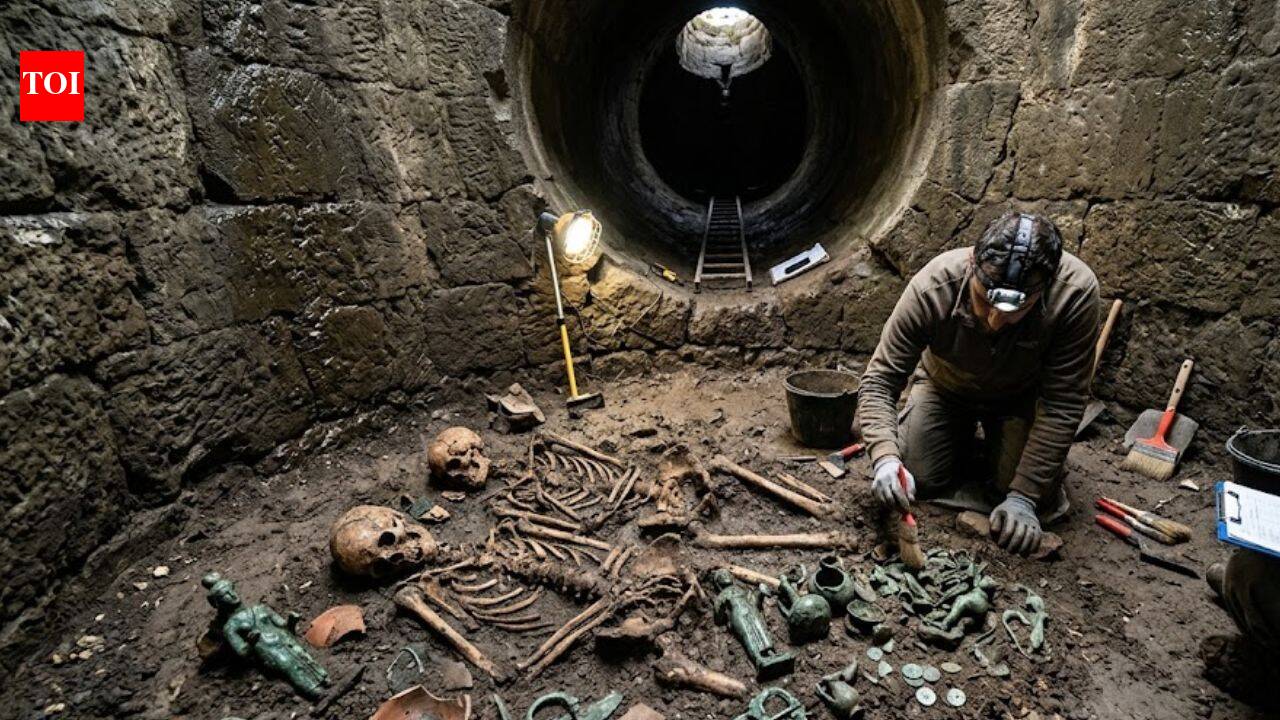
At the bottom of the well, researchers found two bronze female statuettes and a rare bronze plate, all remarkably well preserved.
asserted
all → find → statuettes
According to Alma Mater Studiorum, Università di Bologna (University of Bologna, Italy), these objects are interpreted as votive offerings placed during a foundation ritual between the end of the 6th and the first decades of the 5th century BC.
uncertain
objects → accord → BC
Two adult human skeletons were also discovered and are associated with the ritual closing of the structure.
asserted
skeletons → discover → structure
The findings suggest that the well was far more than a simple source of water for the community.
asserted
well → suggest → community
Instead, it formed part of a complex religious practice connected with water, sacred urban space and the foundation of the Etruscan city.
asserted
it → form → city
Bronze offerings found in a sacred well reveal Kainua’s earliest religious traditions
The newly discovered well was found in the sacred urban area of Kainua, where archaeologists have identified monumental temples associated with major Etruscan deities.
asserted
archaeologists → find → deities
The University of Bologna excavation, directed by Elisabetta Govi, uncovered the structure during its 39th campaign at the site.
asserted
excavation → direct → site
The well contained three objects, including two female bronze statuettes and a rare bronze plate.
asserted
well → contain → statuettes
Their remarkable preservation has allowed researchers to see the metal's original shiny appearance.
asserted
researchers → allow → appearance
The excavation team says the objects were not ordinary items left behind.
asserted
objects → say → ?
They were votive offerings placed during a solemn foundation ceremony.
asserted
They → place → ceremony
The ritual dates to between the late 6th century and the early decades of the 5th century BC, around the time when Kainua was founded.
asserted
Kainua → date → time
PC: AI Generated
What the ritual well reveals about water and Etruscan religion
asserted
reveals → generate → water
The location of the well helps explain why archaeologists believe it may have held religious significance.
uncertain
it → help → significance
Kainua’s sacred urban area was home to two imposing temples associated with Tinia and Uni, the supreme divine couple.
asserted
area → associate → Tinia
Tinia corresponds broadly to Zeus or Jupiter, while Uni is associated with Hera or Juno.
asserted
Uni → correspond → Hera
The area dedicated to Uni also provides evidence for the cult of Vei, linked with agricultural and human fertility.
asserted
area → dedicate → fertility
Within this landscape, water appears to have held more than a practical role.
asserted
water → appear → role
Two human skeletons mark the ritual closing of the well
The human remains are among the most striking aspects of the discovery.
asserted
remains → mark → discovery
The excavation announcement describes two adult human skeletons associated with the ritual closure of the well.
asserted
announcement → describe → well
Current evidence does not conclusively show that these individuals were victims of human sacrifice.
asserted
individuals → show → sacrifice
Instead, the archaeologists interpret their presence as part of an act that marked the end of the structure’s ritual use.
asserted
that → interpret → use
The sequence is particularly significant as votive objects were placed at the bottom when the well was founded, and human remains were associated with its closing.
asserted
remains → place → closing
Together, the findings indicate a defined ceremonial life.
asserted
findings → indicate → life
They also provide new evidence of how Etruscan communities connected construction, water and religious practices with the foundation of an urban settlement.
asserted
communities → provide → settlement
What the discovery reveals about Etruscan city foundations
The discovery offers further insight into how Etruscan cities were founded and how religious practices shaped their early development.
asserted
practices → reveal → development
Kainua has been excavated by the University of Bologna since 1988, and the latest campaign was supported by a €140,000 grant from the Directorate General of Museums of Italy’s Ministry of Culture.
asserted
campaign → excavate → Culture
The additional funding allowed researchers to extend the 2026 excavation by two weeks, allowing researchers to investigate the area further.
asserted
researchers → allow → area
The newly found objects are expected to be added to the National Etruscan Museum of Marzabotto, known as MNEMA.
asserted
objects → find → MNEMA
For archaeologists, the well is valuable because its intact artefacts and their positions preserve evidence of a ritual sequence.
asserted
artefacts → preserve → sequence
 The Aporia