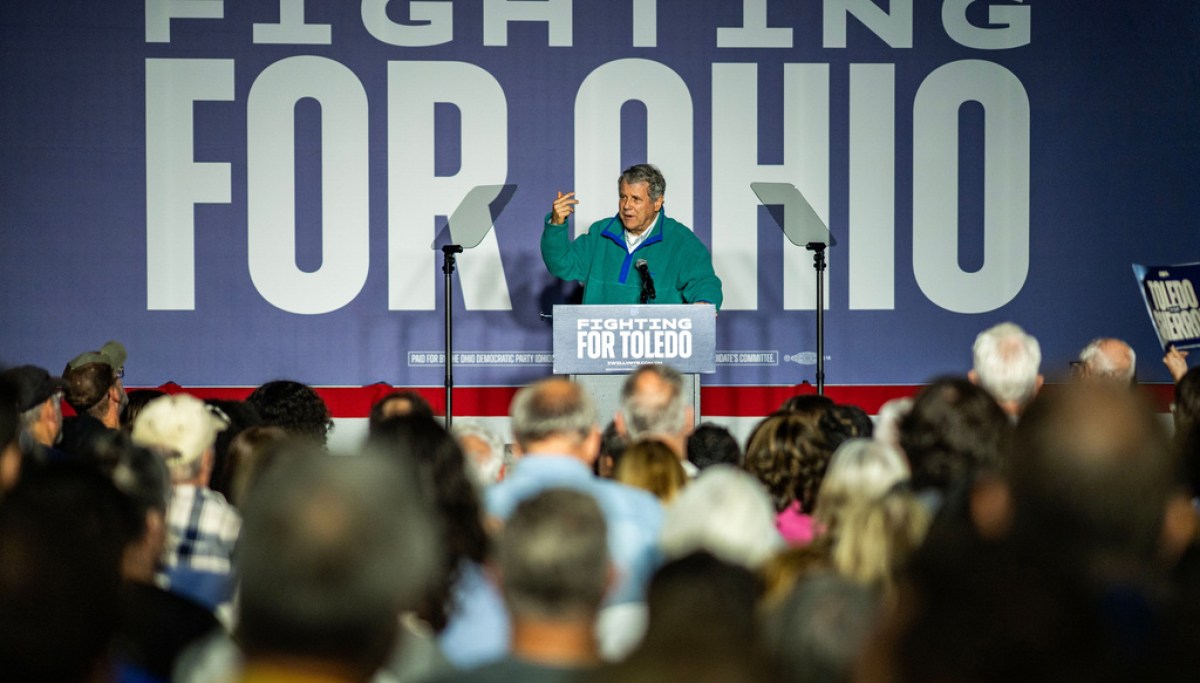
Photo via CBC News

Ohio and Texas went from red to blue in the midterms, but may not stay that way in 2028

Read the original at CBC News ↗
Cite

Gollom, M. (2026, May 27). Ohio and Texas went from red to blue in the midterms, but may not stay that way in 2028. CBC News. https://www.cbc.ca/news/world/texas-ohio-midterm-results-9.7409481?cmp=rss

Dated from the outlet's own feed. Check the original for its byline.

CBC News · collected 2026-11-05 · by Mark Gollom

Quick Summary

In the recent midterm elections, Ohio and Texas saw significant shifts with Democrats winning governorships and Senate seats previously held by Republicans. In Ohio, Sherrod Brown defeated Jon Husted for the Senate, while Amy Acton won the governorship after defeating Vivek Ramaswamy; in Texas, James Talarico became the state's first Democratic senator since 1993 and Gina Hinojosa won the governorship from incumbent Greg Abbott. These changes have political observers predicting that both states could become battlegrounds for future presidential elections despite each retaining at least one Republican senator.
Written by AI on 2026-11-05, from this article's own text only (the story summary below draws on all the coverage).

AI analysis

Story summary

In the 2026 midterm elections, Ohio and Texas turned blue, flipping Senate seats and governorships from Republican control. This shift marked a significant political change, making both states likely battlegrounds for the 2028 presidential election. Democrats won majorities in state legislatures and governors' mansions in traditionally red states, ending a two-decade-long GOP dominance in these roles. In Ohio, Democrat Sherrod Brown defeated Republican Senator Jon Husted, while Amy Acton became the first Democratic governor of Ohio by defeating Vivek Ramaswamy. Despite this change, both states still have one remaining Republican senator each, raising questions about whether Democrats can maintain their new political edge beyond 2026.

Written for “Midterm Election Shifts Ohio Texas” on 2026-11-05, grounded in this article and the 0 other(s) covering the same event.

Story

📰 Midterm Election Shifts Ohio Texas
Politics · 1 article(s) covering the same event.

Compared with similar articles

This article reads leans left and hedges 7% of its claims. Each row says how that neighbour differs.
Washington Examiner
⚖️ Leans left Hedges 0 of 2 claims Outlet record 69/100
“Article A covers a broader shift in multiple red states' US House delegations to Democratic control, while Article B focuses specifically on Ohio and Texas flipping during midterms but also discusses the possibility of future shifts back.”
CBS News
Hedges 0 of 68 claims Outlet record 65/100
“The articles describe shifts in overall electoral outcomes across multiple states and districts rather than a single specific election event.”
Washington Examiner
⚖️ Leans left Hedges 0 of 2 claims Outlet record 69/100
“Article A focuses on Sherrod Brown's efforts to appeal to white working-class voters in Ohio for midterms, while Article B discusses overall political shifts in both Ohio and Texas during the same elections.”
TIME
⚖️ Leans left Hedges 8 of 34 claims Outlet record 59/100
“While both articles discuss significant shifts in voting patterns in Texas during an election, they do not describe the exact same specific incident or outcome. Article A focuses on the broader implications of the Democratic gains in deep-red Texas, while Article B specifically mentions that both Ohio and Texas flipped from red to blue.”
NBC News
⚖️ Leans strongly left further left than this Hedges 3 of 26 claims Outlet record 78/100
“The articles discuss different aspects of election results; Article A focuses on Democrats winning secretary of state contests in key battleground states, while Article B discusses shifts in partisan control of Ohio and Texas.”
The Guardian
Hedges 1 of 44 claims Outlet record 66/100
“Article A provides an overview of the US midterm elections results across all states, while Article B specifically discusses the political shift in Ohio and Texas. Although they refer to the same general election event, they describe different specific aspects.”
Choosin' Texas I Can Tell Different event
Reason
⚖️ Leans left Hedges 4 of 43 claims Outlet record 67/100
“Article A focuses on the judicial races in Texas, while Article B discusses the flipping of Senate seats and governorships for both Ohio and Texas during midterms.”
The Straits Times
⚖️ Leans strongly left further left than this Hedges 5 of 50 claims Outlet record 66/100
“While both articles discuss Texas turning blue in the US midterms, Article B broadens its scope to include Ohio and discusses future implications, indicating a different specific focus or timeframe.”
Al Jazeera
⚖️ Leans left Hedges 8 of 92 claims Outlet record 60/100
“While both articles discuss the 2026 US midterm elections and Democratic gains, they describe different aspects of the election results with distinct focuses.”
The Guardian
Hedges 1 of 44 claims Outlet record 66/100
“Article A provides a broad overview of midterm election results across the US, while Article B focuses specifically on the shifts in political control in Ohio and Texas.”
How this article was measured signals, leaning charts, publisher record, byline, topics and claims

Signals How these are calculated →

Claims extracted
42
sentences that state something as happening or true
Uncertain
7%
3 of 42 hedged ("reportedly", "may", "according to")
Leaning
Leans left
of the writing, not the subject · beta estimate
Publisher signals
71/100
CBC News's corrections and hedging, across everything collected from it. Not a measure of accuracy.
Outlets on this story
1
Politics
Same framing elsewhere
1
articles that frame the event the way this one does
Analyzed 2026-11-05 · how these are computed

How this is being covered How these are calculated →

Article leaning vs. publisher reliability
Source leaning vs. consistency

Publisher

CBC News · 1914 article(s) · 6 correction(s) detected
Running correction rate · 6 correction(s)

Who wrote this

Mark Gollom
10 article(s) here · 1 carrying a prediction
🔮 Ohio and Texas went from red to blue in the midterms, but may not stay that way in 2028 Both states flipped Senate seats and governorships, revealing a new political reality for the next election
🔮 Lee told reporters earlier this week that, "I suspect her sentence will be the same as before unless determined otherwise by the courts." Following the unsuccessful execution attempt, Lee halted further executions for the remainder of the year and ordered a comprehensive third-party review to determine exactly what occurred.
🔮 Election cycle has featured 'relentless rise of the mega donor,' political science prof says The 2026 U.S. midterm elections are shaping up to be the most expensive elections in the country's history. This election cycle will reach $11.6 billion US in spending, according to AdImpact, an advertising intelligence company that analyzes political advertising.
🔮 Report says order to restrict Ukraine access to Starlink came from the White House Earlier this week, Ukrainian officials said they had lost some access to Starshield, the military-grade version of Starlink, the satellite communications system operated by Elon Musk's SpaceX. Musk, CEO of SpaceX, denied any involvement in restricting Ukraine's access, saying that decision would be up to the U.S. government. Meanwhile, on Friday, U.S. President Donald Trump denied he was involved in the decision to restrict access and said he didn't think Musk was involved either.
🔮 Starlink restrictions may hamper Ukraine's war effort.
🔮 "So it makes total sense if you attack Yandex, that automated traffic online would go down," he said.
🔮 Why Elon Musk waded into the separatism debate Prime minister, premiers rejected Musk's calls for provinces to separate from Canada When Elon Musk called for Quebec, Alberta and Saskatchewan to separate from Canada earlier this week, it may have been nothing more than the trillionaire engaging in some anti-Canadian trolling.
🔮 How AI could usher in a 'new scientific golden age' — if it doesn't kill us all first Some scientists express concern government regulation could hamper important progress
🔮 "If we try to look at the new defence agreement compared to the old defence agreement, I would characterize it as a moderate improvement for the U.S.," Mikkel Runge Olesen, a senior researcher at the Danish Institute of International Studies, told CBC News.
🔮 This story refers to sexual assault allegations and may affect those who have experienced sexual violence or know someone affected by it.
Also by Mark Gollom
Nothing else under this byline is closely related to this article, so these are simply their most recent.
All 10 articles by Mark Gollom →

Topics

Democrats Ohio Republican Senate Texas

Subjects

Texas GPE · 14× Democrats NORP · 8× Republican NORP · 7× Ohio GPE · 6× Democrat NORP · 4× Democratic NORP · 4× Senate ORG · 4× Barrett PERSON · 3× Amy Acton PERSON · 2× Talerico PERSON · 2×

Narrative

Democrats 'zero in' on populist values Political science professor Robert Alexander at Ohio-based Bowling Green State University, said Democrats all over the U.S., but particularly in Ohio and Texas, featured the same kind of candidates hitting the same kind of populist messages.
framing: assertive · carried by 1 article(s) · first seen 2026-11-05
🔮 Ohio and Texas went from red to blue in the midterms, but may not stay that way in 2028 Both states flipped Senate seats and governorships, revealing a new political reality for the next election

Claims (42 extracted, 3 hedged)

Ohio and Texas went from red to blue in the midterms, but may not stay that way in 2028 Both states flipped Senate seats and governorships, revealing a new political reality for the next election uncertain
states → go → election
The Democrats flipping governor and Senate seats in Texas and Ohio — along with some state legislature victories — resulted in both states turning dramatically blue on election night. asserted
states → flip → night
Some political observers caution that the wins, while significant, don't necessarily mean that Democratic blue will remain the permanent political colour — after all, each state still has one Republican senator. asserted
state → caution → senator
But it does reveal a new political reality that Texas and Ohio will be electoral battlegrounds in the 2028 presidential election. asserted
Texas → reveal → election
On Tuesday, Democrats scored victories in governor's races in states long controlled by Republicans, giving the party the first majority of governors for the first time in two decades. asserted
Democrats → score → decades
Democrats also flipped seven seats in the upper chamber, including in Ohio, where Democrat Sherrod Brown defeated incumbent Republican Sen. Jon Husted. asserted
Brown → flip → Husted
Also in Ohio, Amy Acton delivered what was considered an upset victory, defeating Republican Vivek Ramaswamy and becoming the first Democrat to win the governorship in 20 years. asserted
what → deliver → years
Democratic gubernatorial candidate Amy Acton speaks Tuesday in Columbus, Ohio, following her victory on election night. asserted
Acton → speak → night
The 'earthquake' felt across Texas But perhaps some of the most surprising flips came in Texas, where James Talarico defeated Republican Ken Paxton to become the state's first Democratic senator since 1993. asserted
Talarico → feel → 1993
More shocking to political observers was Democrat Gina Hinojosa defeating Republican incumbent Greg Abbott for the governorship. asserted
defeating → defeat → governorship
Hinojosa became the first Democratic governor of Texas in more than 30 years. asserted
Hinojosa → become → years
Gina is an earthquake," Garry Mauro, a former Texas land commissioner who was among the last Democrats to win a statewide race in 1994, told The New York Times. asserted
who → win → Times
Not only did Democrats flip a Senate seat, the governorship and seize control of the Texas House for the first time in more than two decades, they also flipped two Texas seats in the House of Representatives. asserted
they → flip → Representatives
The success of Democrats in Texas in the midterms is particularly significant for the 2028 election because it's a traditionally red state that has long been expected to automatically deliver its 40 electoral votes to the Republican presidential candidate. asserted
that → expect → candidate
John Barrett, a professor of political science at Texas-based LeTourneau University, told CBC News that had Talerico been the state's only winner, he may have chalked it up to a political "fluke," that Talerico was just a good candidate with a weak opponent. uncertain
Talerico → base → opponent
But Abbott's concession, along with the Senate and governorship victories, indicated to Barrett that a "political earthquake" had indeed occurred. asserted
earthquake → indicate → Barrett
I like that term because every generation or so, the political plates, you know, realign." asserted
you → like → term
Texas 'will continue to evolve' asserted
Texas → continue → ?
Barrett listed off a number of areas in Texas, including Denton County, Tarrant County, Collin County, that Democrats have almost never carried. asserted
Democrats → list → that
"They all turned blue," he said. asserted
he → turn → ?
"The suburbs all around the cities turned blue." asserted
suburbs → turn → cities
Barrett says much of this can be attributed to Latino voters and so-called soccer moms switching their votes from Republican to Democrat. asserted
voters → say → Democrat
Those demographics may have initially been drawn to Trump two years earlier over his promises to fix the economy and lower inflation, but he says they've since soured on the president because they believe he hasn't lived up to his promises. uncertain
he → draw → promises
He believes that in the future, those voters will still be up for grabs. asserted
voters → believe → grabs
"That's not to say that the Democrats are going to win from here on out," he said. asserted
he → say → ?
"But I do think it's going to be more feasible for them to win." asserted
them → think → ?
"Texas is going to be in play in a way that it hasn't been to date." asserted
it → go → date
Cal Jillson, a political science professor at Texas-based Southern Methodist University, says it's too soon to write off Republicans in Texas. asserted
it → base → Texas
He noted that years ago, the state was a Democratic stronghold and it took decades for the Republicans to become the natural governing party. asserted
it → note → Republicans
Jillson says he believes the midterm results were due, in part, to an electorate that was negative on Trump, saw top Republicans as tied to him and regarded the Republican Party in general as arrogant and entitled. asserted
that → say → Party
"I think Texas is still a red state, but not as deeply red as it once was, and it will continue to evolve toward two-party competitive politics," Jillson told CBC News. asserted
Jillson → think → News
Democrats 'zero in' on populist values Political science professor Robert Alexander at Ohio-based Bowling Green State University, said Democrats all over the U.S., but particularly in Ohio and Texas, featured the same kind of candidates hitting the same kind of populist messages. asserted
Democrats → zero → messages
Trump has won Ohio three times, and carried the state by 11 points in 2024. asserted
Trump → win → 2024
But Alexander, who is also the founding director of the Democracy and Public Policy Network, says the same voters who chose Trump then, turned around and voted Brown into the Senate this year. asserted
who → found → Senate
"So I think the Democrats really did zero in on those populist values," he said. asserted
he → think → values
Democrats also made huge inroads in Ohio's state legislature, breaking the Republican supermajority there. asserted
Democrats → make → supermajority
Alexander says that despite Republican losses at the Senate and governor level, the party was still competitive in races at the state and local level. asserted
party → say → level
"They still lost in most cases, but those races were razor thin," he told CBC News. asserted
he → lose → News
"I think that speaks to, there is a pull toward the Republican Party in the state, even in a wave year." asserted
that → think → year
Alexander says that rather than being distinctly red or blue, he sees Ohio as "more populist and purplish." asserted
he → say → Ohio
…and 2 more, not listed.

💬Give feedback · no sign-in needed

No sign-in needed for now. Your note is sent without a name, so it cannot be answered.

🕘History 🎫Support