Returning the budget to a cash surplus in the next term of government, setting a debt cap and commissioning an independent review of spending would help repair Victoria’s finances, say four of Australia’s top economists.
asserted
four → return → economists
Independent economist Saul Eslake, former Reserve Bank board member Ian Harper, Australian National University economics professor Bob Breunig and UNSW chief societal economist Richard Holden have warned that by “virtually every measure, Victoria’s fiscal position is dire and needs repair”.
asserted
position → warn → repair
Their joint statement comes at the outset of the campaign for the November 28 election, in which debt is a major concern for voters and a threat to the state’s economic prosperity.
asserted
debt → come → prosperity
During the 25-day campaign, Victoria will borrow $870 million and pay $610 million in interest, according to analysis by debt reduction advocacy group AMPLIFY.
uncertain
Victoria → borrow → AMPLIFY
“We recognise that Victoria’s fiscal position will not be turned around overnight,” the economists said in the statement as part of AMPLIFY’s campaign.
asserted
economists → recognise → campaign
“But it also won’t be turned around if major political parties adopt a business-as-usual approach to this election.”
asserted
parties → turn → election
Harper and Eslake said the priority should be delivering a cash surplus, which there has not been in Victoria since 2008-09 during the global financial crisis.
asserted
priority → say → crisis
“Setting in place a medium-term strategy for managing public debt secures the future of public services needed to meet the demands of a growing population,” Harper said.
asserted
Harper → set → population
“Returning the budget to cash surplus is the first leg of this journey.”
asserted
Returning → return → journey
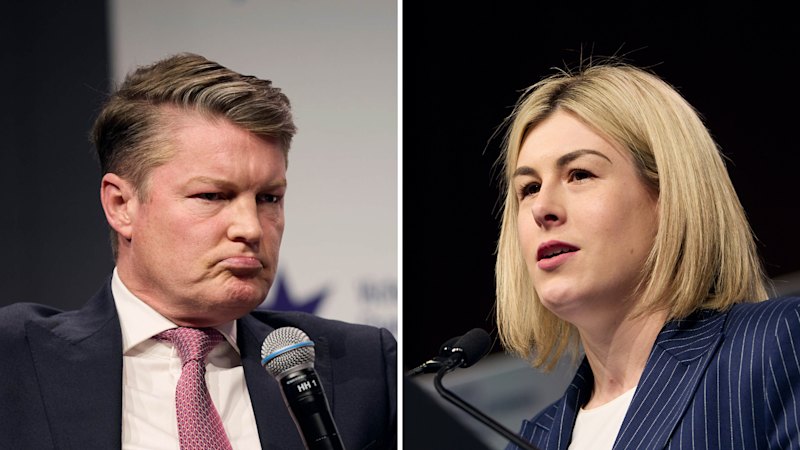
Opposition Leader Jess Wilson has campaigned on fiscal repair and pledged to deliver a cash surplus by 2032.
asserted
Wilson → campaign → 2032
The plan is heavily reliant on a decade-long hiring freeze across parts of the public service, and is complicated by the Coalition’s promised tax cuts, which would deliver a hit to revenue of about $5 billion in its first term.
asserted
which → complicate → term
Premier Ben Carroll has not laid out a similar plan, but has continually positioned himself as “financially responsible, socially progressive”, and pointed to savings he has made since taking power in July.
asserted
he → lay → July
He told ABC Radio on Wednesday that the Coalition’s promised spending and tax cuts would “100 per cent” induce a recession in Victoria, which Wilson called “desperate lies”.
asserted
Wilson → tell → which
To return the budget to a cash surplus, Eslake said Victoria would need to cut spending, as increasing taxes and selling public assets were no longer options.
asserted
increasing → return → assets
Most of the state’s public assets were sold off under Jeff Kennett, with Daniel Andrews’ $9.7 billion sale of the Port of Melbourne essentially emptying the cupboard.
asserted
sale → sell → cupboard
Victorians are the highest taxed citizens of any state, and Eslake said further increasing taxes “would probably be damaging to employment and investment”.
asserted
increasing → tax → employment
He pointed to recent data from the Commonwealth Grants Commission, which revealed Victoria was spending 7 per cent more per person than other states to provide an average level of government services, and 10 per cent more per person to deliver average infrastructure.
asserted
Victoria → point → infrastructure
“If you convert those percentages into millions of dollars, they basically suggest that by reducing spending ... from the levels that are forecast, you could reduce operating expenditure by about $5.5 billion and [capital expenditure] by about $1.75 billion, which is just about enough to get you back to a cash balance,” Eslake said.
uncertain
Eslake → convert → balance
Eslake said the problem with the Liberal plan for a cash surplus was their announced cuts did not go far enough, and if the Coalition did not win a majority in the upper house, it might have legislation for further cuts shot down.
uncertain
legislation → say → cuts
“The parties that collectively constitute a majority in the upper house would be ... entitled to block it.
asserted
that → constitute → it
But Labor is already attacking the Coalition over $40 billion in supposed cuts, and announcing further reductions to spending would be politically tricky for Wilson.
asserted
announcing → attack → Wilson
Holden said the only way Victoria could achieve a fiscal reset was through an independent audit.
uncertain
Victoria → say → audit
“If there’s an iron law of public finance it’s this: revenues may come and go, but spending is forever,” he said.
uncertain
he → ’ → finance
When Kennett was elected in 1992, partly on a platform for fixing the state’s debt crisis, he called a commission of audit to extensively review the state’s public finances.
asserted
he → elect → finances
Following the report, his government aggressively privatised state agencies and made public sector cuts.
asserted
government → follow → cuts
Breunig said legislating fiscal rules and frameworks would give clarity to government spending and help rein in debt.
asserted
legislating → say → debt
“They provide guidelines for policymakers and a benchmark against which excessive government spending can be identified and curtailed,” Breunig said.
asserted
Breunig → provide → which
“Victoria clearly needs these rules to help restore discipline and balance to their budgetary situation.”
asserted
Victoria → need → situation
Read more on the Victorian election:
- Hot seats: Follow four key races that will shape the election
- See how your neighbours voted in 2022: And what it means for this election
- Security crackdown: Officers to patrol polling booths
- ‘Big Build must stop’: Why experts want work frozen
asserted
work → read → booths
 The Aporia