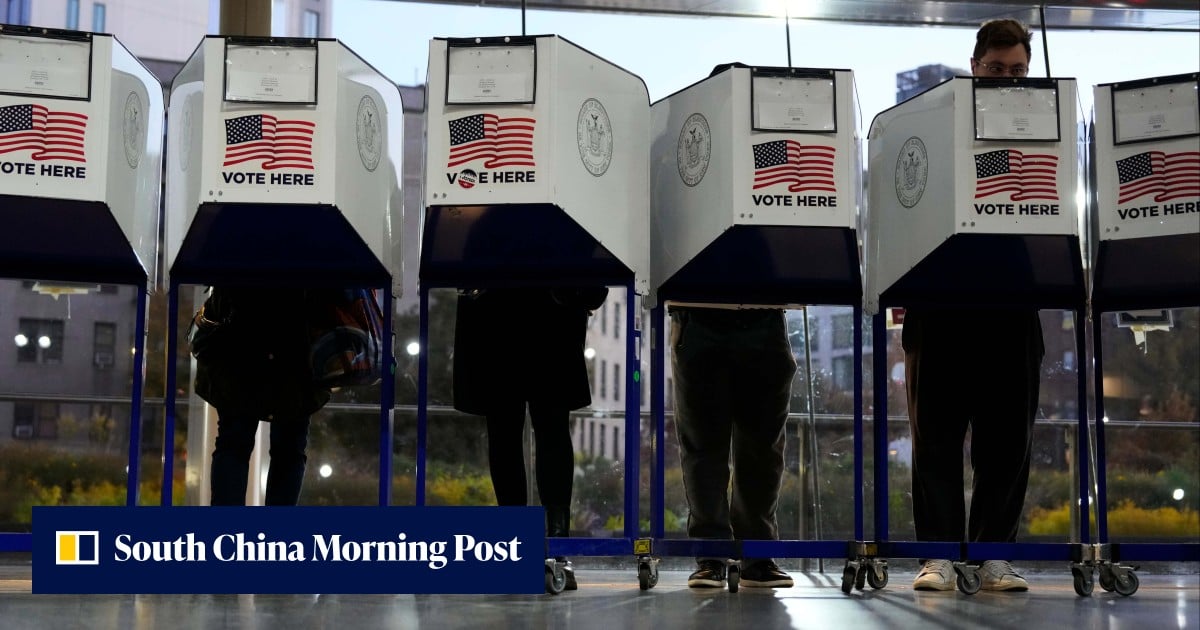
Photo via The Guardian

After the US midterms, what will a lame duck Trump mean for the global economy?

Read the original at The Guardian ↗
Cite

correspondent, R. P. S. e. (2026, November 4). After the US midterms, what will a lame duck Trump mean for the global economy? The Guardian. https://www.theguardian.com/us-news/2026/nov/04/explainer-midterms-trump-us-global-economy-markets

Dated from the outlet's own feed. Check the original for its byline.

The Guardian · collected 2026-11-04 · by Richard Partington Senior economics correspondent

Quick Summary

The article discusses how Donald Trump's weakened position after the midterm elections will affect the global economy during his final two years as president. It highlights concerns over political uncertainty and erratic policies, particularly regarding foreign policy and artificial intelligence regulation. Stock markets initially dropped due to the election results but then rallied, reflecting investor optimism about checks on Trump’s power. The article also notes that inflation has surged due to war-related economic disruptions, leading central banks to raise interest rates despite pressure from Trump.
Written by AI on 2026-11-04, from this article's own text only (the story summary below draws on all the coverage).

AI analysis

Story summary

On November 3, 2026, Democrats swept the U.S. midterm elections, winning control of both the House of Representatives and the Senate, marking a significant shift in power from the previously dominant Republicans. This outcome was seen as a direct referendum on President Donald Trump's second term policies, particularly his handling of domestic issues like inflation and international conflicts such as the war against Iran. Markets responded positively to the election results, with the Dow Jones Industrial Average, Nasdaq, and S&P 500 all opening higher on November 4th. Analysts predicted that a weakened Trump in his final two years would likely lead to more cautious economic policies and increased market volatility.

Written for “Democrat's Win US Midterm Elections” on 2026-11-04, grounded in this article and the 434 other(s) covering the same event.
Why this leaning score
The article's own words the score was based on. Each is quoted verbatim and was checked against the article text before being stored, so you can find it in the original.
Reading Leans strongly left (beta estimate) Confidence high 1 quote(s) discarded as not found in the article
Leaning: leans strongly left for article 129155 (high confidence, 2 verified quotes) · logged 2026-11-04

Story

📰 Democrat's Win US Midterm Elections
Politics · 435 article(s) covering the same event. Compare every outlet's account →

Compared with similar articles

This article reads leans strongly left and hedges 19% of its claims. Each row says how that neighbour differs.
The Sydney Morning Herald
⚖️ Leans left further right than this Hedges 10 of 56 claims Outlet record 61/100
South China Morning Post
⚖️ Leans left further right than this Hedges 1 of 8 claims Outlet record 62/100
“The articles discuss different aspects of the midterm elections' aftermath, with Article A focusing on the implications for Trump's presidency and Article B specifically addressing the economic consequences. They are not describing the same specific incident.”
South China Morning Post
Hedges 1 of 2 claims Outlet record 62/100
“The articles discuss different aspects of the midterm election outcomes, with Article A focusing on US-China relations and Article B on the global economic implications for a lame-duck Trump presidency.”
South China Morning Post
⚖️ Leans left further right than this Hedges 1 of 1 claims Outlet record 62/100
“The articles discuss general concerns about diplomatic uncertainty and economic pressure following the US midterms, but they do not describe the same specific incident or outcome.”
Deutsche Welle
Hedges 11 of 40 claims Outlet record 95/100
Semafor
⚖️ Leans right further right than this Hedges 2 of 20 claims Outlet record 59/100
“The articles discuss different aspects of the aftermath of the midterm elections, with Article A focusing on who gets blamed for economic issues and Article B discussing the implications of Trump losing control of both houses.”
South China Morning Post
⚖️ Leans left further right than this Hedges 1 of 3 claims Outlet record 62/100
“The articles discuss different aspects of the aftermath of the US midterm elections: trade policy relations with China versus broader economic implications.”
Washington Examiner
⚖️ Leans left further right than this Hedges 0 of 2 claims Outlet record 69/100
“The articles discuss the potential outcomes of the midterms on Trump's presidency, but they describe different points in time and analyses.”
How this article was measured signals, leaning charts, publisher record, byline, topics and claims

Signals How these are calculated →

Claims extracted
32
sentences that state something as happening or true
Uncertain
19%
6 of 32 hedged ("reportedly", "may", "according to")
Leaning
Leans strongly left
of the writing, not the subject · beta estimate
Publisher signals
66/100
The Guardian's corrections and hedging, across everything collected from it. Not a measure of accuracy.
Outlets on this story
435
Politics
Same framing elsewhere
1
articles that frame the event the way this one does
Analyzed 2026-11-04 · how these are computed

How this is being covered How these are calculated →

Article leaning vs. publisher reliability
Source leaning vs. consistency

Publisher

The Guardian · 2049 article(s) · 6 correction(s) detected
Running correction rate · 6 correction(s)

Who wrote this

Richard Partington Senior economics correspondent
16 article(s) here · 1 carrying a prediction
🔮 After Democrats swept aside his Republican party in the midterm elections, analysts said the prospect of a highly erratic lame-duck president would have significant implications for financial markets, growth, inflation, government borrowing costs and living standards.
🔮 Angela Rayner has said voters will begin to see a difference in their high street before the next general election as Labour prioritises investment in struggling local communities.
🔮 Helen Miller, the director of the IFS, said avoiding a return to austerity for unprotected government departments could require a £17bn top-up to the spending plans for 2030-31.
🔮 Britain’s economy has taken a multibillion-pound hit as the war in the Middle East drags down growth and triggers a fresh cost of living crisis, according to the government’s independent forecaster.
🔮 Drawn up before Wednesday’s budget, the proposal, which was first reported last week, is expected to form part of the government response to Alan Milburn’s review into why so many young people are unemployed.
🔮 As he prepares for his debut budget, the chancellor said that Andy Burnham’s government would commit hundreds of millions of pounds to develop a “distinctively British” approach to AI that would capitalise on the benefits of the frontier technology.
🔮 With less than a week before his tax and spending speech to the Commons, the chancellor is under pressure to take action to support households amid warnings that consumer energy bills could reach £2,000 a year from January for the typical household.
🔮 With his final report delayed until after the budget, the former Labour cabinet minister this week signalled that boosting access to apprenticeships would be critical for fixing the first rungs of the career ladder for young people.
🔮 Shevaun Haviland, the director general of the British Chambers of Commerce (BCC), said she welcomed the prime minister reopening the Brexit battle lines despite the uncertainty it could create, arguing that the UK’s current trading relationship with the EU was bad for business.
🔮 City economists had forecast the economy would shrink by 0.1%.
Also by Richard Partington Senior economics correspondent
Nothing else under this byline is closely related to this article, so these are simply their most recent.
All 16 articles by Richard Partington Senior economics correspondent →

Topics

Democrats Iran Republican Senate the House of Representatives

Subjects

Trump PERSON · 6× Iran GPE · 5× Democrats NORP · 2× Fed ORG · 2× Donald Trump’s PERSON · 1× Holger Schmieding PERSON · 1× Republican NORP · 1× Senate ORG · 1× Veto PERSON · 1× the House of Representatives ORG · 1×

Narrative

After Democrats swept aside his Republican party in the midterm elections, analysts said the prospect of a highly erratic lame-duck president would have significant implications for financial markets, growth, inflation, government borrowing costs and living standards.
framing: assertive · carried by 1 article(s) · first seen 2026-11-04
🔮 After Democrats swept aside his Republican party in the midterm elections, analysts said the prospect of a highly erratic lame-duck president would have significant implications for financial markets, growth, inflation, government borrowing costs and living standards.

Claims (32 extracted, 6 hedged)

Donald Trump’s loss of control of the House of Representatives and the Senate has put the world economy on notice for an unpredictable final two years of his presidential term. asserted
loss → put → term
After Democrats swept aside his Republican party in the midterm elections, analysts said the prospect of a highly erratic lame-duck president would have significant implications for financial markets, growth, inflation, government borrowing costs and living standards. asserted
prospect → sweep → markets
Here are the biggest expected consequences for the US economy and for other countries. asserted
consequences → expect → countries
Markets initially dropped in early trading in Asia overnight but rallied as investors weighed up the midterm results. asserted
investors → drop → results
Investors typically dislike uncertainty and political chaos. asserted
Investors → dislike → uncertainty
The fact that the president conceded the result and acknowledged the impact of the Iran war has been taken as a positive in markets. asserted
president → concede → markets
However, his warning that he will become “Mr Veto” raises the prospect of a turbulent finale to his time in the White House. asserted
he → become → House
Holger Schmieding, the chief economist at Berenberg, said the result showed that US voters had “rejected Trump and his somewhat authoritarian penchant for crony capitalism. asserted
voters → say → capitalism
[That] shows that US institutions and its checks and balances work. asserted
institutions → show → ?
Traders expect the Democrats to take a tougher line on AI regulation and the datacentre rollout, raising questions over a driver of stock market growth. asserted
Democrats → expect → growth
There are also concerns that Trump, with the midterms out of the way and his control over domestic policy weakened, could take a more aggressive approach to foreign policy, with potential to intensify the war in Iran. uncertain
control → be → Iran
The cost to US households from surging inflation triggered by a deeply unpopular war, alongside a chaotic tariff policy that has devastated small businesses, was key to the midterm result. asserted
that → surge → result
US diesel prices surged to a record high in August, while the headline inflation rate has risen to 3.7%. asserted
rate → surge → %
The US-Israeli invasion of Iran, leading to the closure of the critical strait of Hormuz, reignited global inflationary pressures amid the biggest energy price shock of the modern age. asserted
invasion → lead → age
Oil prices have fallen back thanks to hopes of a diplomatic breakthrough. asserted
prices → fall → breakthrough
However, Brent crude, the international benchmark, remains above $100 a barrel, significantly higher than its prewar level of about $70. asserted
crude → remain → 70
As a consequence, the International Monetary Fund expects global headline inflation to rise to 4.7% this year, with energy-importing countries hardest hit. asserted
countries → expect → %
The possibility of Trump ramping up hostilities against Iran would add to the inflationary shock, but it would also further add to his unpopularity. asserted
it → ramp → unpopularity
Higher inflation has forced central banks to raise interest rates, with the US Federal Reserve defying pressure from Trump by increasing the cost of borrowing for the first time since 2023. asserted
Reserve → force → 2023
Against a volatile backdrop in the war and as inflationary pressures persist, investors anticipate at least one more rate increase from the Fed. asserted
investors → persist → Fed
The Bank of England is expected on Thursday to raise rates, while the European Central Bank is also expected to push up borrowing costs. asserted
Bank → expect → costs
After losing control of Congress, the Republicans will lack the votes to confirm new appointments to critical public bodies, including new Fed governors. asserted
Republicans → lose → governors
Trump could still use his veto powers, which can be overturned only if two-thirds of both chambers agree. uncertain
thirds → use → chambers
Government finances Higher inflation and interest rates triggered by the Iran war have driven up borrowing costs, adding to the pressure on countries with high levels of public debt. asserted
inflation → trigger → debt
In the US, the logjammed political system will face its first major test on 11 December, when politicians have to agree to authorise government spending to avoid a shutdown. asserted
politicians → face → shutdown
The gridlock could prevent Trump from launching new tax and spending measures, which could cut two ways, restricting the capacity for fiscal stimulus to boost the economy, but also limiting a further rise in borrowing and debt. uncertain
which → prevent → borrowing
Analysts say the crushing midterm defeats for Maga candidates will hurt the president’s authority and could pave the way for more cooperation between Republicans and Democrats in Congress. uncertain
defeats → say → Congress
Analysts say political turbulence and presidential actions on trade and immigration could put US growth at risk, but inflation and, most importantly, the prospects for de-escalation in the Middle East are the main factors to watch. Investors are wary that a clampdown by the Democrats on AI could hit investment and growth in the US. uncertain
clampdown → say → US
The spillovers from the tech boom have been felt around the globe, with AI investment helping to bolster the UK economy. asserted
investment → feel → economy
However, tech industry leaders were already cooling on the rollout of AI amid concerns over cyber risks. asserted
leaders → cool → risks
Many investors also feared the emergence of a bubble in the US stock market. asserted
investors → fear → market
Analysts at Allianz say the scale of AI investment, and its capacity to power global economic growth, could mean the left-right political playbook is less predictable than in the past. uncertain
playbook → say → past

💬Give feedback · no sign-in needed

No sign-in needed for now. Your note is sent without a name, so it cannot be answered.

🕘History 🎫Support