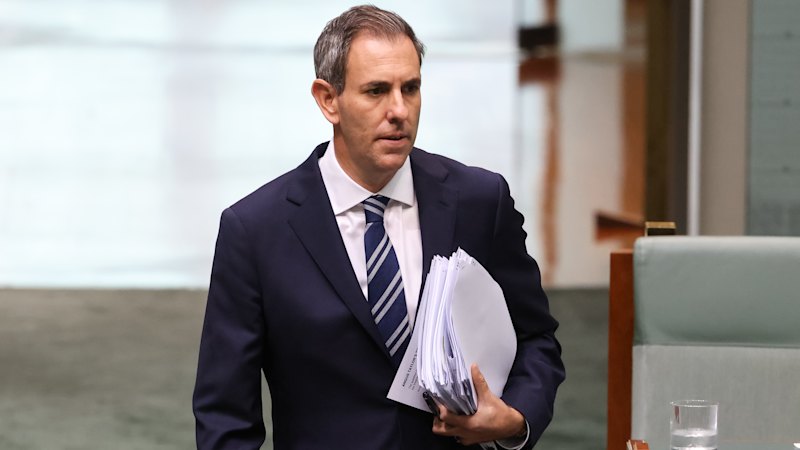
Photo via The Guardian

Healey’s budget paves way for ‘brutal’ spending review next year, warns IFS

Read the original at The Guardian ↗
Cite

correspondent, R. P. S. e. (2026, October 29). Healey’s budget paves way for ‘brutal’ spending review next year, warns IFS. The Guardian. https://www.theguardian.com/uk-news/2026/oct/29/john-healey-budget-brutal-spending-review-next-year-ifs

Dated from the outlet's own feed. Check the original for its byline.

The Guardian · collected 2026-10-29 · by Richard Partington Senior economics correspondent

Quick Summary

John Healey's recent budget address did not cover a £28 billion shortfall in public finances, according to the Institute for Fiscal Studies (IFS). The IFS warns of impending “brutal” spending cuts next year unless significant additional funding is allocated, particularly noting a need for an extra £17 billion by 2030-31. Helen Miller, director of the IFS, highlights that without substantial changes, some public services may face real-term cuts in the upcoming spending review. The article reports on Healey's low-key approach to address immediate fiscal challenges while avoiding decisive action that could lead to speculation about future tax hikes and budget cuts.
Written by AI on 2026-10-29, from this article's own text only (the story summary below draws on all the coverage).

AI analysis

Story summary

John Healey, Britain's Chancellor of the Exchequer, delivered his first Budget on October 28, 2026, amid economic challenges exacerbated by the Iran war and international market turmoil. Key announcements included a new £1.5 billion borrowing facility to support local authorities, a £100 payment to help households with energy bills, and VAT cuts on electricity bills. He also unveiled plans for additional defense spending of £15 billion, which will be funded by "reprioritizing" budgets across other departments. Critics argue that the budget lacks detail and fails to address long-term economic issues, while supporters see it as a necessary measure to provide immediate relief after years of austerity, Brexit, and the pandemic.

Written for “John Healey's Micro Budget Announcements” on 2026-10-29, grounded in this article and the 61 other(s) covering the same event.
Why this leaning score
The model judged this article politically coded and scored it -0.50, but every quote it verified points right, so the score is not published.
Written under an earlier scoring contract, which gave a paragraph rather than checkable quotes. Re-analysing this article replaces it.
Leaning score withheld for article 114802: score contradicts its own evidence · logged 2026-10-29

Story

📰 John Healey's Micro Budget Announcements
Economy/Business · 62 article(s) covering the same event. Compare every outlet's account →

Compared with similar articles

This article reads unscored and hedges 21% of its claims. Each row says how that neighbour differs.
BBC News
⚖️ Leans left Hedges 6 of 36 claims Outlet record 69/100
The Sydney Morning Herald
⚖️ Leans left Hedges 2 of 36 claims Outlet record 61/100
“The articles describe different events: one is about Jim Chalmers refusing to cap government spending, while the other is about John Healey facing a £28bn shortfall and a potential brutal spending review.”
Daily Mail
⚖️ Leans left Hedges 0 of 3 claims Outlet record 68/100
“Article A describes live updates before John Healey's first Budget announcement on October 28, while Article B discusses the aftermath and analysis of the Budget delivered by Healey a day later.”
The Guardian
⚖️ Leans left Hedges 6 of 41 claims Outlet record 66/100
BBC News
Hedges 0 of 2 claims Outlet record 69/100
“While both articles discuss Chancellor John Healey's first Budget speech, Article B covers a follow-up analysis and critique by the Institute for Fiscal Studies on the day after the initial budget presentation.”
Evening Standard
⚖️ Leans left Hedges 0 of 20 claims Outlet record 65/100
“The articles discuss different aspects of John Healey's budget speech and its implications, but describe separate evaluations or reactions to it rather than the same specific incident.”
Daily Mail
⚖️ Leans strongly right Hedges 2 of 27 claims Outlet record 68/100
“The articles discuss different aspects of John Healey's budget and fiscal policies, with Article A focusing on defense spending demands and Article B addressing a projected shortfall in public finances.”
How this article was measured signals, leaning charts, publisher record, byline, topics and claims

Signals How these are calculated →

Claims extracted
14
sentences that state something as happening or true
Uncertain
21%
3 of 14 hedged ("reportedly", "may", "according to")
Leaning
withheld
no quote in the article backed the model's score
Publisher signals
66/100
The Guardian's corrections and hedging, across everything collected from it. Not a measure of accuracy.
Outlets on this story
62
Economy/Business
Same framing elsewhere
1
articles that frame the event the way this one does
Analyzed 2026-10-29 · how these are computed

How this is being covered How these are calculated →

Article leaning vs. publisher reliability
Source leaning vs. consistency

Publisher

The Guardian · 2669 article(s) · 6 correction(s) detected
Running correction rate · 6 correction(s)

Who wrote this

Richard Partington Senior economics correspondent
14 article(s) here · 1 carrying a prediction
🔮 Helen Miller, the director of the IFS, said avoiding a return to austerity for unprotected government departments could require a £17bn top-up to the spending plans for 2030-31.
🔮 Britain’s economy has taken a multibillion-pound hit as the war in the Middle East drags down growth and triggers a fresh cost of living crisis, according to the government’s independent forecaster.
🔮 Drawn up before Wednesday’s budget, the proposal, which was first reported last week, is expected to form part of the government response to Alan Milburn’s review into why so many young people are unemployed.
🔮 As he prepares for his debut budget, the chancellor said that Andy Burnham’s government would commit hundreds of millions of pounds to develop a “distinctively British” approach to AI that would capitalise on the benefits of the frontier technology.
🔮 With less than a week before his tax and spending speech to the Commons, the chancellor is under pressure to take action to support households amid warnings that consumer energy bills could reach £2,000 a year from January for the typical household.
🔮 With his final report delayed until after the budget, the former Labour cabinet minister this week signalled that boosting access to apprenticeships would be critical for fixing the first rungs of the career ladder for young people.
🔮 Shevaun Haviland, the director general of the British Chambers of Commerce (BCC), said she welcomed the prime minister reopening the Brexit battle lines despite the uncertainty it could create, arguing that the UK’s current trading relationship with the EU was bad for business.
🔮 City economists had forecast the economy would shrink by 0.1%.
🔮 The chancellor is however under growing pressure to take action to support households and businesses before the winter amid predictions that consumer energy bills could reach £2,000 a year from January for the typical household.
🔮 As the war in the Middle East rattles the public finances, the Institute for Fiscal Studies (IFS) said the damage from higher inflation meant the chancellor would need to either top up funds for his current government spending plans or impose deep real-terms cuts by the end of the decade.
Also by Richard Partington Senior economics correspondent
Nothing else under this byline is closely related to this article, so these are simply their most recent.
All 14 articles by Richard Partington Senior economics correspondent →

Topics

Britain Commons IFS Labour the Institute for Fiscal Studies

Subjects

Healey PERSON · 4× IFS ORG · 3× Andy Burnham’s PERSON · 1× Britain GPE · 1× Commons ORG · 1× Helen Miller PERSON · 1× John Healey PERSON · 1× Labour ORG · 1× Rachel Reeves PERSON · 1× the Institute for Fiscal Studies ORG · 1×

Narrative

With Labour having promised there would be no return to austerity, and as Andy Burnham’s government prepares for the next election, she said it appeared extremely unlikely that Healey would follow through with such cuts. “A clear short-term risk with the chancellor’s choices is that next year – with low headroom and a spending review that looks pretty brutal for some departments – we see another season of damaging speculation about tax rises,” she said.
framing: mixed · carried by 1 article(s) · first seen 2026-10-29
🔮 Helen Miller, the director of the IFS, said avoiding a return to austerity for unprotected government departments could require a £17bn top-up to the spending plans for 2030-31.

Claims (14 extracted, 3 hedged)

John Healey has paved the way for a “brutal” spending review next year after his budget failed to cover a £28bn shortfall in the public finances needed to avoid a return to austerity, according to Britain’s leading tax and spending experts. uncertain
budget → pave → experts
A day after his address to the Commons, the Institute for Fiscal Studies (IFS) said the chancellor had left himself a mountain to climb by ducking several big decisions in his debut tax and spending statement. asserted
chancellor → say → statement
After his low-key speech designed with febrile bond markets in mind, the thinktank said Healey had left plans for overall departmental spending across the rest of the parliament broadly unchanged in cash terms. asserted
Healey → design → terms
But as the war in the Middle East fuels a surge in inflation – raising the cost of delivering public services – the chancellor has in effect pencilled in large cuts in the run-up to the next general election. asserted
chancellor → fuel → election
Helen Miller, the director of the IFS, said avoiding a return to austerity for unprotected government departments could require a £17bn top-up to the spending plans for 2030-31. uncertain
avoiding → say → 2030
That is before taking into account an additional £11bn needed to fund a commitment to increase defence spending to 3% of GDP. asserted
That → take → GDP
“It effectively implies that some public services will see real-terms cuts in next year’s spending review,” she said. asserted
she → imply → review
With Labour having promised there would be no return to austerity, and as Andy Burnham’s government prepares for the next election, she said it appeared extremely unlikely that Healey would follow through with such cuts. “A clear short-term risk with the chancellor’s choices is that next year – with low headroom and a spending review that looks pretty brutal for some departments – we see another season of damaging speculation about tax rises,” she said. asserted
she → promise → rises
In his first budget as chancellor on Wednesday, Healey raised taxes on banks and landlords to fund relief for households being squeezed by the energy shock emanating from the Middle East war. asserted
Healey → raise → war
Against a highly uncertain global backdrop, Healey stuck to the government’s fiscal rules with £15bn of headroom – allowing a hit to the £23.6bn buffer left by his predecessor, Rachel Reeves, as the conflict drives up the UK government’s borrowing costs. asserted
conflict → stick → costs
Faced with grim forecasts for household living standards and growth in the British economy, the IFS said it was a “reasonable choice” for the chancellor to allow for a modest reduction in headroom. asserted
chancellor → face → headroom
However, his deferral of some important decisions to next year’s spending review prompted the thinktank to criticise his plans for meeting the fiscal rules, because they in effect relied on him cutting public spending or announcing tax increases that he had yet to prepare the public for. asserted
he → prompt → public
“My concern is not that it would be impossible to deliver the implied cuts to other services – that could be done. uncertain
that → deliver → services
But I’m sceptical that this government would be willing to do it,” Miller said. asserted
Miller → ’m → it

💬Give feedback
🕘History 🎫Support