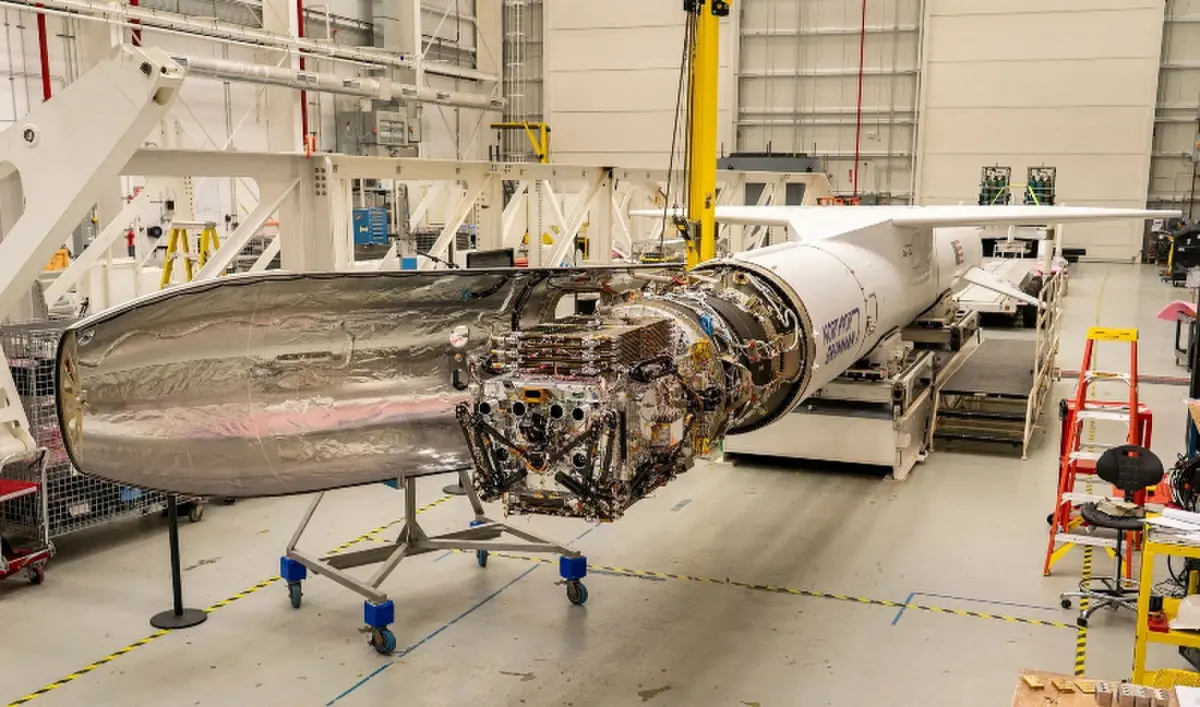
Photo via Dawn

Nasa's Swift satellite telescope heads for fiery re-entry 22 years after launch

Read the original at Dawn ↗
Cite

Reuters. (2026, November 4). Nasa's Swift satellite telescope heads for fiery re-entry 22 years after launch. Dawn. https://www.dawn.com/news/2042049/nasas-swift-satellite-telescope-heads-for-fiery-re-entry-22-years-after-launch

Dated from the outlet's own feed. Check the original for its byline.

Dawn · collected 2026-11-04 · by Reuters

Quick Summary

NASA's Neil Gehrels Swift Observatory, launched in 2004 and weighing about 3,200 pounds, is set to re-enter Earth’s atmosphere on Wednesday after nearly 22 years in orbit. The satellite, which has been studying gamma-ray bursts and cosmic phenomena since its launch, will likely burn up over the tropics with a low risk of debris harming anyone. The US Space Force estimates the chance of harm at one in 2,100, while other projections place re-entry around early Wednesday morning EST. A rescue mission to extend Swift’s life failed this summer when the LINK spacecraft designed to retrieve it malfunctioned.
Written by AI on 2026-11-04, from this article's own text only (the story summary below draws on all the coverage).

AI analysis

Story summary

An aging NASA telescope, the Neil Gehrels Swift Observatory, is expected to crash back to Earth on November 4 or 5, 2026, after a failed rescue mission. The U.S. Space Force predicts it will re-enter the atmosphere around late Wednesday morning Australian Eastern Daylight Time (AEDT) or early Thursday morning AEDT, though the exact time remains uncertain. Most of its 1.5-ton mass is expected to burn up in the atmosphere, but some dense components like tungsten pieces and mirror parts could survive re-entry. The telescope, launched in 2004 for a two-year mission, operated successfully for over two decades before solar activity accelerated its descent.

Written for “NASA Swift Telescope Plunges Back To Earth” on 2026-11-04, grounded in this article and the 7 other(s) covering the same event.
Why this leaning score
This article does not take a side on a contested political question, so it has no leaning score. That is an answer rather than a gap: a match report or a rescue can be warmly or critically written without being left or right, and scoring it anyway is how approval of a subject gets recorded as a political position.
No political leaning scored for article 127950 · logged 2026-11-04

Story

📰 NASA Swift Telescope Plunges Back To Earth
Science · 8 article(s) covering the same event. Compare every outlet's account →

Compared with similar articles

This article reads unscored and hedges 6% of its claims. Each row says how that neighbour differs.
The Guardian
Hedges 2 of 21 claims Outlet record 66/100
Toronto Star
Hedges 1 of 21 claims Outlet record 64/100
Global News
Hedges 1 of 21 claims Outlet record 63/100
CBC News
Hedges 1 of 21 claims Outlet record 60/100
The Independent
Hedges 2 of 15 claims Outlet record 59/100
CBS News
Hedges 1 of 26 claims Outlet record 65/100
ABC News (AU)
Hedges 7 of 39 claims Outlet record 67/100
How this article was measured signals, leaning charts, publisher record, byline, topics and claims

Signals How these are calculated →

Claims extracted
17
sentences that state something as happening or true
Uncertain
6%
1 of 17 hedged ("reportedly", "may", "according to")
Leaning
not political
takes no side on a contested political question
Publisher signals
72/100
Dawn's corrections and hedging, across everything collected from it. Not a measure of accuracy.
Outlets on this story
8
Science
Same framing elsewhere
1
articles that frame the event the way this one does
Analyzed 2026-11-04 · how these are computed

How this is being covered How these are calculated →

Article leaning vs. publisher reliability
Source leaning vs. consistency

Publisher

Dawn · 2683 article(s) · 3 correction(s) detected
Running correction rate · 3 correction(s)

Who wrote this

Reuters
877 article(s) here · 1 carrying a prediction
🔮 The Neil Gehrels Swift Observatory, weighing roughly 3,200 pounds (1,452 kg), was set to tumble out of orbit and burn up in the atmosphere somewhere over the tropics, with fragments surviving re-entry unlikely to threaten populated areas, according to Nasa.
🔮 Trump struck a conciliatory note despite his history of questioning election results, telling The New York Times: “I am absolutely willing to accept those results” and promising to “work with the Democrats.” But minutes later on social media the 80-year-old signaled how he intends to deal with Democratic attempts to pass laws, posting a picture of a red baseball cap emblazoned: “VETO.”
🔮 Democrats have seized control of both houses of Congress, in a rout of President Donald Trump’s Republicans in the midterm elections, US networks projected.
🔮 Democrats won the House and were within reach of taking over the Senate in a rapidly building midterms wave Tuesday projected to sweep Republicans aside and deliver a stinging repudiation of Donald Trump’s bruising presidency.
🔮 Mr. Cooper, 69, will replace Republican Senator Thom Tillis, who announced his retirement after breaking with Mr. Trump over Medicaid cuts in the president’s signature tax and spending law.
🔮 The US justice department said on Tuesday that Donald Trump’s proposed 250ft (76 meter) triumphal arch in Washington would not be completed until after the end of his second term.
🔮 Around $2.85bn of the stolen $6.34bn has been frozen, Binance said, meaning that the attackers could not use it or convert it to another currency.
🔮 Industry officials warn prolonged closures could delay shipments and damage Bangladesh’s reputation as a reliable sourcing hub as it competes with rivals such as Vietnam and India for global apparel orders.
🔮 “The Russians believe that America will not notice this signal from them.
🔮 US President Donald Trump on Tuesday said he made a deal with Israeli Prime Minister Benjamin Netanyahu that Washington would stop $4 billion in funding to Israel after the end of this year.
Wire or desk byline, not an individual reporter.
Also by Reuters
Nothing else under this byline is closely related to this article, so these are simply their most recent.
All 877 articles by Reuters →

Topics

Katalyst LINK Nasa Swift US Space Force

Subjects

Nasa ORG · 6× Katalyst ORG · 2× US Space Force ORG · 2× Arizona GPE · 1× China GPE · 1× Jonathan McDowell PERSON · 1× London GPE · 1× Reuters ORG · 1× The Aerospace Corporation ORG · 1× the Durham University Space Research Centre ORG · 1×

Narrative

Originally designed for a two-year prime mission, Swift remained in operation far longer with observations of a wide range of cosmic objects, from galaxies powered by supermassive black holes and stars emitting X-ray flares, to comets and asteroids streaking through our own solar system.
framing: assertive · carried by 1 article(s) · first seen 2026-11-04
🔮 The Neil Gehrels Swift Observatory, weighing roughly 3,200 pounds (1,452 kg), was set to tumble out of orbit and burn up in the atmosphere somewhere over the tropics, with fragments surviving re-entry unlikely to threaten populated areas, according to Nasa.

Claims (17 extracted, 1 hedged)

An aging Nasa satellite telescope that a robotic spacecraft was sent to retrieve on a failed rescue mission this summer was headed for a fiery re-entry into Earth’s atmosphere on Wednesday, nearly 22 years after it was launched into orbit. asserted
it → age → orbit
The Neil Gehrels Swift Observatory, weighing roughly 3,200 pounds (1,452 kg), was set to tumble out of orbit and burn up in the atmosphere somewhere over the tropics, with fragments surviving re-entry unlikely to threaten populated areas, according to Nasa. uncertain
fragments → weigh → Nasa
The US Space Force has put the odds of harm coming to anyone on Earth at one chance in 2,100, Nasa said in an online statement, projecting the time of re-entry at approximately 3:30am EST (0830 GMT). asserted
Nasa → put → EST
The Aerospace Corporation, a nonprofit national security research entity, projected a re-entry window of 5:19am EST, plus or minus two hours. asserted
Corporation → project → hours
London-based astrophysicist Jonathan McDowell, an honorary professor at the Durham University Space Research Centre, cited revised US Space Force data predicting re-entry most likely to come around 7:45am EST. asserted
McDowell → base → EST
“The satellite is in a very circular orbit, skimming the top of the atmosphere,” he told Reuters by phone on Tuesday night. asserted
he → skim → night
“The question is at what point does it heat up enough that it starts breaking up.” asserted
it → heat → ?
Nasa’s prized $500 million Swift satellite, a first-of-its-kind multi-wavelength space observatory, has been studying gamma-ray bursts and other cosmic phenomena since 2004, using its array of three telescopes. asserted
satellite → prize → telescopes
The observatory, which has no onboard propulsion system of its own, has been drifting toward an expected demise for months as it circles the globe at a speed of roughly 17,000 miles per hour (27,359 kph). asserted
it → have → hour
Astronomers had hoped to extend Swift’s mission for a number of years by giving the satellite telescope a lift. asserted
Astronomers → hop → lift
In July, Nasa and Arizona-based startup Katalyst launched a specially built rescue vehicle called LINK on a mission to rendezvous with Swift, latch onto the satellite and tug the observatory back into a higher, more sustainable orbit. asserted
Nasa → base → orbit
But the LINK spacecraft itself began spinning uncontrollably soon after reaching space, and by mid-August, mission managers abandoned the effort, resigned to letting Swift continue to meet its fate. asserted
Swift → begin → fate
The aborted rescue attempt, the first US mission of its kind, took on heightened significance as a demonstration of a new orbital grappling technology seen as pivotal to the outcome of the US-China space race. asserted
attempt → take → race
The LINK effort was closely watched as a trial run of a key satellite-maintenance technology with potential dual-use military space applications. asserted
effort → watch → applications
Katalyst touted the mission as a historic endeavor that designed, built and tested the LINK rescue vehicle on an unprecedented nine-month production schedule under a $30 million Nasa contract. asserted
that → tout → contract
Swift was launched more than two decades ago to explore the most powerful known explosions in the universe, bursts of gamma-ray radiation emanating from the cores of distant galaxies. asserted
Swift → launch → galaxies
Originally designed for a two-year prime mission, Swift remained in operation far longer with observations of a wide range of cosmic objects, from galaxies powered by supermassive black holes and stars emitting X-ray flares, to comets and asteroids streaking through our own solar system. asserted
Swift → design → system

💬Give feedback
🕘History 🎫Support