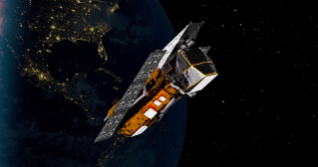
A defunct NASA space telescope is expected to plummet back to Earth sometime tomorrow.
asserted
telescope → expect → Earth
After attempts to save it failed earlier this year, the Neil Gehrels Swift Observatory, aka the Swift telescope, was shut down at the end of October.
asserted
Observatory → save → October
The telescope, about the size of a minibus with solar-panel wings, is expected to re-enter Earth's atmosphere sometime on November 4 (AEDT).
asserted
telescope → expect → November
Where it will land, and what will survive its fiery re-entry remain unknown.
asserted
what → land → entry
The 1.5-tonne space telescope was launched in 2004 to research the origin of high-energy gamma-ray blasts.
asserted
telescope → launch → blasts
Astrophysicists, including Brad Tucker of the Australian National University, used it to study cosmic explosions such as supernovas, stellar collisions, and stars being ripped apart by black holes.
asserted
Astrophysicists → include → holes
In its lifetime, Swift detected at least 1,400 supernovas.
asserted
Swift → detect → supernovas
"It may not be as big or as popular as Hubble or James Webb Space Telescopes, but we have used it for ages," Dr Tucker said.
uncertain
Tucker → use → ages
Over the past 22 years, it had been slowly dropping in altitude due to drag from Earth's atmosphere, but increased solar activity over the past two years (the same activity that has been causing spectacular aurora on Earth) hastened its demise.
asserted
that → drop → demise
In July, NASA hatched an audacious plan to bump the telescope back up in its orbit.
asserted
NASA → hatch → orbit
But this failed due to problems orientating the private satellite sent to rescue it.
asserted
this → fail → it
On October 20, the aging telescope had reached the no-return point of 275km and was shut down.
asserted
telescope → age → km
This means it no longer has a propulsion system to push it back up or guide it to a controlled landing.
asserted
it → mean → landing
Where and when will it crash?
asserted
it → crash → ?
Because the space telescope is now uncontrolled, we can't yet predict when or where it will crash.
asserted
it → predict → ?
It's now travelling about 8 kilometres a second as it nears its re-entry.
asserted
it → travel → entry
Predicting when and where it might re-enter Earth's atmosphere and land is tricky.
uncertain
enter → predict → atmosphere
At this stage, the NASA-funded Space Weather Operational Readiness Development program predicts it will crash-land about 4:37am AEDT on November 4, give or take a few hours, while the Aerospace Corporation predicts 8:11pm AEDT on November 4, give or take 12 hours.
asserted
Corporation → fund → hours
The re-entry point could be anywhere along its orbit, which extends between 21 degrees North and South, which means it travels across northern Australia as far south as Mackay, Tennant Creek and Marble Bar (although it may not pass over these specific locations).
uncertain
it → extend → locations
Dr Tucker said the "likelihood" is that it will drop in the ocean, but it also travels over northern Australia, Africa, India, South-East Asia, South and Central America.
"If 70 per cent of the Earth is ocean, 30 per cent is land.
asserted
cent → say → Earth
So three out of 10 times it's on land, not ocean," he said.
asserted
he → say → land
Predicting where and when it will land becomes more precise in the final couple of orbits shown on space telescope track maps below.
asserted
it → predict → maps
You can keep track of Swift predictions here.
asserted
You → keep → predictions
Will I be able to see it?
asserted
I → see → it
Everything depends upon the telescope's final orbit.
asserted
Everything → depend → orbit
"The final orbit could be in the middle of the day or over the ocean, and no-one would see it, and we've had those," Dr Tucker said.
uncertain
Tucker → see → those
"Or it could be over the night-time over a populated area, and then we'll get some great footage.
uncertain
we → get → footage
"
While we don't know where it will land, we do know its last moments will be fiery.
asserted
moments → know → ?
Once it drops to about 120km above Earth's surface, the air surrounding it heats up, making it glow.
"For reference, 100 kilometres is where we call space 'space '; 120 kilometres is really when you're coming down in a few orbits," Dr Tucker said.
asserted
Tucker → drop → orbits
Most of the spacecraft will burn up on re-entry, although experts have said some parts could survive, such as denser-than-lead tungsten and mirror parts.
uncertain
parts → burn → parts
"Swift overall is relatively small in comparison to other satellites, so if there are bits that survive they shouldn't be too big, but I think inevitably there will [be debris]," Dr Tucker said.
asserted
Tucker → be → satellites
Dr Tucker said he would miss the Swift telescope.
"
asserted
he → say → telescope
"
And while there will be new spacecraft in the future, Dr Tucker said none were likely to completely fill the gap the Swift telescope would leave.
asserted
telescope → say → gap
In addition to detecting gamma rays, it could also see space in visible light, as well as ultraviolet and X-ray wavelengths not possible from Earth.
uncertain
it → detect → Earth
"We'll lose quite a bit of information, at least when we look at supernova and exploding stars,"he said.
asserted
we → lose → stars,"he
No one site, no one place can do everything.
asserted
site → do → everything
"
Swift is just one of several older spacecraft that will eventually crash back to Earth.
asserted
that → crash → Earth
"Hubble's going to have a very similar fate as well," Dr Tucker said.
asserted
Tucker → go → fate
NASA predicts the Hubble Space Telescope, which is about 8.4 times heavier than Swift, will make an uncontrolled entry sometime in 2033 or 2034.
asserted
which → predict → 2033
 The Aporia