Photo via The Straits Times

US midterm elections 2026: Live results

Read the original at The Straits Times ↗
Cite

Tampus, C., Choon, C. M., & Er, C. (2026, November 3). US midterm elections 2026: Live results. The Straits Times. https://www.straitstimes.com/world/us-midterm-elections-2026-live-results

Dated from the outlet's own feed. Check the original for its byline.

The Straits Times · collected 2026-11-03 · by Charles Tampus, Chang May Choon, Connie Er

Quick Summary

The article reports live updates for the 2026 US midterm elections where over 100 million voters are expected to participate. Democrats need a net gain of four seats in the House and Senate to take control from Republicans who currently hold majorities in both chambers. Results will start coming in after 6pm Eastern time on November 3, with some races potentially taking days or weeks to decide due to close margins or outstanding ballots. Media outlets may project winners based on various data sources but these are not official results until verified by local election authorities.
Written by AI on 2026-11-03, from this article's own text only (the story summary below draws on all the coverage).

AI analysis

Story summary

As of November 3, 2026, the US midterm elections were underway with over 100 million people expected to vote based on previous turnout. Republicans maintain a narrow majority in the House of Representatives with 218 seats compared to Democrats' 214, including two vacancies and one Republican-aligned independent. To gain control, Democrats need to secure a net increase of four seats. For the Senate, where Republicans currently hold a 53-47 edge, Democrats must also capture an additional four seats. The elections also determine governors for 36 states and legislative bodies at the state level in nearly every state. These results provide insights into voter preferences ahead of the presidential election in 2028. Initial results from Indiana and Kentucky could start coming in after 6pm Eastern time on November 3 (7am Singapore time), with some races potentially taking days or weeks to decide definitively due to close margins or provisional ballots.
Written for “US Midterm Elections 2026 Results” on 2026-11-04, grounded in this article and the 0 other(s) covering the same event.
Why this leaning score
This article does not take a side on a contested political question, so it has no leaning score. That is an answer rather than a gap: a match report or a rescue can be warmly or critically written without being left or right, and scoring it anyway is how approval of a subject gets recorded as a political position.
No political leaning scored for article 126658 · logged 2026-11-03

Story

📰 US Midterm Elections 2026 Results
Politics · 1 article(s) covering the same event.

Compared with similar articles

This article reads unscored and hedges 27% of its claims. Each row says how that neighbour differs.
Euronews
Hedges 0 of 4 claims Outlet record 60/100
Washington Examiner
Hedges 1 of 3 claims Outlet record 69/100
“Article A reports on a poll taken days before the election, while Article B provides live results of the ongoing election.”
NPR
Hedges 8 of 28 claims Outlet record 60/100
“Article A discusses strategic House races to watch, while Article B provides live results and overall election trends.”
New York Post
Hedges 2 of 23 claims Outlet record 66/100
“Article A provides general guidance on how to watch election results, while Article B reports live results from the actual election day.”
Al Jazeera
⚖️ Leans left Hedges 14 of 51 claims Outlet record 60/100
“The articles cover different aspects of the midterm elections, with Article A focusing on early voting statistics as of November 1 and Article B providing live results and context for the election day outcomes.”
ABC News (US)
Hedges 0 of 1 claims Outlet record 70/100
“The articles describe different stages of the election process, with Article A focusing on early voting trends before the election date and Article B covering live results after the election day.”
The Independent
Hedges 1 of 16 claims Outlet record 59/100
“Article A discusses uncertainties about election outcomes before the event, while Article B provides live results during the actual voting day.”
Al Jazeera
Hedges 0 of 1 claims Outlet record 60/100
“Article A describes the efforts leading up to the US midterm elections, while Article B reports on the results after the election.”
The Guardian
Hedges 1 of 44 claims Outlet record 66/100
“While both articles discuss US midterm elections, they provide different types of information (live results vs. context and background) about an ongoing election day on November 3rd, 2026.”
South China Morning Post
Hedges 2 of 6 claims Outlet record 62/100
“Article A provides general information about how midterms work, while Article B gives live results and specifics on the races.”
How this article was measured signals, leaning charts, publisher record, byline, topics and claims

Signals How these are calculated →

Claims extracted
11
sentences that state something as happening or true
Uncertain
27%
3 of 11 hedged ("reportedly", "may", "according to")
Leaning
not political
takes no side on a contested political question
Publisher signals
66/100
The Straits Times's corrections and hedging, across everything collected from it. Not a measure of accuracy.
Outlets on this story
1
Politics
Same framing elsewhere
1
articles that frame the event the way this one does
Analyzed 2026-11-03 · how these are computed

How this is being covered How these are calculated →

Article leaning vs. publisher reliability
Source leaning vs. consistency

Publisher

The Straits Times · 4299 article(s) · 5 correction(s) detected
Running correction rate · 5 correction(s)

Who wrote this

Charles Tampus
2 article(s) here · 1 carrying a prediction
🔮 More than 100 million people will likely cast their ballots in 2026’s midterm voting, if the turnout is anything like the previous occasion in 2022.
2026-11-03 · mixed framing · US midterm elections 2026: Live results
Also by Charles Tampus
Nothing else under this byline is closely related to this article, so these are simply their most recent.
Chang May Choon
1 article(s) here · 1 carrying a prediction
🔮 More than 100 million people will likely cast their ballots in 2026’s midterm voting, if the turnout is anything like the previous occasion in 2022.
2026-11-03 · mixed framing · US midterm elections 2026: Live results
The only article under this byline in the corpus.
Connie Er
1 article(s) here · 1 carrying a prediction
🔮 More than 100 million people will likely cast their ballots in 2026’s midterm voting, if the turnout is anything like the previous occasion in 2022.
2026-11-03 · mixed framing · US midterm elections 2026: Live results
The only article under this byline in the corpus.

Topics

Democrats House Republican Republicans the US Senate

Subjects

Democrats NORP · 2× Republicans NORP · 2× Associated Press ORG · 1× House ORG · 1× Indiana GPE · 1× Kentucky GPE · 1× Republican NORP · 1× Singapore GPE · 1× the US Senate ORG · 1×

Narrative

As there is no centralised data source in the US that indicates which states’ electoral votes have gone to which candidates, news organisations have traditionally resorted to making calls by relying on results aggregators, like Associated Press, or by basing them on their own algorithms, data analysis and/or panel of experts.
framing: mixed · carried by 1 article(s) · first seen 2026-11-03
🔮 More than 100 million people will likely cast their ballots in 2026’s midterm voting, if the turnout is anything like the previous occasion in 2022.
2026-11-03 · The Straits Times
US midterm elections 2026: Live results · mixed framing

Claims (11 extracted, 3 hedged)

More than 100 million people will likely cast their ballots in 2026’s midterm voting, if the turnout is anything like the previous occasion in 2022. asserted
turnout → cast → 2022
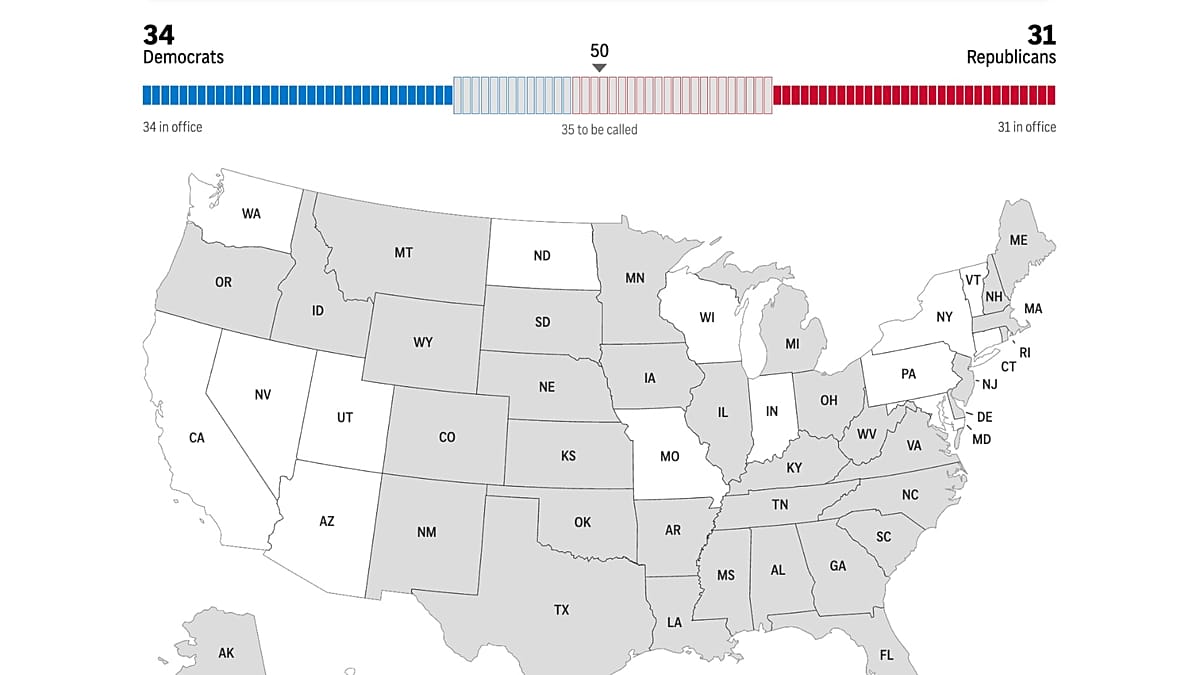
Republicans hold a 218-214 majority in the 435-seat House, which includes two vacancies and one Republican-aligned independent. asserted
which → hold → vacancies
Democrats must win a net gain of four seats to win control. asserted
Democrats → win → control
Democrats also are fighting to win the US Senate, where Republicans hold a 53-47 majority. asserted
Republicans → fight → majority
They must net four additional seats to get control. asserted
They → net → control
This year’s elections also have races for governors in 36 of the 50 states and voting in nearly every state for seats in their state-level legislative bodies. asserted
elections → have → bodies
Midterm election results can give aspiring presidential candidates hints on what voters may be looking for in the next presidential campaign, which will be held in 2028. uncertain
which → give → 2028
Why different media outlets are reporting different numbers The first results could begin arriving after 6pm Eastern time on Nov 3 (7am on Nov 4, Singapore time), when polling locations in parts of Indiana and Kentucky close. uncertain
locations → report → Indiana
But some races could take days or weeks to decide. uncertain
races → take → days
While television networks and news organisations frequently announce election winners, these are “projected winners” and not the official winners. asserted
these → announce → winners
As there is no centralised data source in the US that indicates which states’ electoral votes have gone to which candidates, news organisations have traditionally resorted to making calls by relying on results aggregators, like Associated Press, or by basing them on their own algorithms, data analysis and/or panel of experts. asserted
organisations → be → experts
💬Give feedback
🕘History 🎫Support