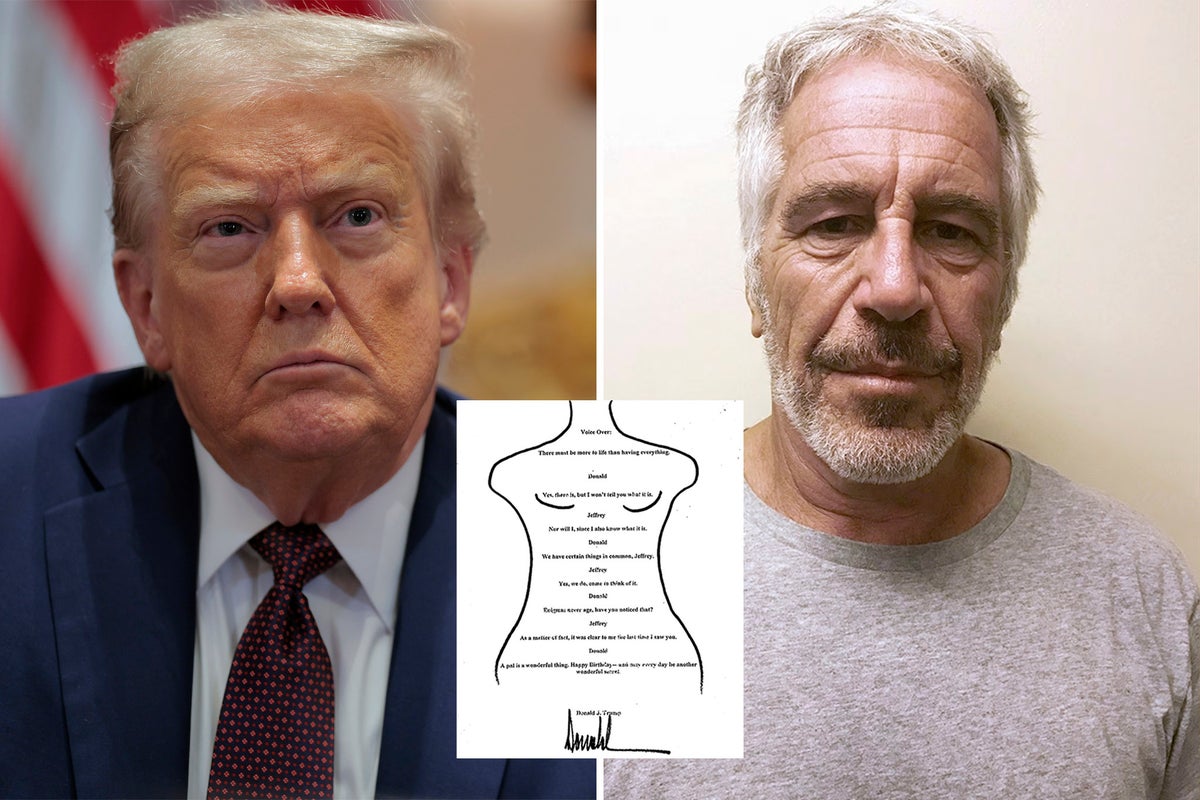
On July 17, 2025, The Wall Street Journal reported that a 2003 album marking the 50th birthday of financier Jeffrey Epstein, who would later be implicated in state and federal sex offenses involving underage girls, included a letter from Donald Trump, a longtime friend.
asserted
who → report → Trump
The very next day, Trump sued the Journal in the U.S. District Court for the Southern District of Florida, saying "the supposed letter is a fake and the Defendants knew it when they chose to deliberately defame President Trump."
asserted
they → sue → Trump
The complaint sought compensatory and punitive damages "not less than $10 billion."
asserted
complaint → seek → damages
Last April, U.S. District Judge Darrin Gayles dismissed that lawsuit but let Trump try again with an amended complaint.
asserted
Trump → dismiss → complaint
On Saturday, Gayles dismissed the lawsuit again, this time with prejudice.
asserted
Gayles → dismiss → prejudice
In both cases, Gayles concluded that Trump's lawyers had fallen far short of alleging "actual malice," a crucial element of defamation cases involving public figures.
asserted
lawyers → conclude → figures
That abject failure illustrates a persistent pattern in Trump's long history of frivolous lawsuits: As far as Trump is concerned, the point is to punish people for saying things he does not like, as opposed to seeking compensation for a legally cognizable injury.
asserted
he → illustrate → injury
What does "actual malice" mean?
asserted
malice → mean → What
Trump seems to think it means that someone published a false statement "out of hatred and ill-will"—a phrase that appears in both Trump's original complaint against the Journal and in his amended complaint, which he filed on May 27, 2026.
uncertain
he → seem → May
But as Gayles explains in his order, that is not what "actual malice" means.
asserted
malice → explain → what
"To plead actual malice," Gayles notes, quoting a 2018 decision by the U.S. Court of Appeals for the 11th Circuit (which includes Florida), Trump "must allege facts sufficient to give rise to a reasonable inference that the false statement was made with knowledge that it was false or with reckless disregard of whether it was false or not.
asserted
it → plead → disregard
This is a subjective test, focusing on whether the defendant 'actually entertained serious doubts as to the veracity of the published account, or was highly aware that the account was probably false.'
asserted
account → focus → account
The Supreme Court established that standard in the 1964 case New York Times v. Sullivan, saying it was required by the First Amendment.
asserted
it → establish → Amendment
"In these cases," the 11th Circuit noted in 2016, "there is a powerful interest in ensuring that free speech is not unduly burdened by the necessity of defending against expensive yet groundless litigation.
asserted
speech → note → litigation
The actual malice standard "was designed to allow publishers the 'breathing
space' needed to ensure robust reporting on public figures and events," the 11th Circuit explained.
asserted
Circuit → design → figures
"Forcing publishers to defend inappropriate suits through expensive discovery proceedings in all cases would constrict that breathing space in exactly the manner the actual malice standard was intended to prevent.
asserted
standard → force → manner
The costs and efforts required to defend a lawsuit through that stage of litigation could chill free speech nearly as effectively as the absence of the actual malice standard altogether.
uncertain
costs → require → standard
That explains why Gayles, after dismissing Trump's first complaint, rejected his motion for discovery "on issues related to actual malice."
asserted
Gayles → explain → malice
Specifically, Trump was keen to find evidence that might illuminate the defendants' "state of mind," which was sorely lacking in his original complaint.
uncertain
which → find → complaint
"President Trump's request to conduct discovery on issues related to actual malice before filing a well-pleaded complaint contravenes the purpose behind the actual malice standard," Gayles wrote.
asserted
Gayles → conduct → standard
Denied a license for that fishing expedition, Trump's lawyers tried again to file "a well-pleaded complaint," meaning their allegations, if true, would be sufficient to infer actual malice.
asserted
allegations → deny → malice
But according to Gayles, they did not do any better this time around.
uncertain
they → accord → Gayles
"President Trump's conclusory allegations that Defendants acted with malice because they 'knew or should have known' the statements in the Article were false are insufficient to state a claim," he writes.
uncertain
he → act → claim
The amended complaint "appears to allege that by choosing to publish the Article despite President Trump's and his team's denials, Defendants acted with actual malice," Gayles says.
asserted
Gayles → amend → malice
"In effect, President Trump argues that once he declared the Letter a 'fake,' Defendants should have disregarded everything else they learned in their investigation and not published the story.
asserted
they → argue → story
But that is not what the actual malice standard requires and runs afoul of the First Amendment.
asserted
standard → require → Amendment
Indeed, were that the law, any time a public figure or his team denies an accusation, journalists would be immediately blocked from publishing negative or contradictory press.
asserted
journalists → deny → press
Trump argued that the Journal's investigation was inadequate.
asserted
investigation → argue → ?
"A failure to investigate, without more, does not establish actual malice," Gayles notes.
asserted
Gayles → investigate → malice
"Rather, 'a plaintiff must show the defendant deliberately avoided investigating the veracity of the statement in order to evade learning the truth.'
asserted
defendant → show → truth
The Amended Complaint comes nowhere close to this standard.
asserted
Complaint → come → standard
In fact, the Journal's article "details a thoughtful and detailed investigation," Gayles writes.
asserted
Gayles → detail → investigation
"Before running the story, Defendants contacted President Trump and his team, Justice Department officials, and the FBI for comment.
asserted
Defendants → run → comment
President Trump and his team responded with his denial [which was quoted in the article], the Justice Department did not respond at all, and the FBI declined to comment."
Journal reporters Khadeeja Safdar and Joseph Palazzolo tried to interview Ghislane Maxwell, the Epstein associate who solicited the messages for his birthday album, but she did not respond, and "her attorney stated that she was focused on her case before the Supreme Court" involving her federal sex trafficking conviction.
asserted
she → respond → conviction
In a July 2025 interview with the Justice Department, according to Trump's lawyers, Maxwell said "she did not remember President Trump submitting a letter for Epstein's 50th Birthday."
uncertain
Trump → accord → Birthday
Judging from that statement, Gayles says, "Maxwell had little to offer to Defendants' investigation."
asserted
Maxwell → judge → investigation
Safdar and Palazzolo also "reached out to other individuals named in the Birthday
Book, including Leslie Wexner and Alan Dershowitz, and to individuals involved in binding the Birthday Book
asserted
Safdar → reach → Book
," Gayles notes.
asserted
Gayles → note → ?
"In short, President Trump's allegation that Defendants failed to conduct an adequate investigation is rebutted by the Article
and is insufficient to establish actual malice."
asserted
Defendants → fail → malice
The amended complaint "attempts to manufacture flaws" in the Journal's investigation, Gayles says, describing those efforts as "grasping at straws."
asserted
Gayles → amend → straws
…and 17 more, not listed.
 The Aporia