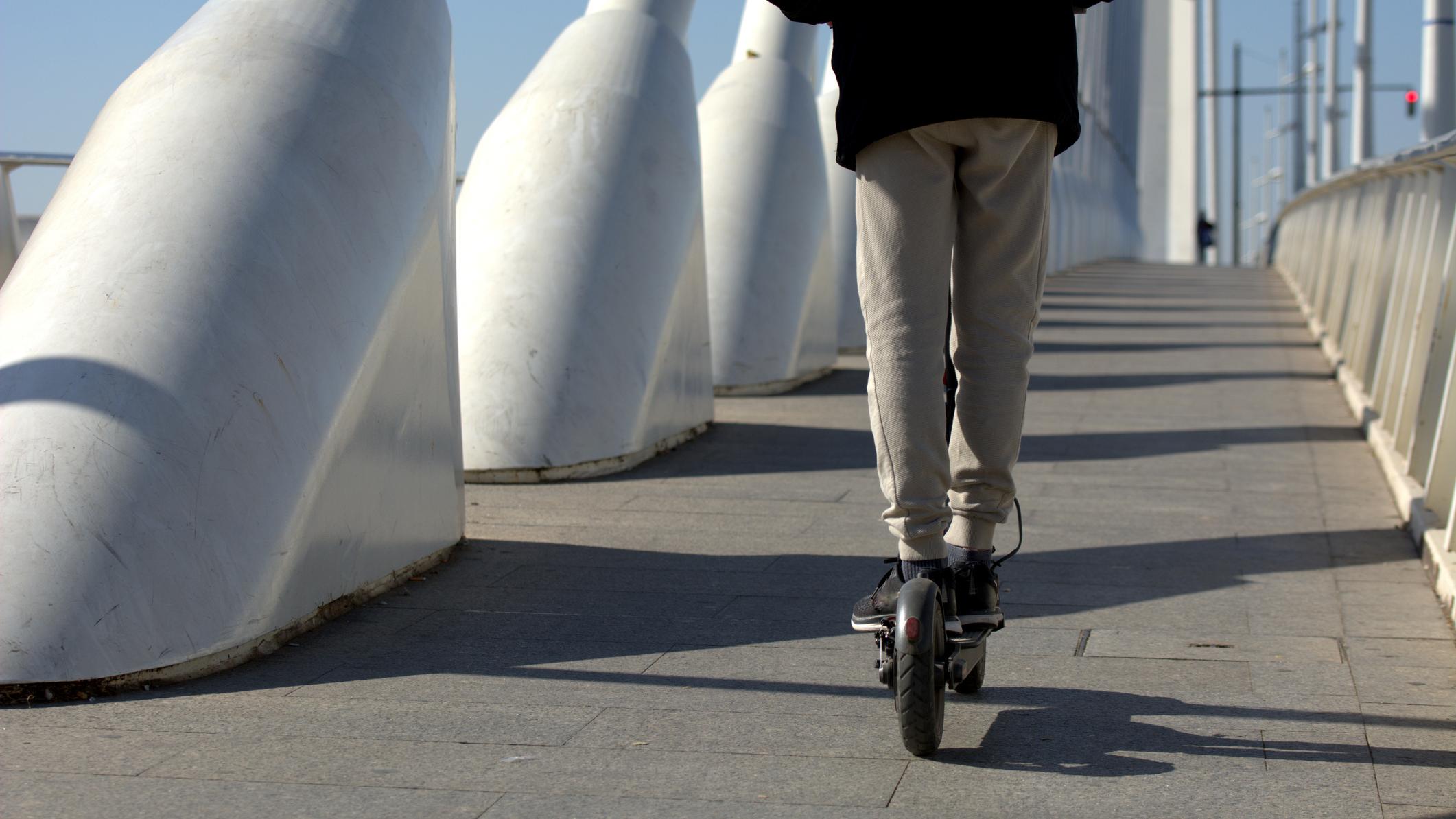
Recently, Dr. Alan Schroeder was walking on the street in New York City when he felt a breeze out of nowhere.
asserted
he → walk → breeze
“I literally was about four inches away from someone on an e-bike, probably going 30 miles an hour, that I didn't see,” he recalls.
asserted
he → go → that
If he’d been hit, the injuries could have been severe, as Schroeder, who is a pediatrician and research scientist at Lucile Packard Children’s Hospital Stanford, well knows.
uncertain
who → hit → Hospital
More children are getting hurt or even dying in crashes involving electric devices like e-bikes and e-scooters.
asserted
children → hurt → bikes
On Nov. 2, Schroeder and his colleagues published a paper in JAMA looking at kids who ended up in a subset of emergency rooms, hospitals, and urgent care centers across the U.S. after accidents on e-bikes, e-scooters, skateboards, and traditional, non-motorized bicycles and scooters.
asserted
who → publish → bikes
They drew on data from 2023 to 2026.
asserted
They → draw → 2026
Injuries from e-bikes showed a roughly 400% relative increase during the study period, and e-scooter injuries rose almost 200%.
asserted
injuries → show → period
The team also found that severe injuries—the kind that need surgery or time in the intensive care unit—were about twice as likely when a powered vehicle like an e-bike or e-scooter was involved, compared to regular bikes and scooters.
asserted
vehicle → find → bikes
The numbers are only growing.
asserted
numbers → grow → ?
“This is just an exponential rise in the frequency of these injuries,” says Dr. Stephanie Chao, a pediatric trauma surgeon at Lucile Packard Children’s Hospital Stanford and an author of the new paper, who says she’s worked on “some pretty devastating operations” in children after e-device accidents.
asserted
she → say → accidents
The researchers hope their study can provide evidence for policies to rein in e-device usage by children—for instance, by making certain types illegal for kids to use, with charges to be filed against both children and their parents if kids are caught operating them.
asserted
kids → hope → them
Similar to a kick scooter, e-scooters are stand-up, two-wheeled devices that have a powered front wheel operated by a throttle.
asserted
that → stand → throttle
E-bikes in the U.S. are classified as bicycles with working pedals that have a battery-powered assist, enabling riders to go up hills and achieve greater speeds with less effort.
asserted
that → classify → effort
Some have hand-operated throttles so that a rider doesn’t even need to use the pedals.
asserted
rider → have → pedals
Laws about e-bikes vary by state, with some mandating that the fastest class of e-bikes, which top out at 28 m.p.h., can only be operated by those 16 years old and up, but you don’t need a license or training.
asserted
you → vary → license
In some states, wearing a helmet is legally required, but not in others.
What many people don’t realize, however, is that what people often call “e-bikes” are in fact e-motos, says Dr. Preeti Panda, a pediatric emergency room doctor at Lucile Packard Children’s Hospital Stanford who was not involved in the study but has seen firsthand the rise in cases.
asserted
who → wear → cases
She says she sees at least one e-device injury every shift she works.
asserted
she → say → injury
E-motos, also called electric motorcycles or electric dirt bikes, may be capable of speeds exceeding 60 m.p.h.
uncertain
motos → call → m.p.h
Regulation is patchy so far, but in California, if these are intended for use on public roads and not just private property, these are classed as motorcycles—meaning that they must be registered and equipped with a license plate, riders must be licensed to drive them and purchase motor vehicle insurance, and people under 16 are not able to get licenses.
asserted
people → intend → licenses
When Panda asks her young patients in the emergency room how fast their e-bikes go, though, she gets answers like 35-45 m.p.h., and even higher.
asserted
she → ask → .
In California and in many states now, e-motos are actually illegal to ride on the street” for children who don’t meet the above criteria, she says.
asserted
she → ride → criteria
“If a child injures someone else or destroys property accidentally on one of these devices that are illegal, both the child and the parents can be held liable and charged criminally.
asserted
child → injure → devices
As part of her own research to understand exactly what electric devices kids are using these days, Panda tours local high school parking lots on what she calls “bicycle counts,” marking down what’s on the bike racks.
asserted
what → understand → racks
E-motos tend to “have that banana seat that motorcycles have,” Panda says, while e-bikes usually do not.
asserted
bikes → tend → that
“I was out at a few bicycle counts last week,” she continues, “and 80-90% of the e-devices were all e-motos…
asserted
% → continue → devices
I saw very few e-bikes.”
asserted
I → see → bikes
Legislation and enforcement that takes these vehicles off public roads and out of the hands of younger children, she suggests, could be a substantial public-health boon.
uncertain
she → take → children
E-bikes and scooters are particularly dangerous for this age group because often, children lack the strength and coordination to pilot these vehicles safely, and sometimes they don’t wear helmets.
asserted
they → lack → helmets
And it’s not just teens who are using them.
asserted
who → ’ → them
“A significant proportion of these injuries are actually in kids younger than the age of 12,” says Chao—a detail from the new study that surprised even the researchers.
asserted
that → say → researchers
“A lot of times we think, ‘Oh, this is an older, teenage-type thing,’ but it's not.
asserted
it → think → times
You're talking about really young middle-school children who really don't have frontal lobe development to be on these really fast motorized vehicles.”
asserted
who → talk → vehicles
The amount of time required to stop an e-bike, e-scooter, or e-moto is much longer than what’s required to bring a regular bike or scooter to a halt, so any experience children have on traditional devices—like regular bikes and scooters—is unlikely to translate to the electric versions.
asserted
children → require → versions
The injuries doctors are seeing are largely a result of that speed.
asserted
doctors → see → speed
“You're not just falling off a bike and maybe breaking an arm.
asserted
You → fall → arm
What we're talking about is potentially serious life-threatening injuries now, serious brain injuries” says Chao.
asserted
Chao → talk → What
“We're talking about middle-school kids whose parents have bought them these bikes.”
asserted
parents → talk → bikes
What should be done?
asserted
What → do → ?
Banning e-bikes and e-scooters outright is likely unrealistic, but there’s plenty of room for common-sense limits, the researchers say.
asserted
researchers → ban → limits
First, consistent, well-enforced age limits might be an effective option.
uncertain
limits → enforce → ?
…and 6 more, not listed.
 The Aporia