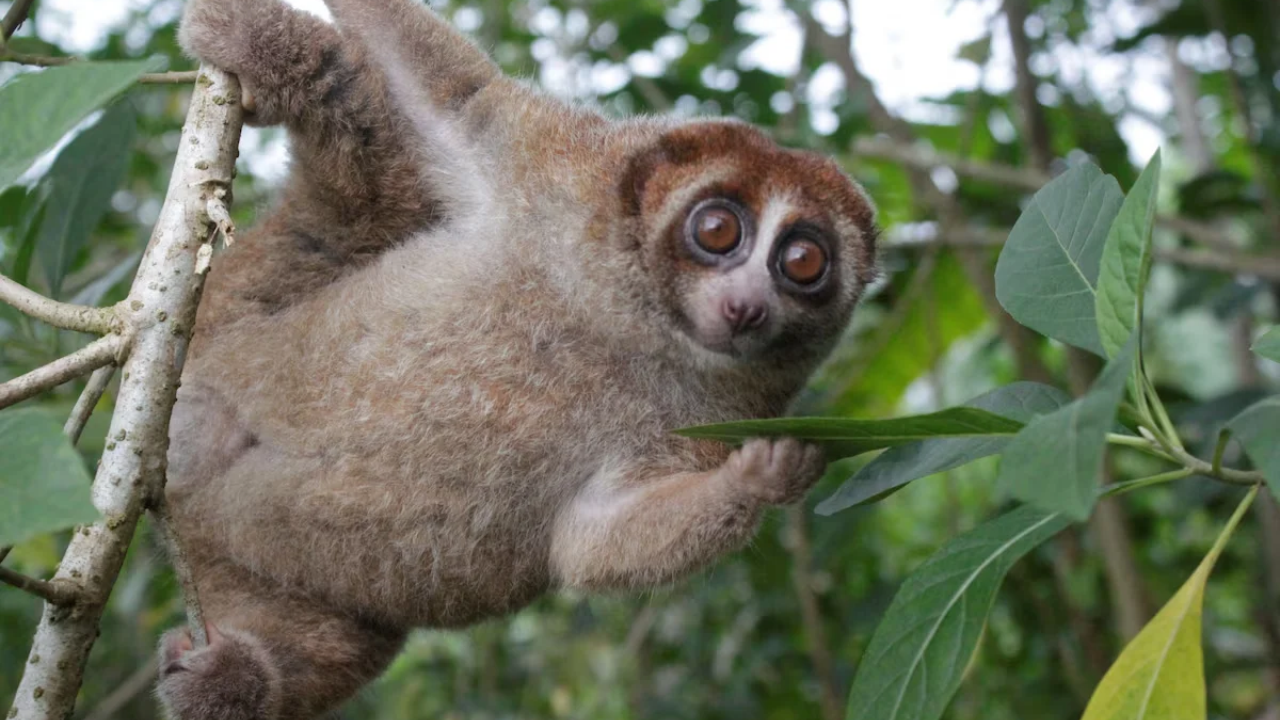
Photo via Times of India

Bangka Slow Loris Rediscovered: Rescues reveal more than 90 venomous primates; habitat loss still threatens

Read the original at Times of India ↗
Cite

TOI Science Desk. (2026, November 2). Bangka Slow Loris Rediscovered: Rescues reveal more than 90 venomous primates; habitat loss still threatens. Times of India. https://timesofindia.indiatimes.com/science/wildlife/a-slow-loris-feared-possibly-extinct-had-not-been-documented-since-the-1930s-researchers-have-now-identified-more-than-90-individuals-in-indonesia-and-86-have-been-rehabilitated-and-released/articleshow/135098143.cms

Dated from the outlet's own feed. Check the original for its byline.

Times of India · collected 2026-11-02 · by TOI Science Desk analysis

Quick Summary

A recent study published in Spixiana reveals that over 90 Bangka slow lorises (Nycticebus bancanus) have been rescued between 2015 and 2025 on the Indonesian island of Bangka. The Alobi Wildlife Rescue Center, along with conservation group Re:wild, documented these findings, which confirm the survival of a species previously feared extinct since scientific records from the early 1930s. Despite this encouraging news, habitat loss continues to threaten the primate's existence.
Written by AI on 2026-11-02, from this article's own text only (the story summary below draws on all the coverage).

AI analysis

Story summary

As of November 2, 2026, Reuters reported that a new study published in the journal Spixiana has identified more than 90 Bangka slow lorises between 2015 and 2025. This discovery marks a significant resurgence for the species, which was last documented scientifically from around 1930 to 1932, making it one of Indonesia’s rarest primates. Found on the island of Bangka off Sumatra's southeastern coast, these nocturnal creatures were thought to have possibly gone extinct due to a lack of recent scientific records and continued habitat loss.

The study highlights that while the rediscovery offers hope for conservation efforts, the Bangka slow loris remains endangered because its forest habitats continue to face significant threats. The Alobi Wildlife Rescue Center and conservation group Re:wild have been instrumental in these rescue operations, emphasizing the need for ongoing protection measures despite this positive finding.

Written for “Bangka Slow Loris Rediscovered” on 2026-11-03, grounded in this article and the 0 other(s) covering the same event.
Why this leaning score
This article does not take a side on a contested political question, so it has no leaning score. That is an answer rather than a gap: a match report or a rescue can be warmly or critically written without being left or right, and scoring it anyway is how approval of a subject gets recorded as a political position.
No political leaning scored for article 124049 · logged 2026-11-02

Story

📰 Bangka Slow Loris Rediscovered
Environment · 1 article(s) covering the same event.

Compared with similar articles

Nothing to compare against. No article is close enough to this one for the pipeline to have linked or judged the pair.
How this article was measured signals, leaning charts, publisher record, byline, topics and claims

Signals How these are calculated →

Claims extracted
32
sentences that state something as happening or true
Uncertain
6%
2 of 32 hedged ("reportedly", "may", "according to")
Leaning
not political
takes no side on a contested political question
Publisher signals
59/100
Times of India's corrections and hedging, across everything collected from it. Not a measure of accuracy.
Outlets on this story
1
Environment
Same framing elsewhere
1
articles that frame the event the way this one does
Analyzed 2026-11-02 · how these are computed

How this is being covered How these are calculated →

Article leaning vs. publisher reliability
Source leaning vs. consistency

Publisher

Times of India · 3982 article(s) · 3 correction(s) detected
Running correction rate · 3 correction(s)

Who wrote this

TOI Science Desk
307 article(s) here · 1 carrying a prediction
🔮 According to Reuters reporting by Will Dunham, a new study published in the journal Spixiana documents more than 90 Bangka slow lorises identified between 2015 and 2025.
🔮 “Normally, my job is quite monotonous, so I wanted to create something that would entertain people, turning my ‘serious’ job into something fun,” he said in a Guinness World Records news release.
🔮 The subsequent collision between the two galaxy clusters may then have compressed the cloud or re-energised its particles, causing it to shine more brightly in radio wavelengths once again.
🔮 The mathematicians at the University of California, Davis, argue that the answer may already lie within Einstein’s own equations and that an invisible form of energy may not be needed at all.
🔮 The work will be carried out by the West Tennessee River Basin Authority, which is preparing a plan to restore the river and the land around it.
🔮 Cornell University scientists have developed genetically engineered tomato plants that turn red-purple when nitrogen becomes scarce, giving farmers a visible warning that crops may need fertiliser.
🔮 By studying these crystals and other mineral grains, scientists could establish the meteorite's age and identify later changes caused by water.
🔮 Centuries later, bronze objects found in Scandinavia would preserve chemical signatures consistent with the metals produced at this Spanish site, offering evidence of connections that may have crossed much of Europe.
🔮 Deposited impurities and staining may also have contributed, while low temperatures and humidity could cause the fabric to crack.
🔮 Two male king cobras meeting during the breeding season may engage in a prolonged contest, using their bodies to wrestle for control rather than relying on the venomous strikes associated with these snakes.
Wire or desk byline, not an individual reporter.
Also by TOI Science Desk
Nothing else under this byline is closely related to this article, so these are simply their most recent.
All 307 articles by TOI Science Desk →

Topics

Indonesia Reuters Spixiana the Alobi Wildlife Rescue Center wild

Subjects

the Alobi Wildlife Rescue Center ORG · 2× wild ORG · 2× Bangka NORP · 1× Indonesia GPE · 1× Indonesian NORP · 1× Reuters ORG · 1× Spixiana ORG · 1× Sumatra GPE · 1× Will Dunham PERSON · 1× the International Union for Conservation of Nature ORG · 1×

Narrative

Rediscovery brings hope, but not a guarantee The return of the Bangka slow loris to scientific attention highlights an important distinction in conservation: a species that has gone undocumented is not necessarily extinct, but rediscovery does not mean it is safe from extinction.
framing: assertive · carried by 1 article(s) · first seen 2026-11-02
🔮 According to Reuters reporting by Will Dunham, a new study published in the journal Spixiana documents more than 90 Bangka slow lorises identified between 2015 and 2025.

Claims (32 extracted, 2 hedged)

For decades, one of Indonesia’s rarest primates survived largely beyond the view of scientists. asserted
one → survive → scientists
Now, a series of wildlife rescues on the island of Bangka has brought the elusive animal back into focus, offering fresh hope for a species once feared to have disappeared entirely. asserted
series → bring → species
According to Reuters reporting by Will Dunham, a new study published in the journal Spixiana documents more than 90 Bangka slow lorises identified between 2015 and 2025. uncertain
study → accord → 2015
The findings, also highlighted by the Alobi Wildlife Rescue Center and conservation group Re:wild, suggest that the little-known primate has survived despite decades without reliable scientific records and continuing pressure on its habitat. asserted
primate → highlight → habitat
A rare primate emerges from decades of uncertainty The Bangka slow loris, scientifically known as Nycticebus bancanus, lives on Bangka, an Indonesian island off the southeastern coast of Sumatra. asserted
loris → emerge → Sumatra
Small, nocturnal and adapted to life in trees, it has reddish-brown fur, distinctive facial markings and large eyes that help it navigate the forest after dark. asserted
it → adapt → dark
The species was last documented in historical scientific records from around 1930 to 1932. asserted
species → document → 1932
With little reliable information available for decades, its continued existence became uncertain. asserted
existence → continue → decades
In 2020, the International Union for Conservation of Nature classified the Bangka slow loris as Critically Endangered and possibly extinct. uncertain
Union → classify → loris
Conservation organisation Re:wild also included it among its lost primates, species that had not been reliably documented for an extended period. asserted
that → include → period
The recent findings change that picture. asserted
findings → change → picture
Between 2015 and 2025, the Alobi Wildlife Rescue Center encountered more than 90 individuals from different locations across Bangka, indicating that the species has persisted in multiple parts of the island. asserted
species → encounter → island
The discoveries do not establish the total population or prove that the species is secure. asserted
species → establish → population
They do, however, provide researchers with a starting point for understanding where the animals survive and what protection they need. asserted
they → provide → protection
How wildlife rescues helped bring the species to light Many of the slow lorises were discovered after being found in houses, gardens, plantations or near roads. asserted
Many → bring → roads
Some had suffered serious injuries, including damage caused by electrical wires. asserted
Some → suffer → wires
The rescue centre documented the animals while providing care, helping researchers gather information about a species that has received remarkably little scientific attention. asserted
that → document → attention
Of the more than 90 individuals identified, 86 recovered sufficiently to be released into suitable natural habitats. asserted
86 → identify → habitats
The releases represent an important conservation milestone, but they are only one part of the effort needed to protect the species. asserted
they → represent → species
Without reliable information about population size, distribution and breeding, researchers cannot yet determine how well the remaining population is faring in the wild. asserted
population → determine → wild
The new study also illustrates the role rescue organisations can play in documenting threatened wildlife, particularly when animals are encountered outside protected forests. asserted
animals → illustrate → forests
A venomous primate facing habitat loss Slow lorises are unusual among mammals because they produce venom. asserted
they → face → venom
Specialised glands near their elbows release a secretion that the animals combine with saliva before delivering it through a bite. asserted
animals → release → bite
The venom can cause severe allergic reactions in humans and is believed to play a role in conflicts between lorises, as well as defence against potential threats. asserted
venom → cause → threats
On Bangka, tin mining and the expansion of oil palm plantations have reduced natural forest cover, threatening the places where the primates feed, shelter and move through the trees. asserted
primates → reduce → trees
Their slow, cautious movements and nocturnal habits can also make them difficult to study in dense forest, contributing to gaps in scientific knowledge. asserted
them → make → knowledge
Protecting the remaining woodland is therefore central to the species’ future. asserted
Protecting → protect → future
Researchers say systematic field surveys are needed to establish how many Bangka slow lorises remain, identify the areas where they persist and assess the condition of their habitats. asserted
they → say → habitats
Rediscovery brings hope, but not a guarantee The return of the Bangka slow loris to scientific attention highlights an important distinction in conservation: a species that has gone undocumented is not necessarily extinct, but rediscovery does not mean it is safe from extinction. asserted
it → bring → extinction
The latest findings offer an opportunity to move beyond rescue and release towards a more comprehensive conservation strategy, combining habitat protection, population surveys and continued monitoring. asserted
findings → offer → protection
For a primate that remained scientifically elusive for nearly a century, finding more than 90 individuals is a significant step. asserted
finding → remain → individuals
Whether that discovery leads to lasting recovery will depend on protecting the forests they inhabit and ensuring that the animals can survive there for generations to come. asserted
animals → lead → generations

💬Give feedback
🕘History 🎫Support