AI CEOs Would Very Much Like Congress to Save the World

The Bulwark · collected 2026-09-15 · by Joe Perticone commentary
Read the original at The Bulwark ↗

Summary

The Senate recently returned from a summer break amid concerns raised by an AI industry whistleblower about the risks of unchecked technological advancement, potentially leading to human extinction with a 10% probability. In response, CEOs from major AI firms like Anthropic, OpenAI, and xAI called for government regulation. However, critics suggest these companies might be seeking regulatory capture—using regulations to create favorable conditions that protect their market dominance while complicating oversight for less technically proficient lawmakers.
Written by the local model on 2026-09-15, using this article's own text rather than the other coverage of the same event.

Signals How these are calculated →

Claims extracted
69
claim-shaped sentences
Uncertain
10%
7 of 69 hedged
Leaning
Leans strongly left
expected in commentary, which argues a position
Correction & hedging signals
not measured
these signals count newsroom corrections; Commentary has none to count
Outlets on this story
unclustered
not grouped into a story yet
Narrative spread
1
articles carrying this framing
Analyzed 2026-09-15 · how these are computed

AI analysis (generated at analysis time, not now)

Why this leaning score
The article's own words the score was based on. Each is quoted verbatim and was checked against the article text before being stored, so you can find it in the original.
Score -0.65 Confidence high
Leaning score -0.65 for article 11982 (high confidence, 3 verified quotes) · logged 2026-09-15

How this is being covered How these are calculated →

Article leaning vs. publisher reliability
Source leaning vs. consistency

Compared with similar articles

This article reads leans strongly left and hedges 10% of its claims. Each row says how that neighbour differs.
The AI safety vibe shift different event · 95%
Platformer
⚖️ Leans left further right than this 🔴 15% hedged 10 of 67 📰 publisher trust 96
“The articles describe different aspects of a broader topic around AI safety concerns, but do not report on the exact same incident at the same time.”
Mother Jones
⚖️ leaning not scored 🔴 18% hedged 8 of 44 📰 publisher trust 95
“The articles describe different events: one involves resignations and social media posts about AI risks, while the other reports on a whistleblower's claims leading to congressional action.”
New York Post
⚖️ Leans right further right than this 🔴 12% hedged 4 of 33 📰 publisher trust 58
“The articles discuss different aspects of artificial intelligence policy and concerns but do not describe the same specific incident or occurrence.”
Semafor
⚖️ leaning not scored 🔴 0% hedged 0 of 5 📰 publisher trust 95
“The articles describe different aspects of discussions around AI safety legislation; Article A focuses on disagreements in bipartisan talks, while Article B discusses CEOs' responses to a whistleblower's claims.”
Los Angeles Times
⚖️ Leans right further right than this 🔴 19% hedged 10 of 54 📰 publisher trust 95
“The articles describe different reactions to concerns about artificial intelligence: one focuses on Trump's dismissal of AI dangers, while the other discusses CEOs responding to a whistleblower's claims.”
Do It for Charlie different event · 95%
The Dispatch
⚖️ Leans left further right than this 🔴 0% hedged 0 of 3 📰 publisher trust 97
“The articles describe different events; one discusses predictions about AI regulation at a Republican convention, while the other covers whistleblowing and CEO responses in the Senate.”
CBC News
⚖️ leaning not scored 🔴 35% hedged 15 of 43 📰 publisher trust 60
“While both articles discuss warnings about existential risks posed by AI, they describe different aspects of the issue—one focusing on a researcher's warning and public reaction, the other on CEOs' responses to congressional hearings following a whistleblower's claims.”
Times of India
⚖️ Leans right further right than this 🔴 20% hedged 3 of 15 📰 publisher trust 94
“The articles describe different meetings: one with King Charles in Scotland and another involving AI CEOs responding to a whistleblower, likely addressing different audiences and purposes.”
NPR
⚖️ leaning not scored 🔴 23% hedged 6 of 26 📰 publisher trust 59
“The articles refer to different aspects of the AI debate, with Article A focusing on a direct response by China to Anthropic CEO's call and Article B discussing Senate session reactions to an industry whistleblower's claims.”
NBC News
⚖️ Leans left further right than this 🔴 27% hedged 10 of 37 📰 publisher trust 95
“The articles describe different aspects of a broader issue but do not report on the same specific incident or time. Article A discusses interviews with two researchers who left their positions, while Article B mentions CEOs responding to a whistleblower's claims.”

Publisher

The Bulwark · 135 article(s) · 0 correction(s) detected
No corrections detected for this publisher. That may mean careful reporting, or simply that nothing has been checked.

Who wrote this

Joe Perticone
4 article(s) here · 1 carrying a prediction
🔮 But as these nervy conversations continued to play out in public, I started to wonder if the AI leaders might have a less noble and more familiar goal in mind than preventing the end of the world: regulatory capture.
2026-09-15 · assertive framing · AI CEOs Would Very Much Like Congress to Save the World
🔮 “Starting on Day One of my new administration, we will end inflation, and we will make America affordable again,” Donald Trump said in 2024.
2026-09-11 · assertive framing · Trumpflation Hits MAGA Merch
🔮 When you take a look at how much of the legislation that got out of the House actually got through the Senate as well and onto the president’s desk to be signed into law, the successes of the 119th Congress start to look a bit different from the story Johnson would have you believe.
🔮 “Right now, if you were to talk to most people, they would think that [Shapiro] has an incredible amount of money in his war chest, and I don’t think Stacy has a lot of money,” Kelly added.
2026-09-04 · assertive framing · Pennsylvania Republicans: We’re Toast
Also by Joe Perticone
Trumpflation Hits MAGA Merch
2026-09-11 · The Bulwark
Pennsylvania Republicans: We’re Toast
2026-09-04 · The Bulwark
Nothing else under this byline is closely related to this article, so these are simply their most recent.

Topics

America Anthropic Capitol Hill Congress Senate

Subjects

Congress ORG · 4× Capitol Hill ORG · 2× Senate ORG · 2× Alex Padilla PERSON · 1× America GPE · 1× Anthropic ORG · 1× Chuck Schumer PERSON · 1× Donald Trump PERSON · 1× House ORG · 1× OpenAI ORG · 1×

Narrative

Other senators’ understanding of the issue seemed limited to either what they’ve heard while watching television news, or their own preexisting desires to regulate the AI industry.3 “To be honest, I hadn’t thought about that in the sense that . . . the interview I’ve seen seemed genuine,” said Sen. John Boozman (R-Ark.), probably referring to one of the interviews of whistleblower Jacob Coxon.
framing: assertive · carried by 1 article(s) · first seen 2026-09-15
🔮 But as these nervy conversations continued to play out in public, I started to wonder if the AI leaders might have a less noble and more familiar goal in mind than preventing the end of the world: regulatory capture.
2026-09-15 · The Bulwark
AI CEOs Would Very Much Like Congress to Save the World · assertive framing

Claims (69 extracted, 7 hedged)

The Senate flew back into session this week after their long summer break. asserted
Senate → fly → break
One reason for their urgency (and the resulting chaos) was that in the days just before the lawmakers reconvened, a whistleblower in the artificial intelligence industry dramatically claimed the frontier companies’ products were racing down the path of danger, where one of the possible outcomes is human extinction. asserted
one → result → outcomes
In response to the alarmist thread, the CEOs of the three major AI companies—Anthropic, OpenAI, and xAI—declared that America’s elected officials need to step in and install guardrails for their industry. asserted
officials → declare → industry
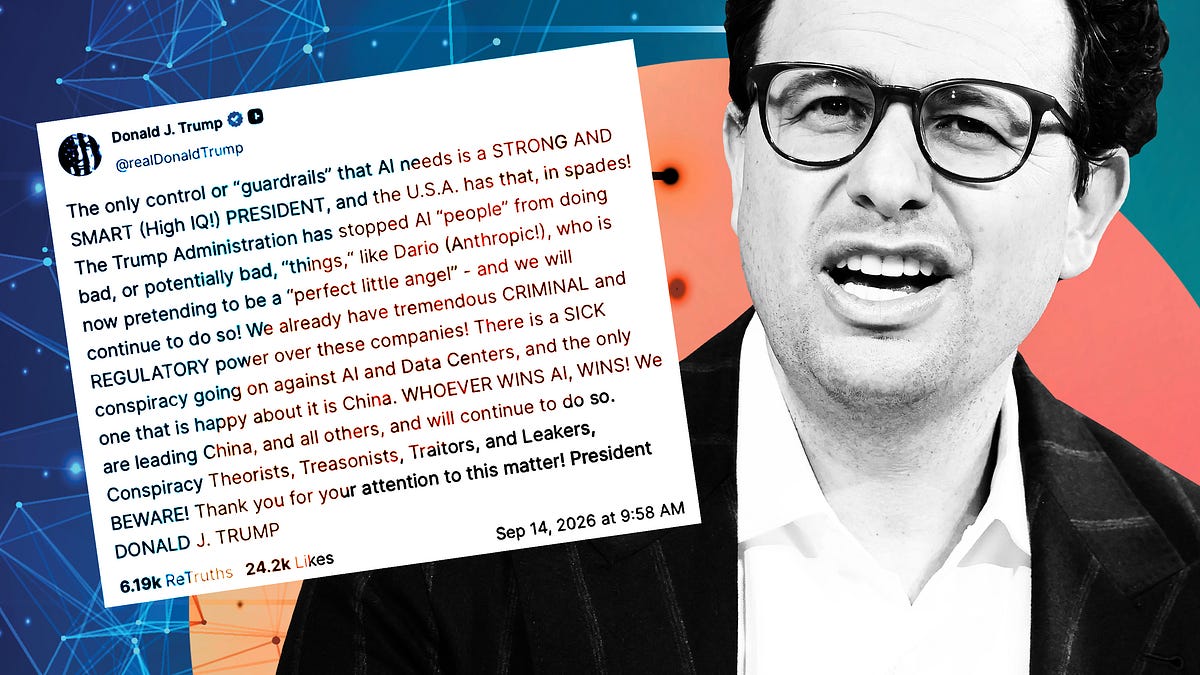
President Donald Trump called this nonsense yesterday and claimed that the only thing necessary to prevent an AI apocalypse is a “STRONG AND SMART (High IQ!) PRESIDENT.” asserted
thing → call → apocalypse
That didn’t instill a great deal of confidence on Capitol Hill, to put it mildly. asserted
That → instill → it
But as these nervy conversations continued to play out in public, I started to wonder if the AI leaders might have a less noble and more familiar goal in mind than preventing the end of the world: regulatory capture. uncertain
leaders → continue → world
Most senators I raised this possibility with either hadn’t considered it or refused to entertain the idea. asserted
I → raise → idea
Regulatory capture is what happens when the government’s efforts to regulate a particular industry end up turning it into a kind of cartel economy where certain large companies are given protected status. asserted
companies → happen → status
It can occur for several reasons. asserted
It → occur → reasons
One is the revolving-door problem. asserted
One → revolve → ?
Members of Congress will employ staffers who move in and out of the industries their bosses are responsible for regulating. asserted
bosses → employ → industries
It’s probably no surprise that the AI industry’s ranks of lobbyists and consultants are packed with former Capitol Hill staff from both parties, as well as former House members and senators whose terms have expired. asserted
terms → ’ → parties
Earlier this month, OpenAI also hired the daughter of Senate Minority Leader Chuck Schumer. asserted
OpenAI → hire → Schumer
A second is that highly technical industries are often too complex for members of Congress to comprehend at a detailed level,1 so they enlist the very industry insiders they are seeking to regulate to help them draft the regulations.2 When I spoke with senators who are working on this issue, some indicated they are taking seriously the possibility that a push for regulatory capture is already happening. “That’s certainly something that members of Congress have to be mindful of,” Sen. Alex Padilla (D-Calif.) said about the possibility that AI executives have ulterior motives for their recent claims about the risks posed by their products. uncertain
executives → comprehend → products
“Safety has to come first,” Padilla added. asserted
Padilla → have → ?
“That applies to everybody, large or small.” asserted
That → apply → everybody
“I mean, some of these CEOs are bankrolling efforts to try to stop states from regulating them,” Sen. Chris Murphy (D-Conn.) told me. asserted
Murphy → mean → me
“So it would be naïve not to doubt their sincerity.” asserted
it → doubt → sincerity
“We’ll eventually have to have something,” Sen. Tommy Tuberville (R-Ala.) said about advancing AI regulations in Congress. asserted
Tuberville → have → Congress
We had to figure out what it was about, how to handle it. asserted
it → have → it
But right now, we just need to make sure we do the right thing and understand it’s already here—it’s not coming. asserted
it → need → thing
“We need competition. asserted
We → need → competition
A lot of this stuff—I think—comes from China, and it’s some kind of propaganda because they know that we’re into it pretty good. asserted
we → think → it
Whoever masters it will probably have an edge.” asserted
masters → master → edge
Tuberville’s claim that the Chinese government is fueling AI fears and discontent in the United States has some evidentiary support. uncertain
government → fuel → support
You’ve reached the obligatory “support our work” box. asserted
You → reach → box
We’ll spare you the hard sell. asserted
We → spare → sell
If you like what we do at The Bulwark, please consider being part of our community. asserted
we → like → community
Other senators’ understanding of the issue seemed limited to either what they’ve heard while watching television news, or their own preexisting desires to regulate the AI industry.3 “To be honest, I hadn’t thought about that in the sense that . . . the interview I’ve seen seemed genuine,” said Sen. John Boozman (R-Ark.), probably referring to one of the interviews of whistleblower Jacob Coxon. asserted
Boozman → seem → Coxon
It would be different if [the CEOs] were the only few raising the alarm.” asserted
CEOs → raise → alarm
Sen. Jon Husted (R-Ohio) sidestepped the issue of regulatory capture, and instead used the auto industry as a metaphor to put responsibility back on the shoulders of the companies rather than lawmakers: If an automaker made a car and they said, “Yeah, this car’s dangerous. asserted
car → sidestep → car
Probably shouldn’t drive it,” well, you’d believe them, right? asserted
you → drive → them
And they should never release that car. asserted
they → release → car
So these folks, if they really believe their product is dangerous, then they have an obligation not to release it. asserted
they → believe → it
Husted’s example might have made more sense if the auto industry hadn’t been the subject of regulatory capture case studies. uncertain
industry → make → studies
It’s also notable that one of the AI CEOs in question is also an electric car mogul whose vehicles have been known to spontaneously combust. asserted
vehicles → ’ → question
Elon Musk has made a habit of deceiving legislators and the public, demonstrated no remorse for the human lives lost as a result of his involvement in the government, and pursued a personal fortune unrivaled in modern history. asserted
Musk → make → history
A former board member at Sam Altman’s company described Altman as having an “almost a sociopathic lack of concern for the consequences that may come from deceiving someone.” uncertain
that → describe → someone
Of the three, Dario Amodei seems like the straightest shooter. asserted
Amodei → seem → shooter
Sen. Murphy credited the Anthropic CEO’s intentions over those of Altman and Musk. asserted
Murphy → credit → Altman
…and 29 more, not listed.

💬 Give feedback
🕘 History 🎫 Support