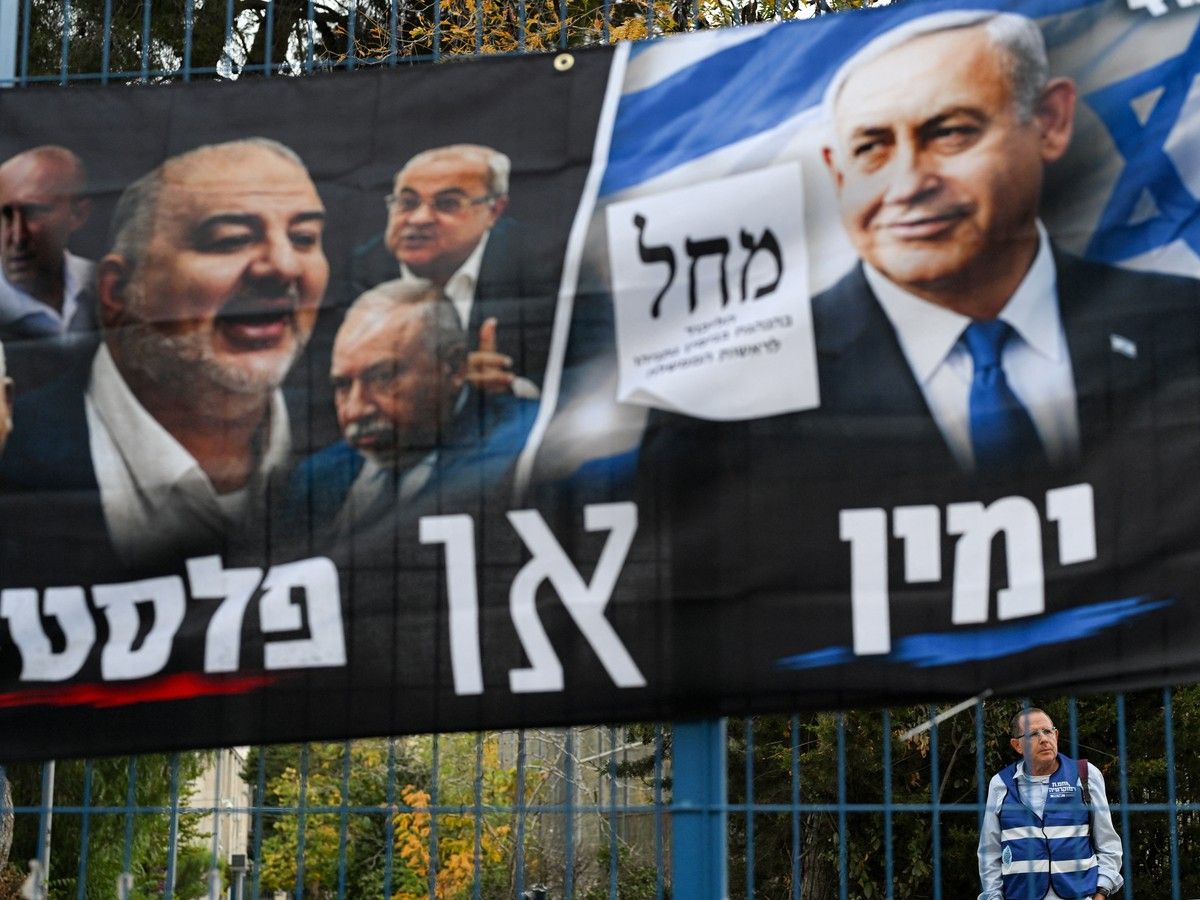
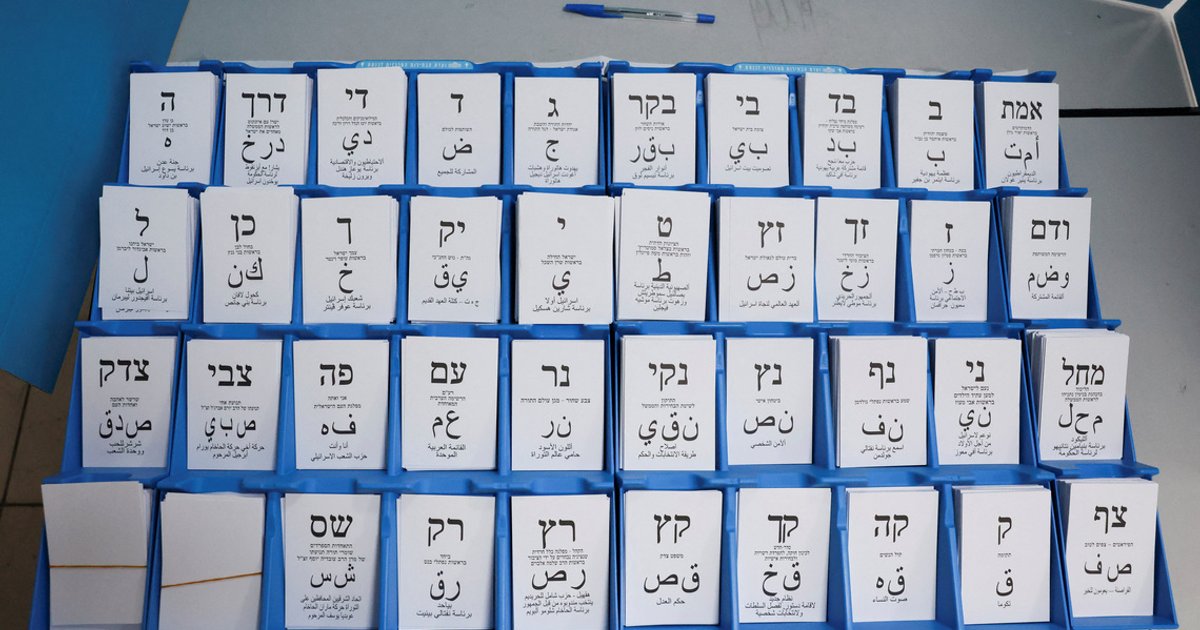
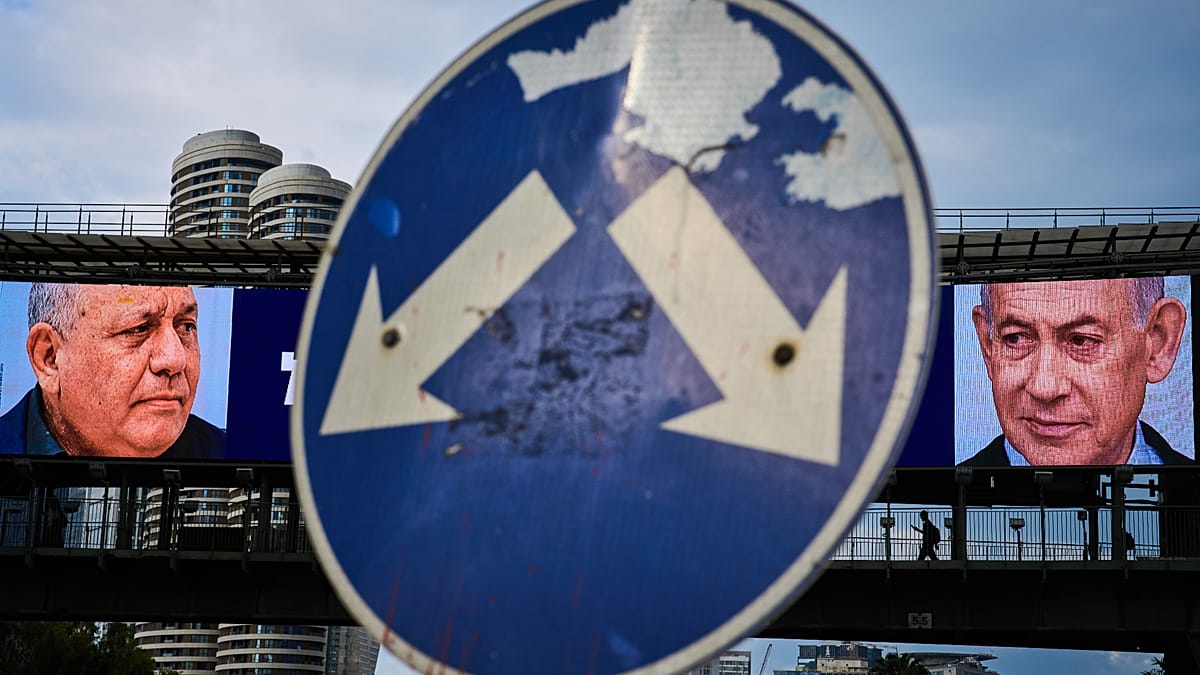
Israel’s parliament remains in deadlock.
asserted
parliament → remain → deadlock
After one of the highest voter turnouts in decades, neither Prime Minister Benjamin Netanyahu’s coalition nor the self-styled Zionist opposition alliance secured the 61 seats required for a parliamentary majority in the October 27 polls.
asserted
coalition → style → polls
Recommended Stories
list of 4 items- list 1 of 4Israel election result shows no overall majority as vote count complete
- list 2 of 4‘Arab voice doesn’t count’: Jewish Israeli blocs reject Palestinian support
- list 3 of 4Coalition wrangling, a second election: How Israel could break the deadlock
- list 4 of 4Why is Netanyahu accusing Palestinian Israeli parties of fraud?
uncertain
Netanyahu → show → fraud
Netanyahu’s camp came first, with 53 seats, five more than the main opposition bloc.
asserted
camp → come → bloc
The Arab parties surged to a record 19 seats but have been relegated to merely observing coalition negotiations.
asserted
parties → surge → negotiations
Viewed from a distance, the results could appear startling.
uncertain
results → view → distance
The judicial reforms ushered in at the start of Netanyahu’s government term in 2022 provoked the largest street protests in Israel’s history, while the prime minister himself is still embroiled in a corruption trial dating back to 2019.
asserted
minister → usher → 2019
Alleged failures ahead of the Hamas-led attacks on October 7, 2023, that triggered Israel’s genocidal war against Palestinians in the Gaza Strip have still to be reckoned with, despite overwhelming public pressure to do so.
asserted
that → allege → pressure
Moreover, the genocide has led to growing international isolation, while also providing the pretext for multiple attacks on countries across the region – the latest of which, undertaken with the United States on Iran in February, continues to roil energy markets around the world.
asserted
latest → lead → world
Nevertheless, roughly 2.38 million Israelis on Tuesday made the journey to the polls to back Netanyahu’s coalition, led by his Likud party, while some 2.21 million cast their ballots for the opposition alliance.
asserted
million → make → alliance
Between the two, little space was given to examine the multiple war crimes Israel stands accused of having carried out in Gaza, where Israeli attacks have killed more than 74,500 people and left much of it in ruins, or government complicity in the surging violence and pogroms in the occupied West Bank, where a United Nations commission of inquiry said on Monday that Israel had been committing crimes against humanity, including extermination, torture and rape.
asserted
Israel → give → extermination
Gaza did not make the ballot
asserted
Gaza → make → ballot
Analysts said the fact that neither Gaza nor the West Bank were a deciding factor in how Israelis voted on Tuesday was largely because they already represented an area of broad agreement across both alliances.
asserted
they → say → alliances
Instead, the election was fought on largely internal issues: the power of Israel’s courts, whether members of the ultra-Orthodox minority should be exempted from military service, and whether the government’s alleged culpability in missing the warnings of the October 2023 attack should be examined.
asserted
culpability → fight → attack
Leading Israeli sociologist Yehouda Shenhav-Shahrabani said the issues were pitched to the Israeli public along broadly similar lines to those used by the politicians enacting the policies.
asserted
issues → lead → policies
“I don’t think the problem is simply that people are uninformed or disengaged,” he told Al Jazeera.
asserted
he → think → Jazeera
“Many Israelis know that Gaza has been devastated, even though they are exposed to a very selective representation of that devastation.
asserted
they → know → devastation
But knowing something and recognising its moral and political implications are different things,” Shenhav-Shahrabani added, providing one explanation for the absence of empathy displayed by many Israelis in the face of the widely reported suffering of Palestinians in Gaza.
asserted
Shahrabani → know → Gaza
“Ordinary people, who love their families, care for their friends, and consider themselves decent human beings, can participate in or acquiesce to a political order that produces immense suffering for others,” he said.
asserted
he → love → others
“Not necessarily denial of the facts, but denial of their meaning,” he said.
asserted
he → say → meaning
Security on the agenda
For Netanyahu’s supporters, however, this denial could be traced to something more personal.
uncertain
denial → trace → something
“The Likud is a tribe, or perhaps a cult and, as far as they are concerned, Dear Leader is always right,” Israeli analyst Ahron Bregman said of the prime minister’s base, which has sustained his rule for a cumulative 19 years – roughly a quarter of Israel’s entire existence.
asserted
which → concern → existence
“For them, the enemy, straight after the Arabs, is the left, and they would vote for Netanyahu regardless of his faults,” added Bregman, a senior teaching fellow at King’s College London.
asserted
Bregman → vote → London
For much of this electorate, the vote was less a judgement on the government’s conduct than a choice between competing claims to political legitimacy – or as Israeli academic Roi Zur put it, a contest over “the heart and soul of democracy” and the future of Jewish and Israeli identity.
uncertain
Zur → compete → identity
“The most important thing, I think, for turnout among Netanyahu’s supporters is the understanding, or the belief, that the alternative coalition would be weaker on security,” said Zur, an expert on voter behaviour who teaches at Essex University.
asserted
who → think → University
What Netanyahu had been particularly successful in doing, he continued, was creating “this campaign of fear and the belief that he is the only one who can deal with this situation, that he is the only strong enough prime minister”.
asserted
he → do → situation
“The idea that Netanyahu is the only and the strongest leader that can lead Israel through these recent times and the post-October 7 war.”
asserted
that → lead → times
War and occupation, according to Shenhav-Shahrabani, were not choices to be made on the ballot paper.
uncertain
War → accord → paper
Instead, they had become the prism through which, over decades, Israelis had come to view “security, citizenship, and the very meaning of democracy”.
asserted
Israelis → become → democracy
“That is why replacing Netanyahu, important as it may be, would not by itself resolve the deeper problem.”
uncertain
it → replace → problem
 The Aporia