I did not initially want to see the re-release of Ken Russell's 1971 film, The Devils.
asserted
I → want → film
As the critic Armond White pointed out, Warner Bros. somewhat deceptively marketed the film as a subversive horror movie, "promising steady, anti-Christian jolts and atrocities."
asserted
Bros. → point → jolts
Based on the film's trailer alone, one might believe that The Devils is truly about demonic forces possessing a convent of nuns.
uncertain
Devils → base → nuns
If this were the case, I would have had little interest in paying for a ticket and would have opted to avoid any nightmares.
asserted
I → have → nightmares
But the marketing successfully brought in moviegoers seeking October thrills, filling enough seats to extend the film's run indefinitely.
asserted
marketing → bring → run
After reading more about the film's premise, I saw the newly restored, uncensored NC-17 film on Wednesday night, and found White's assessment to be largely correct.
asserted
assessment → read → night
The movie is, above all, a tale of politically motivated persecution, and it serves as a warning against succumbing to mob hysteria.
asserted
it → motivate → hysteria
Based on the nonfiction book The Devils of Loudun by Aldous Huxley and John Whiting's play, The Devils, the film chronicles a French town's descent into hysteria, chaos, and religious perversion following a sexually repressed nun's false accusations against a priest.
asserted
film → base → priest
The priest named Father Grandier (Oliver Reed) is an iconoclastic, rakish man who defies the church's orthodoxies in his personal and public life.
asserted
who → name → life
He impregnates (and somewhat callously casts aside) a magistrate's daughter and later secretly marries Madeleine de Brou, one of the many enamored townswomen who confess their sins to him.
asserted
who → impregnate → him
As the town's acting governor, Grandier defends Loudun's independence against Catholic leaders who wish to tear down its white walls.
asserted
who → act → walls
Grandier is a highly educated, tolerant priest who allows Protestants and Catholics to coexist peacefully in the city.
asserted
Protestants → educate → city
All the while, France's Catholic leaders (who are one with the state) seek to purge the country of Protestants and consolidate power.
asserted
who → seek → power
Grandier's defiance makes him an enemy of the state, and his philandering and eccentricities make him a vulnerable target.
asserted
him → make → state
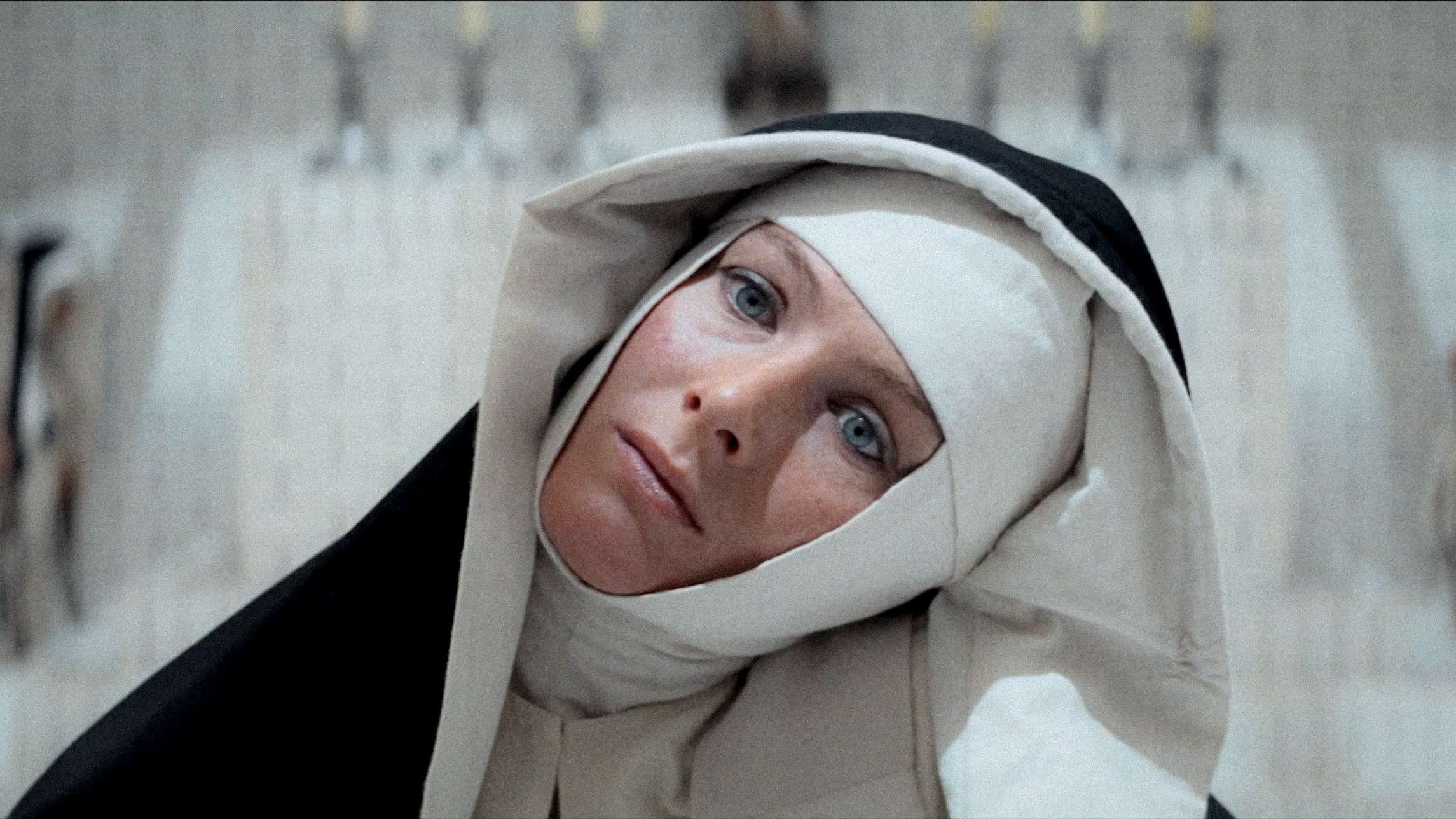
The town's bureaucrats seize the opportunity to destroy Grandier's life when the local convent's Mother Superior, Sister Jeanne (Vanessa Redgrave), tells the convent's confessor, Father Mignon, that Grandier has possessed her and the other nuns.
asserted
Grandier → seize → her
She makes this baseless accusation after learning of the priest's marriage to Madeleine, which had devastated and outraged Jeanne, who obsessively lusted for Grandier from within the confines of the convent.
asserted
who → make → convent
Although Grandier has never seen Jeanne (and knows nothing of her defining features: a hunchback, blue eyes, and a cackling laugh), his enemies conspire to wield the accusation against him and call in a professional witch hunter.
asserted
enemies → see → hunter
Mass hysteria ensues as more nuns profess their possession, and the church quickly becomes a blasphemous circus of sexual deviancy.
asserted
church → ensue → deviancy
The latter half of the film contains its most controversial sequences, including a previously censored scene of nuns sexually defiling a statue of Jesus and depictions of gruesome torture.
asserted
nuns → contain → torture
Responding to British censors' objections to the torture scene, Russell once told an interviewer that the censors should have known that the scene was based on historically accurate events.
asserted
scene → respond → events
"I've always found that it's much more shocking and indeed more effectual to go for the truth, rather than fiction," he said.
asserted
he → find → fiction
The same could be said of the film more generally.
uncertain
same → say → film
Perhaps the most disturbing part of Russell's movie is its ending, when the town celebrates Grandier's final moments and execution (burning alive at the stake) after a sham trial.
asserted
town → celebrate → trial
Here, the human impulse to deliver mob justice, to punish, and to rejoice in another's demise is on full display.
asserted
impulse → deliver → display
Films are not meant to be purely didactic, and The Devils' set design, story, and acting are worthy of praise on their own.
asserted
design → mean → own
But it is worth noting that Russell himself called the movie his "one political film," and it has a clear message.
asserted
it → note → message
As Grandier's enemies knew, the state can more easily abuse its power when the masses become willing instruments.
asserted
masses → know → power
It is critical to know when the mob is being weaponized against the individual.
asserted
mob → know → individual
Otherwise, "the devils" will only grow stronger.
asserted
devils → grow → ?
The American justice system, while imperfect, seeks to temper these passions and guide jurors and judges toward truth and evidence-based outcomes.
asserted
system → seek → truth
Unfortunately, any system made up of flawed individuals is vulnerable to corruption and public pressures.
asserted
system → make → corruption
At the national level, seemingly every presidential administration punishes its enemies for partisan ends to placate its base and consolidate power.
asserted
administration → punish → power
And as the public, we remain susceptible to condemning others in the court of public opinion before all the facts are presented.
asserted
facts → remain → opinion
Due process is eroded when we cannot separate our passions from principles.
asserted
we → erode → principles
After the film, I asked moviegoers about their reactions.
asserted
I → ask → reactions
Rightfully, most people raved about the film's set design.
asserted
people → rave → design
Some fellow Zoomers told me they enjoyed the "gore" of it all, adding that nothing is really shocking to audiences in 2026.
asserted
nothing → tell → 2026
Nobody remarked on the storyline until pressed.
asserted
Nobody → remark → storyline
My post-movie interviews weren't a representative sample, but I left the theater doubting we will learn from Loudun.
asserted
we → leave → Loudun
 The Aporia