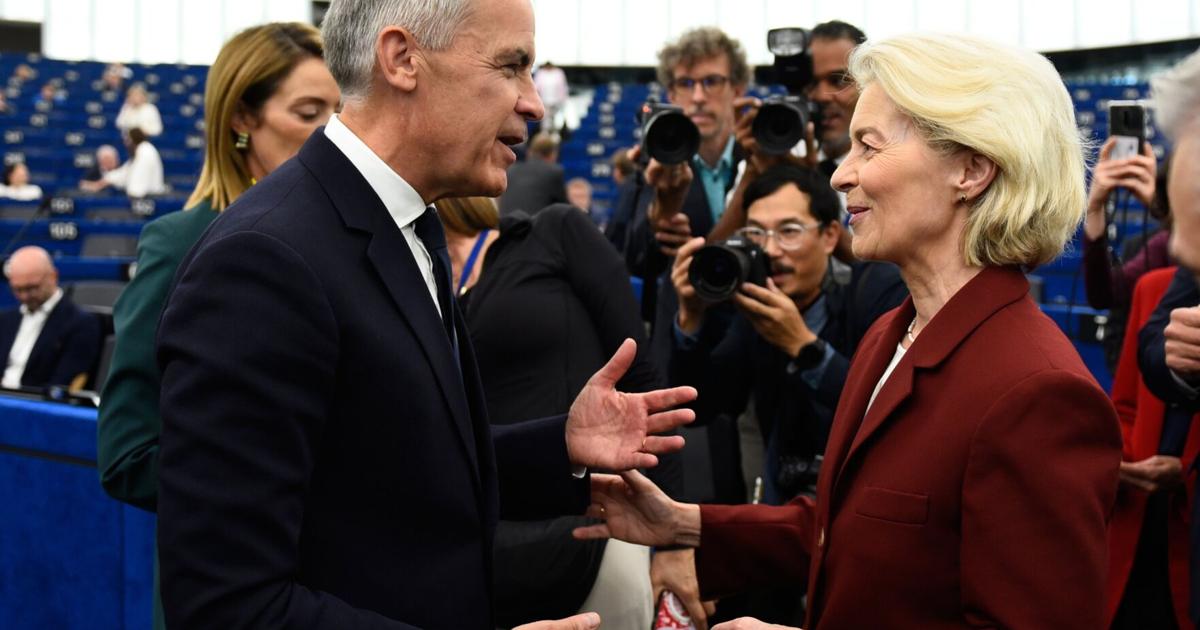
At the end of a two-day summit, Canada and European Union leaders set the two allies on a course toward greater integration in defiance of U.S. threats that would be viewed as a “hostile act” warranting possible stiffer tariffs.
asserted
that → set → tariffs
Negotiations that intensified over the past year led Friday to several agreements signed, with more promised over the next 12 months, that lay out specific details about how Ottawa and Brussels will work to “make Canada the first associate member to the EU,” according to an European fact sheet that was later being updated.
Associate membership means “the closest possible partnership,” with closer alignment on climate, energy, AI, innovation and security “from inception to implementation,” the European document said.
uncertain
document → intensify → implementation
Although it said they were charting a path to associate membership, the formal joint statement used Prime Minister Mark Carney’s preferred phrase, that the two were building an “Alliance for the Future.”
asserted
two → say → Future
Carney made clear in remarks after a signing ceremony that, “In parallel, we are working towards the deepest possible partnership, short of accession - with Canada becoming the European Union’s first Associate Member.”
asserted
Canada → make → accession
Carney and European Commission President Ursula von der Leyen concluded deals on Canada’s participation in the €90 billion Ukraine Support Loan, on digital trade, on the European Investment Bank’s role in developing in critical minerals, on countermeasures to fight anti-competitive activity, as they negotiate much more cooperation down the road, according to the EU side.
uncertain
they → conclude → side
Europe agreed to negotiate bringing Canada further into EU programs that will directly benefit Canadian researchers, innovators and university students by expanding access to billions in research funding through Horizon Europe and bringing Canadian students fully into the Erasmus+ study-abroad program.
asserted
that → agree → program
The two sides will also work to expand professional credential recognition and youth mobility opportunities.
asserted
sides → work → opportunities
According to the Europeans, Canada will get access to European supercomputing resources, AI infrastructure and quantum computing systems.
uncertain
Canada → accord → resources
The two sides agreed to work together on “advanced AI solutions for wildfires, extreme weather events, and climate simulations” and to intensify joint cooperation on Arctic connectivity, including secure broadband in the Arctic region and cooperation on subsea cable and satellite connectivity projects.
asserted
sides → agree → projects
Canada will also be invited to participate in European security missions in Armenia, Moldova and Rafah, in the southern Gaza Strip.
asserted
Canada → invite → Strip
But it is unclear how much more Canada is prepared to spend to join all the new programs.
uncertain
Canada → prepare → programs
Finance Minister François-Philippe Champagne dodged those questions here, saying Canadians should see only “opportunities.”
asserted
Canadians → dodge → opportunities
Canada is already spending more than $25 billion on military, governance and humanitarian support for Ukraine, and pays hundreds of millions to allow Canadian researchers access to the Horizon research funds.
asserted
Canada → spend → funds
Canada paid about $16 million to join Europe’s €150-billion defence industrialization program known as SAFE, which allows Canadian companies to bid on defence procurement contracts with the same rights as European firms.
asserted
companies → pay → firms
Canadian researchers already have access to about €61 million in Horizon funding, and university leaders say broader access is critical.
asserted
access → have → funding
Anja Geitmann, vice-president of global engagement at McGill University, who attended a von der Leyen speech here a day earlier, said: “International collaboration is what we need in order to address the big challenges of this world and this century.”
asserted
we → attend → world
Companies on both sides of the Atlantic are also keen for deeper ties if they bring less regulatory duplication and smoother access to markets.
asserted
they → bring → markets
Christian Ouellet, vice-president of corporate affairs at Sandoz Canada whose global headquarters are in Switzerland, said he hopes there could be more harmonization of regulations and policies — “not redoing the job that has been already done by another credible regulator body …
uncertain
that → say → body
everything in general that could strengthen the relationship between Canada and Europe will be favourable for business such as ours.”
uncertain
that → strengthen → ours
Ouellet said it could speed product approvals and for Canadians, he noted, that’s a real outcome, saying that “if you’ve had surgery in Canada” chances are 100 per cent you’ve received one of their medical products, about half of which are made or packaged in Canada and the other half mainly imported from Europe.
uncertain
half → say → Europe
 The Aporia