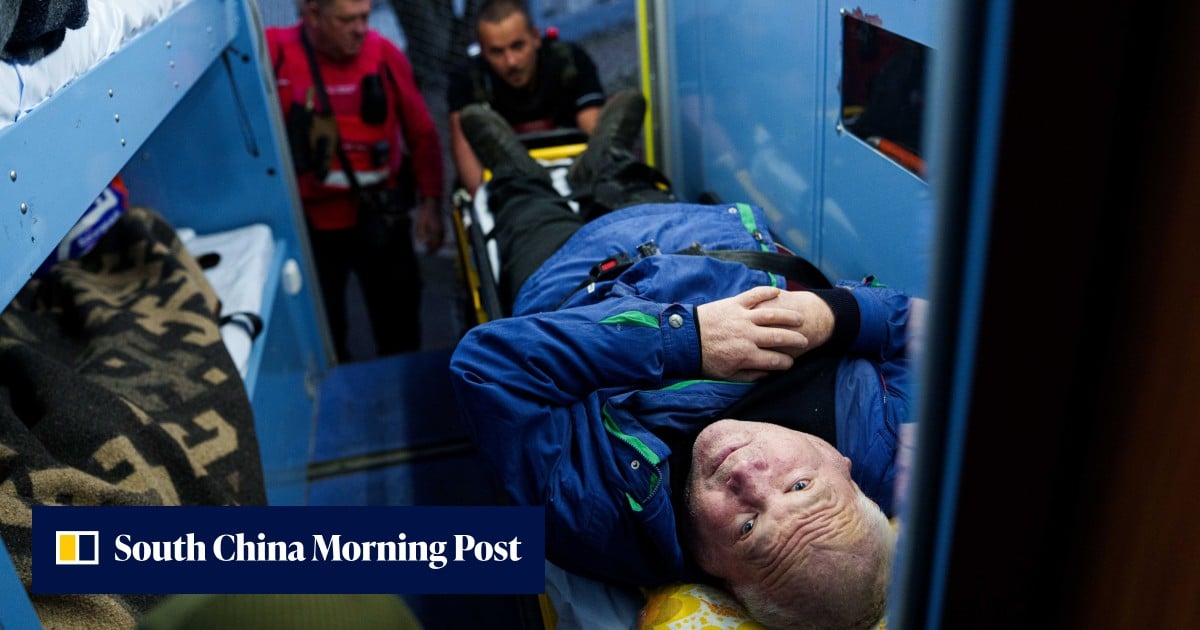
Spain’s transport minister on Friday rejected calls for his resignation over the second train accident on his watch to cause mass casualties this year, as authorities worked to identify the victims from a crash that left at least 69 dead.
asserted
that → reject → 69
Lawmakers from across the political spectrum this week condemned Transport Minister Oscar Puente for attributing Wednesday’s crash to a break in protocol by control centre operators rather than accepting responsibility, with rail workers’ unions calling for his immediate dismissal.
asserted
unions → condemn → dismissal
The crash, which happened near the town of Urda in central Spain, followed another accident involving the same rail companies on the same line that left 46 dead in January.
asserted
that → happen → January
It has reopened a debate about safety and maintenance on Spain’s high-speed rail network, the most extensive in Europe, as the country prepares for an election that left-leaning Prime Minister Pedro Sanchez has called for November 29.
asserted
Sanchez → reopen → November
“My duty now is not to focus on discussing whether I will remain in office, but on solving the problem, determining exactly what happened and providing clear explanations,” Puente said at a press conference on Friday.
asserted
Puente → focus → Friday
The train that smashed into a second stationary one was travelling at a speed between 160 and 200 kph when the collision occurred, according to a preliminary report released on Thursday by the Independent Authority for the Technical Investigation of Accidents and Incidents (AITAT).
“The sequence of malfunctions, instructions, and actions eventually led to the collision, in the absence of the necessary mitigating barriers,” AITAT said in the report.
uncertain
AITAT → smash → report
AITAT said it would not be able to confirm the exact speed of the train until it extracted information from the train’s black box.
asserted
it → say → box
At the scene of the crash, large cranes were lifting the mangled wreckage as the Civil Guard listed 64 people as missing in what is already Spain’s deadliest train accident since 2013.
asserted
what → lift → 2013
Authorities have carried out 49 autopsies so far and formally identified five people — three women and two men — Esther Padilla, spokesperson for the Castilla-La Mancha regional government, said on state television network TVE.
asserted
Padilla → carry → TVE
“Testing is proceeding slowly, although families will be contacted throughout the day so that they can come and collect their results,” Padilla said on Friday.
asserted
Padilla → proceed → Friday
It was unclear if all those missing were accounted for in the death toll.
uncertain
those → miss → toll
Authorities can’t rule out more fatalities
asserted
Authorities → rule → fatalities
No additional bodies were found when rescue teams overturned a train carriage on Thursday, Castilla-La Mancha regional leader Emiliano Garcia-Page said on TVE.
asserted
Page → find → TVE
Identifying the bodies was proving difficult because many were in pieces, he said.
asserted
he → identify → pieces
On Thursday, rescue teams had placed partial remains in 31 bags.
asserted
teams → place → bags
“The truth is that we cannot rule out the possibility that there may be more fatalities,” Garcia-Page said.
uncertain
Page → rule → possibility
As identification of the dead continued, the debate about who was at fault intensified, with unions saying it was unfair to lay the blame on human error.
asserted
it → continue → error
Prime Minister Pedro Sanchez on Friday vowed to find out what caused the accident.
asserted
what → vow → accident
“It is unacceptable for a country like Spain, with such a strong high-speed rail system, to suffer two accidents of this nature and magnitude in a single year,” he said.
asserted
he → suffer → year
The collision occurred after several trains were automatically stopped due to the failure of a signalling system, after which the central control centre in Madrid took over.
asserted
centre → occur → Madrid
A train operated by state-owned Renfe was authorised to proceed, even though there was a stationary Iryo-operated train ahead, according to Puente.
uncertain
train → operate → Puente
Audio of communications between the control centre and the train drivers obtained by El Pais showed how a controller authorised the Renfe train to continue on its journey at a normal speed, which Puente said disregarded a protocol to travel at no more than 40 kph in such circumstances.
asserted
Puente → obtain → circumstances
The audio also showed the controller authorised the Renfe train, carrying 379 passengers and seven crew, to resume its journey even though the Iryo train, carrying 147 passengers and five crew, should have proceeded first according to protocol.
uncertain
train → show → protocol
Controllers say focus should be on failed signal system
Raquel Ayllón, a union leader for state-owned infrastructure operator Adif, said controllers were having to operate under difficult working conditions.
“Human error is being criticised and questioned very quickly, while people are not really focusing on the central issue: the failure of the safety system,” Ayllón said on TVE.
asserted
Ayllón → say → TVE
The LZB system which failed, triggering the sequence of events that led to Wednesday’s crash, was behind schedule for an upgrade, public documents show.
asserted
documents → fail → upgrade
In September 2021, Adif awarded a contract to Thales Espana, the Spanish arm of the French equipment maker, to complete the installation of a new, standardised European system called ERTMS by early 2026 for 93.8 million euros ($105m), according to press releases on the tender.
uncertain
Adif → award → tender
The system has been installed across most of Spanish high-speed rail, according to a factsheet by European rail association UNIFE, which developed the new ERTMS standard.
uncertain
which → instal → standard
But the Madrid-Seville line, site of two fatal crashes, had fallen behind, according to the tender contract.
uncertain
line → fall → contract
The contract was passed to Hitachi Rail in 2024, according to Thales, which declined to provide comment on the delay of the rollout.
uncertain
which → pass → rollout
 The Aporia