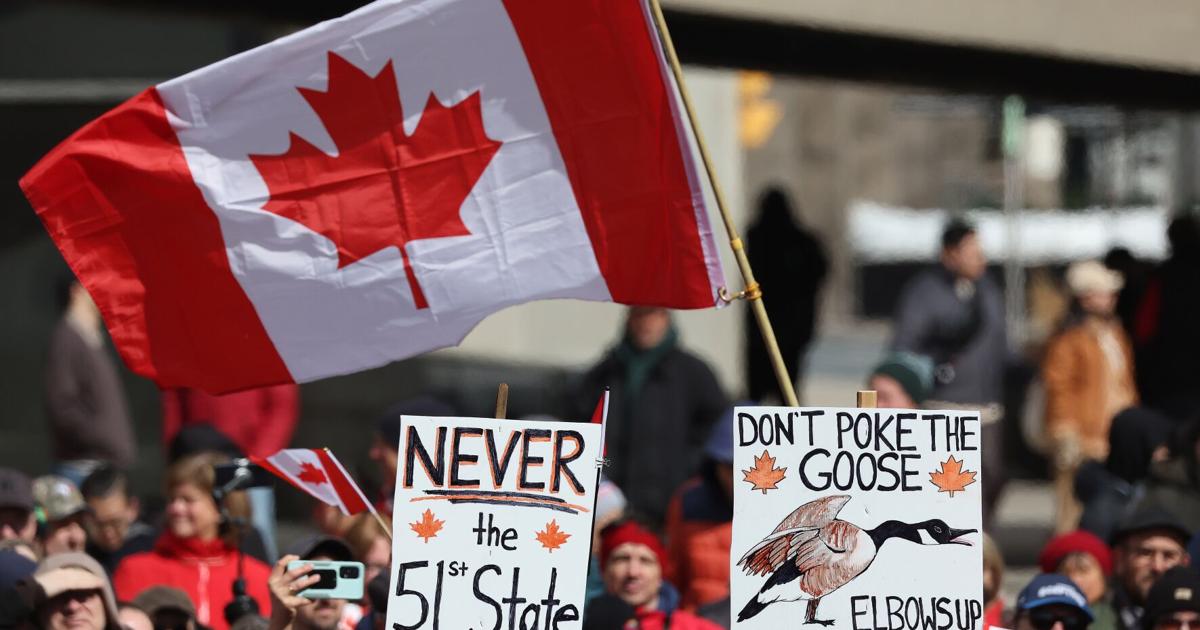
Photo via Toronto Star

If Carney wants to influence global affairs, he'll need to fix Global Affairs first

Read the original at Toronto Star ↗
Cite

Ling, J. (2026, October 30). If Carney wants to influence global affairs, he'll need to fix Global Affairs first. Toronto Star. https://www.thestar.com/opinion/star-columnists/if-carney-wants-to-influence-global-affairs-he-ll-need-to-fix-global-affairs-first/article_013f8a5e-8126-4654-8d6a-9831965e2d45.html

Dated from the outlet's own feed. Check the original for its byline.

Toronto Star · collected 2026-10-30 · by Justin Ling

Quick Summary

The article discusses Prime Minister Mark Carney’s efforts to reshape Canada's global influence through new national security and foreign policy strategies. While these documents aim to clarify Canada's stance in a post-Trump world, the author highlights that Global Affairs Canada, burdened by staffing issues and low morale, lacks the capacity to effectively implement these ambitious policies. The piece emphasizes the historical context of Canadian foreign policy practices and points out the department’s decline since the Cold War, citing a 2023 Senate committee report that highlighted the negative impact on Canada's ability to influence global affairs due to underinvestment and poor recruitment over two decades.
Written by AI on 2026-10-30, from this article's own text only (the story summary below draws on all the coverage).

AI analysis

Story summary

On October 29, 2026, Prime Minister Mark Carney's Liberal government released a long-awaited national security strategy in Ottawa, focusing on safeguarding Canada's economy and modernizing the military. The document aims to address a range of threats including espionage, foreign interference, terrorism, and frontier AI models, which officials cited as one of the greatest current threats to Canadians. Additionally, Carney announced measures to strengthen Canada's "AI digital sovereignty." The strategy also includes an increase in defense spending, with plans to allocate over $163 billion toward military investments by mid-decade.

Written for “Canada's National Security Strategy Release” on 2026-10-30, grounded in this article and the 7 other(s) covering the same event.
Why this leaning score
The article's own words the score was based on. Each is quoted verbatim and was checked against the article text before being stored, so you can find it in the original.
Reading Leans left (beta estimate) Confidence high
Leaning: leans left for article 116834 (high confidence, 2 verified quotes) · logged 2026-10-30

Story

📰 Canada's National Security Strategy Release
Politics · 8 article(s) covering the same event. Compare every outlet's account →

Compared with similar articles

This article reads leans left and hedges 8% of its claims. Each row says how that neighbour differs.
CBC News
⚖️ Leans left Hedges 2 of 48 claims Outlet record 74/100
“The articles discuss different aspects of Canadian foreign policy and do not describe the same specific incident.”
CBC News
⚖️ Leans strongly left further left than this Hedges 4 of 44 claims Outlet record 60/100
“The articles discuss different aspects of Canadian and US foreign policy without describing the same specific incident.”
Global News
Hedges 0 of 7 claims Outlet record 63/100
“Article A specifically discusses the release and content of the national security strategy, while Article B comments broadly on several policy documents released by the Carney government including the national security strategy but not focusing solely on the same specific event described in Article A.”
The Globe and Mail
Hedges 4 of 35 claims Outlet record 52/100
CBC News
Hedges 3 of 19 claims Outlet record 74/100
“Article A discusses policy documents released by Carney's government, while Article B covers a Canada-EU summit hosted by Prime Minister Mark Carney in Montreal.”
Toronto Star
Hedges 0 of 7 claims Outlet record 64/100
“The articles discuss related topics but describe different events; Article A focuses on the release of a national security strategy, while Article B comments broadly on multiple policy documents including the national security strategy.”
CBC News
⚖️ Leans right further right than this Hedges 1 of 28 claims Outlet record 74/100
“The articles discuss related government policies but do not describe the same specific event or occurrence.”
How this article was measured signals, leaning charts, publisher record, byline, topics and claims

Signals How these are calculated →

Claims extracted
74
sentences that state something as happening or true
Uncertain
8%
6 of 74 hedged ("reportedly", "may", "according to")
Leaning
Leans left
of the writing, not the subject · beta estimate
Publisher signals
64/100
Toronto Star's corrections and hedging, across everything collected from it. Not a measure of accuracy.
Outlets on this story
8
Politics
Same framing elsewhere
1
articles that frame the event the way this one does
Analyzed 2026-10-30 · how these are computed

How this is being covered How these are calculated →

Article leaning vs. publisher reliability
Source leaning vs. consistency

Publisher

Toronto Star · 10443 article(s) · 27 correction(s) detected
Running correction rate · 27 correction(s)
2026-10-26
Correction
2026-10-24
Correction
2026-10-07
Correction
2026-09-24
Correction

Who wrote this

Justin Ling
5 article(s) here · 1 carrying a prediction
🔮 They will give us, at long last, a clearer picture of how Prime Minister Mark Carney hopes to reshape a world thrown on its side by U.S. President Donald Trump.
🔮 These losers would still be on the political margins were they not being validated by one person: Premier Danielle Smith.
🔮 “The postwar world is long gone, but the underlying logic that justified multilateral co-operation is more evident than ever,” Carney wrote last month in the Financial Times, along with Brazilian President Luiz Inácio Lula da Silva, Kenyan President William Ruto and European Council President António Costa.
🔮 On Monday, Quebecers will go to the polls to elect a new provincial government.
🔮 “Even when Trump moves on, another Trump will eventually come along.
Also by Justin Ling
Nothing else under this byline is closely related to this article, so these are simply their most recent.

Topics

Canada Cold War Grand Strategy Fall U.S. the Canadian Forces College

Subjects

Canada GPE · 7× Carney PERSON · 3× Boehm PERSON · 2× Global Affairs ORG · 2× Adam Chapnick PERSON · 1× Donald Trump PERSON · 1× Mark Carney PERSON · 1× Pierre Elliott Trudeau PERSON · 1× U.S. GPE · 1× the Canadian Forces College ORG · 1×

Narrative

The Carney government is publishing some serious stacks of paper describing how it plans to make Canada relevant again, including a national security strategy, released on Thursday; a new defence policy, already in effect but not yet published; and a full foreign policy.
framing: assertive · carried by 1 article(s) · first seen 2026-10-30
🔮 They will give us, at long last, a clearer picture of how Prime Minister Mark Carney hopes to reshape a world thrown on its side by U.S. President Donald Trump.

Claims (74 extracted, 6 hedged)

The Carney government is publishing some serious stacks of paper describing how it plans to make Canada relevant again, including a national security strategy, released on Thursday; a new defence policy, already in effect but not yet published; and a full foreign policy. asserted
Canada → publish → effect
While no country has ever sunk a flotilla or defended its borders with glossy-covered policy documents, these three are nevertheless important. asserted
three → sink → documents
They will give us, at long last, a clearer picture of how Prime Minister Mark Carney hopes to reshape a world thrown on its side by U.S. President Donald Trump. asserted
Carney → give → Trump
I’ve been speaking with insiders and experts lately, trying to jam together the strategic puzzle pieces and see the bigger picture. asserted
I → speak → picture
I’ll start with the trickiest of the three: our new foreign policy, set to be released before the end of the year. asserted
I → start → year
“My sense,” said Adam Chapnick, a professor at the Canadian Forces College, “is that the government has a firmer idea of how it wants to position Canada in the world than we have had in at least a decade. asserted
we → say → decade
And in order to get the public service aligned with the government’s vision, there’s a belief that we have to put this stuff on paper.” asserted
we → get → paper
Canada hasn’t published a foreign policy since 2005. asserted
Canada → publish → 2005
In 1970, Prime Minister Pierre Elliott Trudeau dubbed his sweeping agenda to navigate between the Cold War superpowers “Foreign Policy for Canadians,” and he published it in six slickly produced booklets, intended for public consumption. asserted
he → dub → consumption
Carney’s pitch is well known by now. asserted
pitch → know → ?
The prime minister believes the middle powers, including Canada, should band together to reduce the leverage wielded by hegemons such as the United States and China. asserted
powers → believe → States
And he hasn’t waited for the release of this policy to begin re-engaging with the world. asserted
he → wait → world
He’s spent the past year shaking hands and signing deals — just this week, he hosted the Crown Prince of Abu Dhabi in Ottawa, followed by a phalanx of European Union officials in Montreal. asserted
he → spend → Montreal
A truly ambitious foreign policy doesn’t merely describe the world we want; it also tells us how to get there. asserted
it → describe → us
And Global Affairs Canada — beset with staffing problems and lacking the capacity to do big things — isn’t ready. asserted
Canada → beset → things
The department, which runs our network of embassies and missions abroad, is the tool through which we conduct diplomacy, negotiate trade deals and secure new customers. asserted
we → run → customers
But it suffers under an aging bureaucracy and sagging morale. asserted
it → suffer → bureaucracy
Canadian foreign policy — and our capacity to execute it — degenerated after the Cold War. asserted
policy → execute → War
In 2023, a Senate committee found that two decades of declining recruitment and investment had “undermined Canada’s ability to influence and shape global issues and effect change. asserted
decades → find → change
The chair of that committee was Senator Peter Boehm, a career diplomat who served as Sherpa for multiple G7 summits. asserted
who → serve → summits
“We could be doing a lot more,” he told me last month in his East Block office, whose walls are lined with souvenirs from his long career. uncertain
walls → do → career
“The question is how we do it and how to push it.” asserted
we → do → it
Boehm agreed the “multi-headed beast” of Global Affairs is a limiting factor. asserted
beast → agree → Affairs
It is, as his committee’s study found, a top-heavy, risk-averse department beset by malaise, lacking specialization, painfully risk-averse and without the surge capacity to deal with a world of colliding crises. asserted
study → find → crises
One damning indictment summed up our efforts as “less foreign, more office”; another concluded, “much of Canada’s diplomatic presence is a Potemkin village.” asserted
much → sum → presence
The report spurred then-Prime Minister Justin Trudeau to task a senior diplomat with modernizing operations at Fort Pearson, as the department’s headquarters is sometimes called. asserted
headquarters → spur → Pearson
Shortly after, Global Affairs released two big, if vague, strategies — one on the Indo-Pacific and another on Africa. asserted
Affairs → release → Africa
Both led to a careful expansion of Canada’s diplomatic presence abroad. asserted
Both → lead → presence
Carney inherited a foreign service that has been cautiously trying to repair itself, yet many of the problems Boehm and his fellow senators identified remain. asserted
Boehm → inherit → problems
Some of this is down to resources, Boehm said. asserted
Boehm → say → resources
“If you’re going to really take on change and transform, you can’t do it without putting more money into it.” asserted
you → go → it
Global Affairs has a morale problem, too. asserted
Affairs → have → problem
“When you have a public service that is both being pushed really hard, in which morale is not that high,” Chapnick said, “you can only, it seems to me, institute so much change at once.” asserted
it → have → change
Canada once boasted an enviable foreign service that functioned as a real meritocracy. asserted
that → boast → meritocracy
Fort Pearson attracted bright young mandarins, eager to climb the ranks and earn better and better foreign posts and serve in ever more critical roles abroad. asserted
Pearson → attract → roles
This system has, to some degree, fallen apart. asserted
system → fall → degree
It is increasingly common for staff at Global Affairs to spend their whole careers in Ottawa. asserted
staff → spend → Ottawa
Those who serve in the missions, meanwhile, have seen prestigious posts go to political appointees: just last month, Carney sent one of his senior staffers to become ambassador to the United Arab Emirates. asserted
Carney → serve → Emirates
Budget cuts have only soured the mood at the department. asserted
cuts → sour → department
For Canada to matter again, and to become richer in the process, we need more talent, more specialists, more risk-takers and more polyglots working in the Department of Foreign Affairs. asserted
we → matter → Affairs
…and 34 more, not listed.

💬Give feedback
🕘History 🎫Support