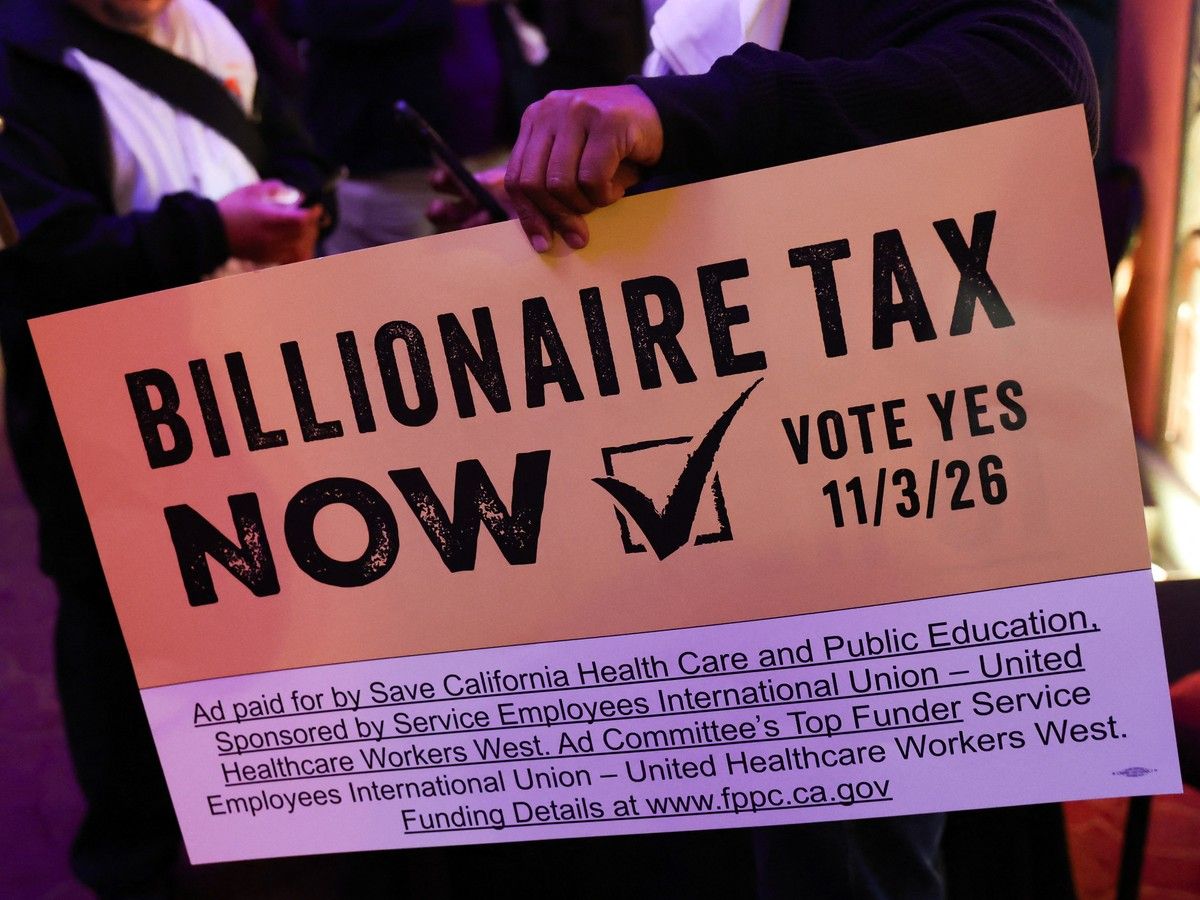
No matter what happens in Tuesday's elections, support for wealth taxes keeps growing.
asserted
support → happen → taxes
Its justification is based on the idea that the very rich owe all of us something, and taxing their fortunes is collecting on that debt.
asserted
taxing → base → debt
We're told their success fuels inequality and that it's selfish of them to keep so much, especially if they don't proclaim that they want to do more for society.
asserted
they → tell → society
Former International Monetary Fund chief economist Olivier Blanchard of France recently gave this narrative a clear voice.
asserted
Blanchard → give → voice
Writing on X, he wondered why California's wealthiest are spending so heavily to defeat Proposition 40, the supposed one-time 5 percent tax on the net worth of billionaires.
asserted
wealthiest → write → billionaires
Blanchard added that billionaires "typically have not indicated that they are building their wealth to eventually make the world a better place."
asserted
world → add → wealth
The entire notion misunderstands how fortunes are made.
asserted
fortunes → misunderstand → ?
In a market economy, people don't build great wealth first and redeem it later through good works.
asserted
people → build → works
They build it by making the world better first.
asserted
world → build → it
When I buy an $800 smartphone, it's because I value the phone more than whatever else I would have bought with the money.
asserted
I → buy → money
The seller values my $800 more than they do the phone.
asserted
they → value → phone
We both walk away richer by our own measure.
asserted
We → walk → measure
Neither owes the other anything more.
asserted
Neither → owe → anything
Repeat this exchange a few hundred million times, and vast fortunes take shape for the people who create amazing technology so abundantly and affordably that we take it for granted.
asserted
we → repeat → it
More importantly, though, people hand over every cent of it voluntarily.
asserted
people → hand → it
As my colleague Arnold Kling aptly explained over the weekend, "Profits are earned within a positive-sum game for society.
asserted
Profits → explain → society
Profits induce firms to serve consumers and to innovate."
asserted
Profits → induce → consumers
The drive for wealth taxes relies on "the opposite point of view.
asserted
drive → rely → view
It regards profits as something that businesses take from the rest of us, as if we can take innovation and efficiency for granted.
asserted
we → regard → innovation
[It] acts as if we are in a zero-sum environment in which one person's gain is necessarily another person's loss.
asserted
gain → act → which
And, yes, the gains are divided more fairly than people think.
asserted
people → divide → ?
Nobel laureate and Yale University economist William Nordhaus estimated that innovators in the U.S. business sector personally captured, on average, a mere 2.2 percent of the social surplus they created between 1948 and 2001.
asserted
they → estimate → 1948
The other 97.8 percent went to everyone else in the form of lower prices, higher wages, better products and goods, and services that didn't previously exist.
asserted
that → go → prices
In short, the world has already been compensated, many times over.
asserted
world → compensate → ?
Those urging billionaires to acquiesce also err by blithely assuming that the state that grabs the money will use it well enough to "make the world a better place."
asserted
world → urge → it
California's government already spends roughly $350 billion a year.
asserted
government → spend → billion
What will the extra few billion accomplish that the rest hasn't?
asserted
rest → accomplish → What
"Giving money and power to government is like giving whiskey and car keys to teenage boys," as journalist and satirist P.J. O'Rourke used to say.
asserted
O'Rourke → give → boys
Maybe California's billionaires aren't eager to fund a Merced-to-Bakersfield rail line that the state prices around $35 billion and its inspector general puts closer to $48 billion.
asserted
general → fund → billion
Perhaps they're hesitant to backfill pension funds like the California Public Employees' Retirement System, whose staff concedes is unlikely to hit an assumed 6.8 percent return without leaning on private equity.
asserted
staff → backfill → equity
Prop 40's revenue is earmarked for health care, but money is fungible.
asserted
money → earmark → care
In the end, California has one budget.
asserted
California → have → budget
Every earmarked dollar frees another for something else.
asserted
dollar → earmark → something
Some billionaires might simply have concluded that their philanthropy does more good elsewhere, or that their dollars are more beneficial when invested in private enterprises.
uncertain
dollars → conclude → enterprises
The tax also doubles down on California's worst habit: spend, spend, spend, and then tax, tax, tax.
asserted
tax → double → habit
The money is never enough to cover all the spending.
asserted
money → cover → spending
A one-time levy spent over five years doesn't fix that.
asserted
levy → spend → that
It funds new commitments with temporary money.
asserted
It → fund → money
Some will want to make the tax permanent, which its intellectual architects clearly prefer and may have made possible.
uncertain
architects → want → which
That's the commitment problem that Blanchard admits California can't solve.
asserted
California → admit → that
…and 6 more, not listed.
 The Aporia