[This is one of the finalists in the 2026 book review contest, written by an ACX reader who will remain anonymous until after voting is done.
asserted
voting → write → reader
I’ll be posting about one of these a week for several months.
asserted
I → post → months
When you’ve read them all, I’ll ask you to vote for a favorite, so remember which ones you liked
asserted
you → read → ones
Introduction: He Who Saw the Deep
I’ve been thinking, lately, about the first epic story ever written.
asserted
I → see → story
If you know anything about the Epic of Gilgamesh, you know that it’s old.
asserted
it → know → Gilgamesh
This is part of why I find it so interesting, but not the only part.
asserted
it → find → ?
The best comparison I can think of is the pyramids, which are just a little older.
asserted
which → think → ?
The Great Pyramid of Giza was built in the 2500s BC, around the same time as Stonehenge1 , twenty-five centuries before Cleopatra lived.
asserted
Cleopatra → build → Stonehenge1
It predates candles, concrete, and coins; it was centuries old when the first empire rose and when the woolly mammoth went extinct.
asserted
mammoth → predate → candles
Around 100 BC, Antipater of Sidon wrote a list of the seven most impressive sights (‘Seven wonders’) of the world - the pyramids were by far the oldest of the group at the time, and now, two thousand years later, all the others on the list have long since been destroyed.
asserted
others → write → list
This should remind us that the pyramids don’t just stretch far back in time - they stretch forward as well.
asserted
they → remind → time
They may be the product of the greatest minds of their age striving to put more stone in a more orderly pile than anyone had before, but still, they are piles of stone, basically artificial rock formations.
uncertain
they → strive → stone
They are so old they brush up against the beginning of civilisation, and yet, we are seeing them today in their youth.
asserted
we → brush → youth
The Epic of Gilgamesh was written down (in its earliest form) around 2100 BC in Mesopotamia - another cradle of civilisation, less well-known than ancient Egypt but every bit as extraordinary.
asserted
Epic → write → Egypt
Like the pyramids, Gilgamesh wasn’t exactly the first of anything; we have writing, and even written literature, that predates it.
asserted
that → have → it
Nothing else had the same length, the same literary gravity, the same reach.
asserted
Nothing → have → length
For centuries it stood alone in its class while empires rose and fell around it.
asserted
empires → stand → it
Its longevity isn’t because it was made of durable rock, and it’s not because a stray copy happens to have been found in modernity.
asserted
copy → make → modernity
This piece of writing lasted because it was considered of such cultural importance, and copied and imitated so extensively, that we can’t help but find parts of it, wherever we find writing from this period.
asserted
we → last → period
The Egyptians built the pyramids to last, and the Mesopotamians put the same care into immortalising this story.
asserted
Mesopotamians → build → story
It’s their gift to us, crafted not from atoms, but from bits.
asserted
It → ’ → bits
That’s what I am in awe of whenever I read this book: the age, the scale, the importance.
asserted
I → ’ → book
Like a rock formation, it was here long before I was, and will be here long after I’m dead.
asserted
I → ’m → formation
Prologue: Uruk
The Epic of Gilgamesh is organised into eleven Tablets (there’s a twelfth but it’s not really part of the story and seems to have been tacked on by tradition).
asserted
it → organise → tradition
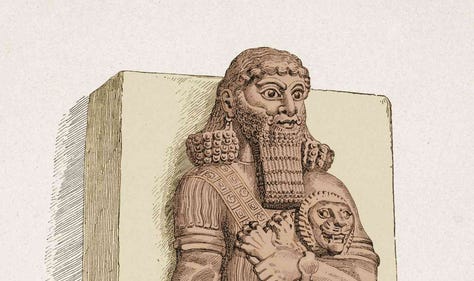
Tablet 1 begins with an introduction to our hero, Gilgamesh2 :
asserted
Tablet → begin → hero
(If you’d like to hear it in the original Akkadian while you read, the internet can provide.)
He who saw the Deep, the country’s foundation
[who] knew the [proper ways, was] wise in all matters!
asserted
who → like → matters
[He] explored everywhere the seats of [power,]
[he knew] of everything the sum of wisdom.
He saw what was secret, discovered what was hidden,
he brought back a tale of before the Deluge.
asserted
he → explore → Deluge
Gilgamesh’s greatness is linked immediately to the city of Uruk, where he rules as King:
asserted
he → link → King
He built the rampart of Uruk-the-Sheepfold,
of holy Eanna, the sacred storehouse.
asserted
He → build → Eanna
Were its bricks not fired in an oven?
asserted
bricks → fire → oven
Did the Seven Sages not lay its foundations?[A square mile is] city, [a square mile] date-grove, a square mile is clay-pit, half a square mile the temple of Ishtar: [three square miles] and a half is Uruk’s expanse.
asserted
miles → lay → Ishtar
The city of Uruk is prominent in this story, and that’s no coincidence.
asserted
that → ’ → story
Mesopotamians associated it with ancient wealth and glory.
asserted
Mesopotamians → associate → wealth
They were right to venerate it: Uruk is the site of an epoch-defining shift in human history.
asserted
Uruk → venerate → history
The Epic of Gilgamesh comes from Mesopotamia, a stretch of land between the Tigris and the Euphrates rivers, roughly corresponding to modern day Iraq and Syria (and part of the Fertile Crescent).
asserted
Epic → come → Crescent
It’s tempting to think of this region as a dry desert, but six to ten thousand years ago it was much wetter, and an ideal environment for agriculture.
asserted
it → ’ → agriculture
From the end of the last ice age in 9700 BC, up to about 500 BC, there was nowhere else on Earth where the transition from hunter-gathers to settled societies went so fast.
asserted
transition → be → societies
This is where farmable strains of wheat, barley, lentils, peas and flax were first bred; where goats, sheep, cattle, pigs, and cats were domesticated; and where the wheel was invented.
asserted
wheel → breed → wheat
In Mesopotamia, technological progress met with a critical mass of population density to create the world’s first city: Uruk3 .
asserted
progress → meet → city
Uruk is so old it predates the literal Ur-City.
asserted
it → predate → City
…and 458 more, not listed.
 The Aporia