[This is one of the finalists in the 2026 book review contest, written by an ACX reader who will remain anonymous until after voting is done.
asserted
voting → write → reader
I’ll be posting about one of these a week for several months.
asserted
I → post → months
When you’ve read them all, I’ll ask you to vote for a favorite, so remember which ones you liked
asserted
you → read → ones
All Quiet on the Western Front ranks as the definitive anti-war novel of World War I, perhaps for all wars, and to some the most important war novel of all time.
asserted
Quiet → rank → time
It was widely banned in the inter-war period yet went on to sell more than 20 million copies and has three film adaptations, the most recent the acclaimed 2022 version.
asserted
recent → ban → adaptations
It’s so famous, so prominent, so dominating, that the novel I think is the best war novel ever written can only point back at it from a ‘see also’ link on Wikipedia.
asserted
I → ’ → Wikipedia
You may recognize that name from 2023’s ACX book review, On the Marble Cliffs.
uncertain
You → recognize → Cliffs
It was my first serious look at Jünger as well; he is described as a “serial killer” and a “sociopath,” the kind of modern psycho who nowadays would take glee in uploading videos of drones blowing people up, someone perhaps who sees war as the chance to visit death upon human beings with the state’s permission.
asserted
who → describe → permission
I had heard of Storm of Steel, heard the acclaim for it, but never read any of his works.
asserted
I → hear → works
The Wikipedia page is light on details, but it’s beyond impressive1.
asserted
it → ’ → details
Jünger fought throughout World War I in the thick of it, starting as a private and ending as a company-commanding Lieutenant.
asserted
Jünger → fight → Lieutenant
He saw action at the Somme and Cambrai, the Battle of Arras then the Third Battle of Ypres and finally the Ludendorff Offensive.
asserted
He → see → Ypres
He was wounded 14 times, sometimes quite severely, and came out of it with the Pour le Mérite (the most prestigious Prussian officer’s decoration) alongside numerous other awards.
asserted
He → wound → awards
After the war he was a very famous writer, and if you want to know more about him you should read the previous ACX review which covers his story more and is interesting in its own right.
asserted
which → want → right
What I will call it is dense.
asserted
call → call → it
It is not a diary that Jünger used to explain his theories, his ideas or his politics except as cursory asides.
asserted
Jünger → use → asides
Storm of Steel is, in my humble opinion, the best war novel ever written.
asserted
Storm → write → opinion
I did not say that it is the best _anti-_war novel; I also did not say that it is a _pro-_war novel, although in some places and versions Jünger claims war can be glorious or make someone stronger in a rising-to-the-challenge sense.
uncertain
someone → say → sense
It is at its core an account of a war, a war more bloody and terrible than any of us could imagine, written by someone intelligent and gifted in writing who happened to see much of it and survive to tell the tale.
uncertain
who → imagine → tale
It is by turns harrowing, riveting, insightful, terrifying, humorous, disgusting and soul-shaking.
asserted
It → shake → turns
I had read All Quiet and Storm of Steel years ago, and for this review I read both again, then got a different version and translation of Storm of Steel to read it yet again; I can say that it was all worth it.
asserted
it → read → it
There is nothing like it, and I hope that nothing like it will come ever again.
asserted
nothing → be → it
The Elephant in the Room
If you will forgive me a meme, if I had a nickel for every German World War I war novel I read that featured a bug-collecting protagonist who drank oily machinegun water during an attack, I’d have two nickels.
asserted
I → forgive → nickels
Which isn’t a lot, but it’s weird that it happened twice.
asserted
it → ’ → ?
Now that I’ve gotten that out of my system, let us truly begin.
asserted
us → get → system
I opened with All Quiet on the Western Front for a reason: you probably know about it, and it’s also a German infantryman’s perspective of World War I.
asserted
it → open → I.
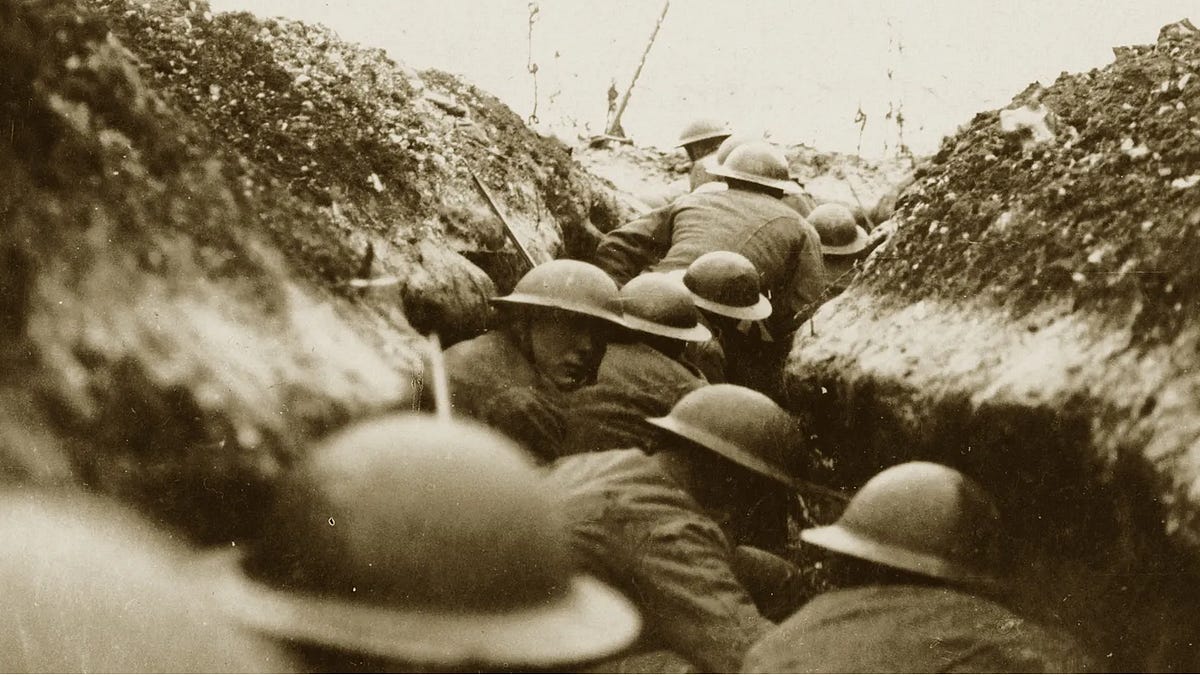
All Quiet also describes the horrors of trench warfare from the perspective of a veteran serving for years, of seeing death and destruction around every corner, breaks up its action with humor and levity, and ends with the war.
asserted
Quiet → describe → war
It covers nearly three years, but Remarque was only on frontline duty for about five weeks.
asserted
Remarque → cover → weeks
It’s unlikely that Remarque ever participated in the actual combat he describes: an article in the Süddeutsche Zeitung describes his service as mostly rear-area construction work; certainly dangerous, he certainly lived through shelling and gas attacks, and it’s a matter of record that he was wounded, but he probably didn’t see the relentless action he describes in All Quiet.
asserted
he → ’ → Quiet
Storm of Steel was first published in 1920, while All Quiet came in 1929.
asserted
Quiet → publish → 1929
I open with the bug-collecting and drinking cooling water because it’s those sorts of shared details that popped out to me after reading them both2, but Jünger was an independently-famous entomologist and a stormtrooper commander and Remarque was not.
asserted
Remarque → open → them
He was on the periphery of such things, and between his time at the front and his time in the hospital, I’m sure he experienced enough and met those who did experience the combat he describes to create the agonizing story,
asserted
he → ’m → story
Remarque was justifiably reticent about discussing his own war experiences or explaining himself.
asserted
Remarque → discuss → himself
All Quiet intersperses brief periods of combat with long scenes of Paul returning home, of soldiers discussing how it’s really the leaders who should fight3, of how training is miserable4 and the food is lousy5 and so on.
asserted
food → intersperse → soldiers
It pontificates about the causes and horrors of war, about the damage it does to one’s psyche and soul, about how it makes men who should be brothers into sincere enemies, how it alienates the soldier from the civilian; it crafts a story for you to do all that.
asserted
you → pontificate → that
But it is a craft, and I think that detracts from its power.
asserted
that → think → power
It really happened, and it reports those happenings with minimal commentary.
asserted
it → happen → commentary
Many books start with an idea and write a world around them; Atlas Shrugged is a vehicle for getting the reader to an 80-page monologue about Objectivism.
asserted
Shrugged → start → Objectivism
All Quiet is in that vein; it wants you to be anti-war, to feel the horrors of it, to know the unfairness, the blundering and chaos and death.
asserted
you → want → unfairness
It starts with the conclusion and works its way backwards.
asserted
It → start → way
…and 293 more, not listed.
 The Aporia