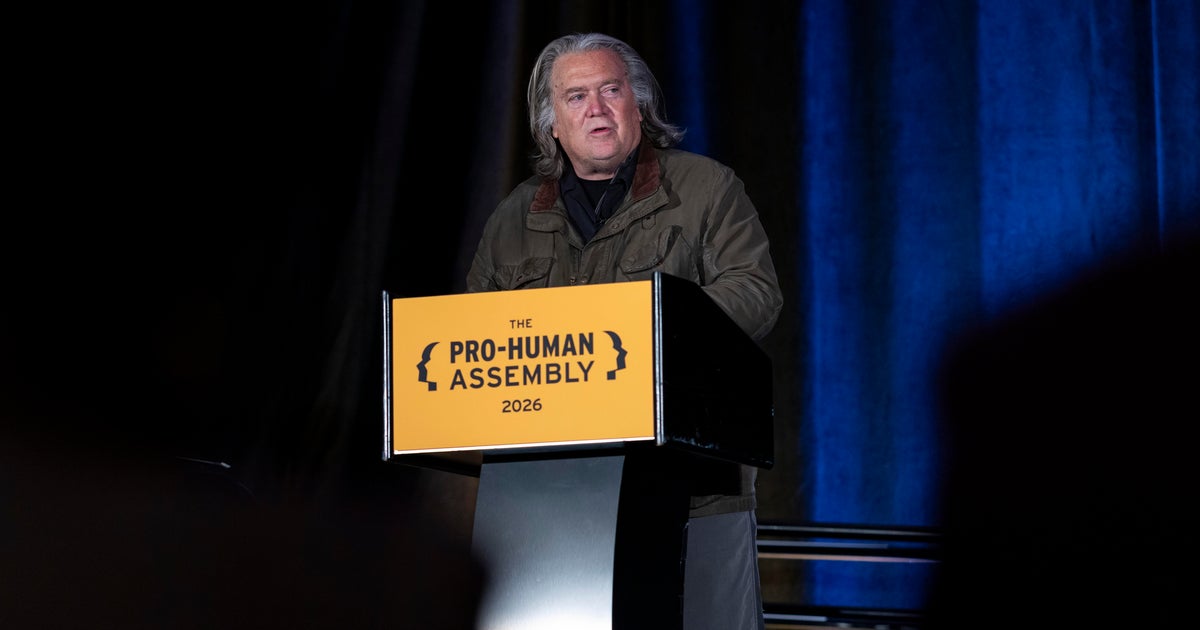
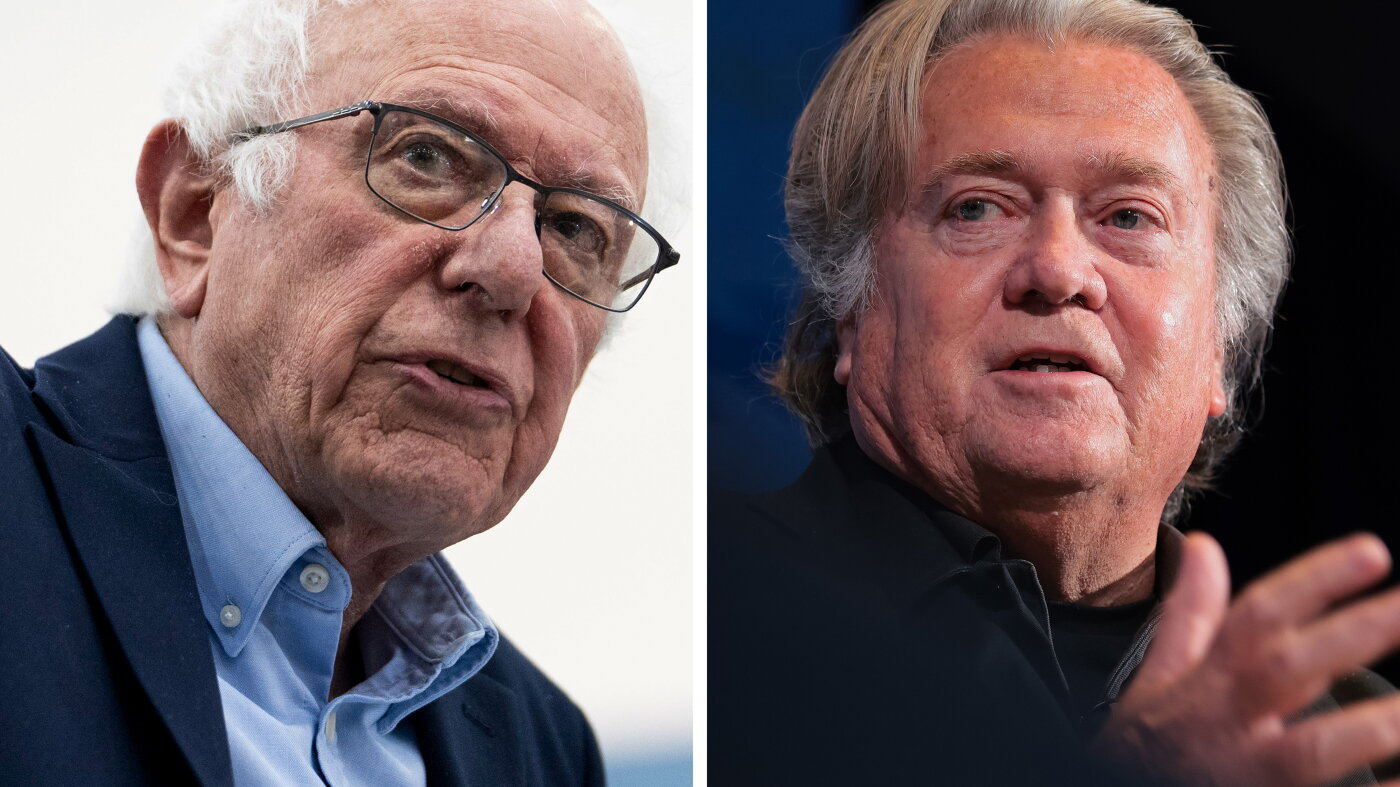
Washington — Steve Bannon, one of President Trump's earliest advisers, and independent Sen. Bernie Sanders may stand on opposite sides of the political spectrum, but both spoke at a gathering Tuesday to press for guardrails for AI.
uncertain
both → stand → AI
The two — along with a bipartisan group of members of Congress — appeared at the "Pro-Human Assembly" in Washington, D.C.
asserted
two → appear → Washington
They're calling for a "human-centric" approach to developing artificial intelligence technology, and are skeptical of the AI companies leading the industry.
asserted
They → call → industry
On Saturday, Anthropic
called for a slowdown in the frontier AI labs, which was quickly echoed by OpenAI CEO Sam Altman and Elon Musk.
asserted
which → call → Altman
Liberal and conservative members of Congress are also urging caution.
asserted
members → urge → caution
"If AI surpasses human intelligence, as many scientists believe could happen, this technology will escape human control with potentially catastrophic consequence," Sanders said as he opened his remarks.
uncertain
he → surpass → remarks
"And perhaps the most important point that I want to leave with you this afternoon is that AI is advancing exponentially — exponentially every single day.
asserted
AI → want → you
In other words, what you are looking at right now is the least capable version of AI that we will ever have."
asserted
we → look → that
Bannon, taking the stage after Sanders, applauded the senator for his speech, saying they may disagree politically and on Mr. Trump, but they're "trying to rise above partisanship, and we have to."
uncertain
we → take → partisanship
Bannon blasted the tech CEOs who have spoken out to say they need more regulations.
asserted
they → blast → regulations
"That's a bald-faced lie," Bannon said, claiming tech CEOs want to "socialize" the risk, shut out competitors and reap the financial benefits for themselves.
asserted
CEOs → say → themselves
Bannon said the companies are trying to make a "liability shift to the American people."
asserted
companies → say → people
Bannon also said Americans, not the U.S. government, need to reap the benefits of the upside of AI, not the government.
asserted
Americans → say → AI
Concern about the ability to control AI's growth has been building.
asserted
Concern → control → growth
Earlier this month, AI researcher Jacob Coxon publicly resigned from Anthropic, which makes the AI app Claude, and said that artificial intelligence, while safe for people to use now, could one day threaten humanity as the technology grows more powerful.
uncertain
technology → resign → humanity
"If you have a super advanced intelligence, it could — it will be smart enough to kill us,"
CBS News senior business and technology correspondent Jo Ling Kent.
uncertain
Kent → have → us
He accused Anthropic and rival developer and ChatGPT-maker OpenAI of by racing to develop advanced AI models.
asserted
He → accuse → models
At the same time, though, Mr. Trump
seven Truth Social posts about AI throughout Monday, repeatedly calling fears over rapid AI development a "HOAX" and saying all AI needs is a strong president like him.
asserted
AI → seven → him
GOP Rep. Chip Roy, a staunch conservative from Texas, told the conference that the crux of the issue goes well beyond "raw politics."
asserted
crux → tell → politics
Roy said he hears his constituents' concerns in Texas about data centers, citing their worries about competing with data centers for water and about the noise the centers generate.
asserted
centers → say → noise
But the fear goes much deeper, he said.
asserted
he → go → ?
"They raise questions about their future.
asserted
They → raise → future
They raise questions about what it means for their children, their communities," he said at the conference, adding, "So, the question here is, how do you harness the power of human-created technology to put — as we are here to discuss — humans first?"
asserted
we → raise → humans
from May shows 65% of Americans think AI will decrease jobs, and 67% of Americans think the federal government probably or certainly will not make sure AI is used in appropriate ways.
uncertain
AI → show → ways
Roy said he's been "scolded" by some of his free-enterprise Republican friends for raising these questions.
asserted
he → say → questions
He also said he disagrees with Mr. Trump, who maintains that a strong president is all that's needed to safeguard AI.
asserted
that → say → AI
Roy also expressed skepticism about the motives of AI CEOs like Amodei.
asserted
Roy → express → Amodei
"Might they be self-interested?" Roy said.
uncertain
Roy → say → ?
"Might they want to corner the market and have a monopoly environment?"
uncertain
they → want → environment
AI needs to be "humans first," Roy said.
asserted
Roy → need → ?
"We are not supposed to be tools for data collection and technology.
asserted
We → suppose → collection
That should be what drives everything that we're thinking about going forward."
asserted
we → drive → that
Just before Roy spoke, Democratic Rep. Greg Casar, a progressive from Texas, took the stage and raised U.S. competitive interests remniscient of the Cold War.
asserted
Casar → speak → War
"We may be Americans or Soviets or Chinese, but we are still human," Casar said.
uncertain
Casar → say → ?
"Now just as back then, we need a pro-human approach."
asserted
we → need → approach
"No one can end the AI arms race.
asserted
one → end → race
It's up to us to end the AI arms race," Casar said.
asserted
Casar → end → race
Rep. Lori Trahan, a Democrat from Massachusetts addressed the gathering after Roy, and took note of the bipartisanship in the room and in Congress on the issue.
asserted
Trahan → address → issue
Trahan introduced the FRONTIER Act with Republican Rep. Jay Obernolte of California, calling for independent evaluators of frontier AI models, among other things.
asserted
Trahan → introduce → things
"Humans are not means to artificial ends," Trahan said.
asserted
Trahan → say → ends
…and 4 more, not listed.
 The Aporia