Some thoughts on South Carolina’s surprisingly close Senate race

Read the original at Silver Bulletin ↗
Cite

Silver, N. (2026, October 29). Some thoughts on South Carolina’s surprisingly close Senate race. Silver Bulletin. https://www.natesilver.net/p/some-thoughts-on-south-carolinas

Dated from the outlet's own feed. Check the original for its byline.

Silver Bulletin · collected 2026-10-29 · by Nate Silver commentary

Quick Summary

This article discusses recent polls for the South Carolina Senate race between Republican Darline Graham and Democrat Annie Andrews, showing the race as extremely close with Graham leading by a negligible margin of 1.5 points. The author argues that while this poll is not an outlier compared to other polling averages, it highlights the uncertainty in predicting electoral outcomes, especially considering factors like high turnout among Black voters which could potentially favor Democrats.
Written by AI on 2026-10-29, from this article's own text only (the story summary below draws on all the coverage).

AI analysis

Story summary

As of October 29, 2026, the Senate race in South Carolina is unexpectedly close, challenging initial predictions. A recent poll from The New York Times and Siena University showed a tight contest between candidates, with Democrats hoping for high turnout among Black voters to potentially swing the election their way. This contrasts with earlier forecasts that favored Republicans. Meanwhile, another poll by FLIPR had Republican Ashley Moody leading in Florida by 6 points, aligning closely with expectations there. The South Carolina race remains a key focus as it could significantly impact overall Senate control despite initial predictions suggesting otherwise.

Written for “South Carolina Senate Race Close” on 2026-10-29, grounded in this article and the 0 other(s) covering the same event.
Why this leaning score
This article does not take a side on a contested political question, so it has no leaning score. That is an answer rather than a gap: a match report or a rescue can be warmly or critically written without being left or right, and scoring it anyway is how approval of a subject gets recorded as a political position.
No political leaning scored for article 113486 · logged 2026-10-29

Story

📰 South Carolina Senate Race Close
Politics · 1 article(s) covering the same event.

Compared with similar articles

This article reads unscored and hedges 20% of its claims. Each row says how that neighbour differs.
The Bulwark
Hedges 1 of 3 claims
“The articles discuss different aspects of the Senate race in South Carolina, not the same specific incident or outcome.”
Fox News
Hedges 0 of 14 claims Outlet record 70/100
“Article A discusses overall polling trends in two key Senate races, while Article B focuses on a more speculative and individual analysis of South Carolina's race specifically.”
CBS News
Hedges 0 of 1 claims Outlet record 66/100
“The articles discuss different aspects of the South Carolina Senate race and do not describe the same specific incident or outcome.”
The Bulwark
Hedges 4 of 98 claims
“The articles discuss different aspects of Senate races but do not describe the same specific incident or occurrence.”
The Bulwark
⚖️ Leans left Hedges 11 of 36 claims
“The articles discuss different topics related to voting and elections but do not describe the same specific incident.”
How this article was measured signals, leaning charts, publisher record, byline, topics and claims

Signals How these are calculated →

Claims extracted
44
sentences that state something as happening or true
Uncertain
20%
9 of 44 hedged ("reportedly", "may", "according to")
Leaning
not political
takes no side on a contested political question
Publisher signals
not measured
these signals count newsroom corrections; Commentary has none to count
Outlets on this story
1
Politics
Same framing elsewhere
1
articles that frame the event the way this one does
Analyzed 2026-10-29 · how these are computed

How this is being covered How these are calculated →

Article leaning vs. publisher reliability
Source leaning vs. consistency

Publisher

Silver Bulletin · 52 article(s) · 0 correction(s) detected
No corrections detected for this publisher. That may mean careful reporting, or simply that nothing has been checked.

Who wrote this

Nate Silver
34 article(s) here · 1 carrying a prediction
🔮 For example, if Democrats have a good night next Tuesday and Peggy Flanagan easily wins in Minnesota, our newsletter from earlier this month that seriously contemplated Michele Tafoya’s chances might be one of those.
🔮 But I’m feeling a little meta-d out this weekend — maybe it was seeing You Can See Everything on Friday.1
2026-10-25 · assertive framing · Let’s talk shop about every Senate race
🔮 Strategic Vision “polls” exhibited statistical patterns — namely, being far more likely to contain some trailing digits (such as 5, 7, 8 and 9) than others, including on obscure questions they probably thought would never be scrutinized — that were canonical signs of forged election results in authoritarian regimes.
2026-10-22 · assertive framing · Fake polls are a real problem
🔮 But leave that philosophical question aside for now — because after a long week of travel,1 I could use a simpler Model Talk.
2026-10-17 · assertive framing · The good, bad and ugly outcomes in the Senate
🔮 Below, you’ll find our forecast for each 2026 Senate race, along with how our numbers have changed over time and which states are likeliest to decide control of the chamber.
2026-10-15 · assertive framing · FLIPR 2026 Senate forecast
🔮 Although our critics might disagree, we seek to avoid false equivocation at Silver Bulletin.
2026-10-09 · assertive framing · Could Minnesota spoil the blue wave?
🔮 It’s not unreasonable to approach election polls from a position of mild — maybe even more-than-mild — skepticism.
2026-10-03 · assertive framing · What if the polls are wrong again?
🔮 That definitely will not happen before the midterms.
2026-10-01 · assertive framing · SBSQ reboot thread
🔮 We think it’s an important story, providing historical context on midterm elections that helps to explain FLIPR’s increasingly optimistic forecast for Democrats.
2026-10-01 · assertive framing · Why did Ohio stop being a swing state?
🔮 The 2026-27 NBA season begins on Oct. 20, when the New York Knicks will lift the championship banner to celebrate their first NBA title in 53 seasons.
2026-09-28 · assertive framing · NBA Future of the Franchise Rankings 4.0
Also by Nate Silver
Let’s talk shop about every Senate race
2026-10-25 · Silver Bulletin
Fake polls are a real problem
2026-10-22 · Silver Bulletin
The good, bad and ugly outcomes in the Senate
2026-10-17 · Silver Bulletin
FLIPR 2026 Senate forecast
2026-10-15 · Silver Bulletin
Nothing else under this byline is closely related to this article, so these are simply their most recent.
All 34 articles by Nate Silver →

Topics

Democrats Minnesota NYT Senate South Carolina

Subjects

South Carolina GPE · 10× Democrats NORP · 7× Minnesota GPE · 7× FLIPR ORG · 4× Flanagan PERSON · 4× Graham PERSON · 3× NYT ORG · 3× Senate ORG · 3× Republican NORP · 2× Times ORG · 2×

Narrative

Although in an interesting twist we’ll return to later, the Citadel had Andrews ahead by 6 points among registered voters.3 In my roundup of Senate races this weekend that compared FLIPR’s forecasts against prediction markets, I didn’t take FLIPR’s side in South Carolina.
framing: mixed · carried by 1 article(s) · first seen 2026-10-29
🔮 For example, if Democrats have a good night next Tuesday and Peggy Flanagan easily wins in Minnesota, our newsletter from earlier this month that seriously contemplated Michele Tafoya’s chances might be one of those.
2026-10-29 · Silver Bulletin
Some thoughts on South Carolina’s surprisingly close Senate race · mixed framing

Claims (44 extracted, 9 hedged)

If you’re fully exploring the probabilistic landscape in an uncertain electoral environment, you’re inevitably going to end up with some posts that “didn’t age well.” asserted
that → explore → posts
For example, if Democrats have a good night next Tuesday and Peggy Flanagan easily wins in Minnesota, our newsletter from earlier this month that seriously contemplated Michele Tafoya’s chances might be one of those. uncertain
that → have → those
If Democrats have a disappointing night, conversely, this post about the South Carolina Senate race will be a candidate for the “didn’t age well” bucket. asserted
post → have → bucket
But we haven’t examined South Carolina all that seriously. asserted
we → examine → Carolina
Nor have we given sufficient attention to a possibility that could give Democrats a winning hand in the Senate, even if they fall short in the Palmetto State: disproportionately high turnout among Black voters. uncertain
they → give → voters
Minnesota and South Carolina, indeed, were two of the three states that The New York Times and Siena University polled in their latest round of surveys, published early this morning. asserted
Times → poll → surveys
The third state, Florida, produced the least interesting result, with Republican Ashley Moody ahead by 6 points, pretty much spot-on to FLIPR’s polling average there. asserted
Moody → produce → average
And that state is actually … Minnesota, where NYT/Siena had Flanagan ahead by 14 points, much greater than her 4.7-point lead in the FLIPR average entering the day. asserted
Flanagan → have → day
The new poll may reflect Democrats coming home despite Flanagan’s weaknesses as a candidate.1 Indeed, our “simple fundamentals” calculation in Minnesota, based on the generic ballot among likely voters and its partisan lean score, pegs it at D +13.7. uncertain
calculation → reflect → D
Even so, the poll may be on the optimistic side for Flanagan: “probably too hot for Democrats”, as the Times’s Nate Cohn wrote. uncertain
Cohn → write → Democrats
(Unlike many other pollsters, the NYT/Siena polls do very little herding, and they’ve never been afraid to publish results that differ from the consensus.) asserted
that → do → consensus
Still, Minnesota comes up as the tipping-point state 6 percent of the time in our simulations, as much as other states that get more attention. asserted
that → come → attention
Pushing Minnesota from “slightly weird race that could give Republicans a few backdoor outs” to “state that Flanagan will win unless Democrats are having huge problems elsewhere and are screwed anyway” is potentially worth something.2 Paid subscribers get full access to our Election Night livestream with The Argument, GD Politics, and Slow Boring. The NYT poll in South Carolina is not an outlier The Times’s poll in South Carolina drew more attention. uncertain
poll → push → attention
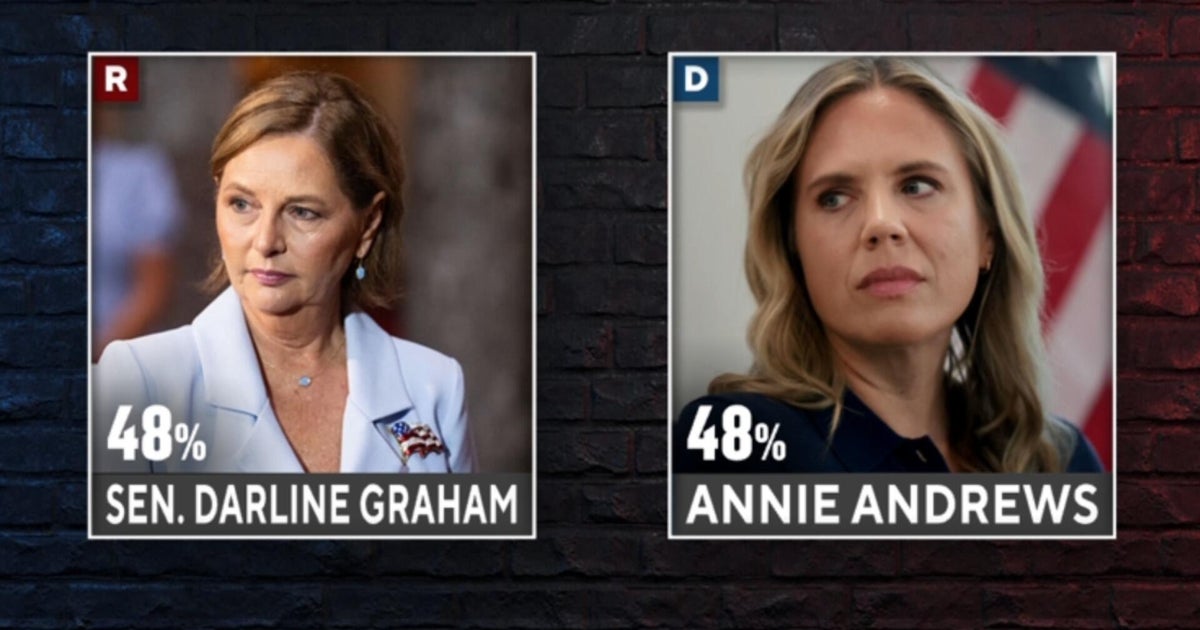
It showed the race tied 48-48. asserted
race → show → ?
(Republican Darline Graham was ahead of Democrat Annie Andrews by less than a full point if you go to the decimal place.) asserted
you → go → place
But this poll is not an outlier relative to the polling average in South Carolina, which had shown Graham up by 1.5 points entering the day. asserted
which → show → day
That’s partly because the NYT survey wasn’t the only new poll of South Carolina to enter our database overnight. asserted
survey → ’ → database
A new Citadel Poll has Graham, who was appointed to succeed Lindsey Graham after he died in July, leading by 3 points. asserted
he → have → points
Although in an interesting twist we’ll return to later, the Citadel had Andrews ahead by 6 points among registered voters.3 In my roundup of Senate races this weekend that compared FLIPR’s forecasts against prediction markets, I didn’t take FLIPR’s side in South Carolina. asserted
I → return → Carolina
At the time, we gave Andrews a 27 percent chance there, as compared to 20 percent for prediction markets. asserted
we → give → markets
This is what I wrote about the state: asserted
I → write → state
Here’s where I feel like we start to get into more speculative territory, even though the difference between FLIPR (27 percent for Annie Andrews) and prediction markets (20 percent) isn’t all that large. asserted
difference → ’ → Andrews
I suppose I have a reflexive concern about taking the bull case on Democrats in South Carolina given two factors. asserted
I → suppose → factors
First, the much overhyped Jaime Harrison race, where he eventually lost to Lindsey Graham (RIP) by 10 points. asserted
he → overhype → points
It has a large Black population, a lot of conservative, evangelical whites, and not many swing voters. asserted
It → have → whites
Even according to FLIPR, there’s little chance — 4 percent — that South Carolina will be the tipping-point state. uncertain
Carolina → accord → FLIPR
If polls are systematically overestimating Democrats in red states, Andrews’s chances are basically zip even if Darline Graham, Lindsey’s sister, is a weak candidate. asserted
Graham → overestimate → states
If the polls are accurate about red-state performance, Democrats could pick up South Carolina if they’re having a fantastic night, but at that point they’ve probably already won Texas and so forth and have more than enough seats in hand. uncertain
they → pick → hand
Ironically, Andrews’s chances have now improved to 27 percent at Polymarket with the new polling, exactly where FLIPR had it previously. asserted
FLIPR → improve → it
Although FLIPR’s odds for Andrews have also ticked up slightly, to 31 percent. asserted
odds → tick → percent
That might actually seem ungenerous to Andrews given how tight the polling is, but FLIPR Classic and FLIPR Deluxe blend polls with “fundamentals” and, in the case of Deluxe, expert ratings. uncertain
Classic → seem → ratings
One point I’ve emphasized in recent interviews is that polls and fundamentals actually aren’t all that out of whack in states like Ohio, Texas and Iowa. asserted
polls → emphasize → Ohio
For instance, a roughly 11-point swing from 2024, in line with FLIPR’s current popular vote forecast, would bring a state like Ohio, which Trump carried by 11 points in 2024, basically to parity. asserted
Trump → bring → parity
But that math doesn’t work in South Carolina, which Trump won by 18 points in 2024. asserted
Trump → work → 2024
Democrats will need basically everything to go right there: first, a serious outperformance for Andrews based on candidate quality and second, turnout patterns that look much different than South Carolina has experienced in the recent past. asserted
Carolina → need → past
Why did FLIPR’s odds for Andrews improve, however slightly, even if our polling average didn’t change? asserted
average → improve → Andrews
It’s because of that disparity between polls and fundamentals. asserted
It → ’ → polls
In a race with no polling at all, FLIPR has no choice but to go entirely on fundamentals. asserted
FLIPR → have → fundamentals
The more polling there is, and the more reliable FLIPR considers polls to be, the more weight it puts on polls instead — although it never entirely zeroes out fundamentals. asserted
it → be → fundamentals
Basically, in possession of more data, FLIPR is a bit more confident now that the polls really do show a close race in South Carolina. asserted
polls → show → Carolina
…and 4 more, not listed.

💬Give feedback
🕘History 🎫Support