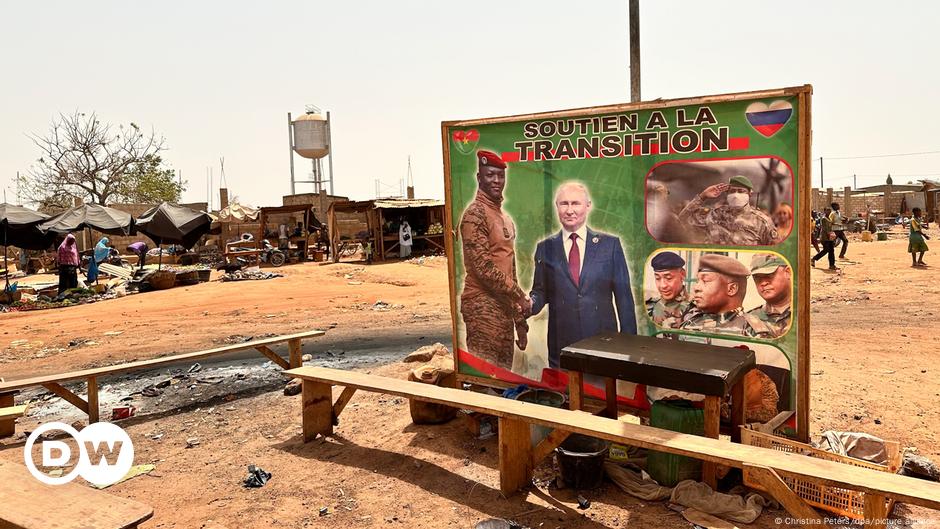
The conflict with the West sparked by Russia's full-scale invasion of Ukraine prompted Russian President Vladimir Putin to seek support from other parts of the world.
asserted
conflict → spark → world
Africa has become a focus, with foreign minister Sergei Lavrov visiting the continent increasingly often.
asserted
Lavrov → become → continent
Russian foreign ministry spokesperson Maria Zakharova has described it as a "historic return," and declared no one and nothing could be compared to what Russia did for Africa in the 20th century.
uncertain
Russia → describe → century
Russia's most important African partner: Egypt
A Russia-Africa summit has been held in Russia at roughly three-year intervals since 2019.
asserted
summit → hold → 2019
The third takes place in Moscow on October 28 and 29.
asserted
third → take → October
The program focusses on economic cooperation.
asserted
program → focusse → cooperation
Other topics range from politics and security to science and culture.
asserted
topics → range → science
But Russia is actively working with only a few African countries, mainly in the north of the continent, and this is reflected in the trade figures.
asserted
this → work → figures
"South Africa is still Africa's largest national economy, but its volume of trade with Russia is small, far less than with Egypt and Algeria," says Ivan Klyszcz from the International Centre for Defence and Security (ICDS) in Tallinn, Estonia.
asserted
Klyszcz → say → Tallinn
Egypt plays an important role in this regard.
asserted
Egypt → play → regard
Russian diplomats and business representatives are trying to extend relationships with other countries, especially Tanzania and Ethiopia, but with no appreciable success so far.
asserted
diplomats → try → success
Egypt is the second-largest economy in Africa, and the bilateral volume of trade with Russia has more than doubled since 2021; in 2025, according to Russia's Federal Customs Service, it was $10.5 billion (€9.4 billion).
uncertain
it → double → Service
Consignments of Russian grain are the main drivers, followed by products of the metal industry.
asserted
Consignments → follow → industry
Russia is building a big nuclear power plant in the Egyptian region of El-Dabaa on the Mediterranean coast.
asserted
Russia → build → coast
Construction is being financed by a Russian loan of 25 billion US dollars, which covers around 85% of the costs.
asserted
which → finance → costs
Egypt is one of the few African countries with which Russia enjoys stable business relationships, as well as having extensive experience of cooperation, says Nikita Smagin, an expert on Russian policy in the Middle East.
asserted
Smagin → enjoy → East
"In the long term, Egypt could become Moscow's gateway to Africa and to other markets," he says.
uncertain
he → become → markets
"But Cairo is pursuing its own interests.
asserted
Cairo → pursue → interests
It would be too optimistic to hope that Egypt is lending its support purely out of political solidarity.
asserted
Egypt → hope → solidarity
According to the Russian customs service, around 39% of Russian–African trade in 2025 was with Egypt, and total sales between Russia and all 54 countries of the African continent came to around 27 billion US dollars.
uncertain
sales → accord → dollars
Africa's share of Russia's foreign trade is therefore very small (3.9% in 2025), and not at all commensurate with the attention Moscow is devoting to its relations with African countries.
asserted
Moscow → devote → countries
In 2025, the volume of trade with the EU came to around 385 billion US dollars.
asserted
volume → come → dollars
African countries' statistics also show that other partners were well ahead of Russia.
asserted
partners → show → Russia
Fidel Owusu, a Ghanaian expert with Geopolitical Intelligence Services (GIS) in Liechtenstein, comments that Russia's economic presence in Africa has not been as significant as that of China, the United States, India, or other traditional powers like France and Britain.
asserted
presence → comment → France
"If you look at the volume of trade and the kind of investment," he says, "in recent times, some middle powers such as Turkey and the UAW are doing far better than Russia."
asserted
powers → look → Russia
Beverly Ochieng, a senior analyst with Control Risks, a global risk and strategic intelligence consultancy in Senegal, observes: "Western countries continue to dominate in strategically important areas such as raw material extraction, finance, and the energy sector, even if their political presence in the region is declining."
asserted
presence → observe → region
According to her, "Russia will compete more intensively for access to critical mineral resources and energy projects.
uncertain
Russia → accord → resources
We see this with lithium projects in Mali as well as with nuclear power initiatives across the continent.
asserted
We → see → continent
Starting with the arrival of the Wagner Group, Russian mercenaries have been supporting African regimes, particularly those of the unstable countries in the Sahel region.
asserted
mercenaries → start → region
In exchange, their associated subsidiaries are granted access to raw materials.
asserted
subsidiaries → associate → materials
Following the death of the Wagner Group leader, Yevgeny Prigozhin, most of these operations were taken over by the Africa Corps, a paramilitary group set up and controlled by Russia's defense ministry.
asserted
most → follow → ministry
According to the Congressional Research Service, the think tank of the US Congress, the largest Russian military contingents, each comprising several thousand men, are in the Central African Republic, Mali, and Libya.
uncertain
contingents → accord → Republic
The Africa Corps is also keen to extend its presence in Burkina Faso and Niger.
asserted
Corps → extend → Faso
Russian mercenaries have also been spotted in Equatorial Guinea.
asserted
mercenaries → spot → Guinea
Irina Filatova from the University of Cape Town stresses that there are several reasons why it's important for Russia to maintain a military presence in Africa.
asserted
Russia → stress → Africa
"The countries have sizeable deposits of minerals such as gold and uranium.
asserted
countries → have → gold
Through them, it's possible to exert influence over Europe's southern borders, including in matters of migration and regional security.
asserted
it → exert → migration
Goods can easily be supplied via Libya to countries without access to the sea," Filatova says.
asserted
Filatova → supply → sea
Ultimately, Russia is still one of the biggest suppliers of arms to African countries, even though Russian exports have fallen over the course of the war in Ukraine.
asserted
exports → fall → Ukraine
The Stockholm International Peace Research Institute (SIPRI) estimates Moscow's share of the African market for the years 2021–2025 at 15%, which puts it in third place behind the United States (19%) and China (17%).
asserted
which → estimate → States
…and 15 more, not listed.
 The Aporia