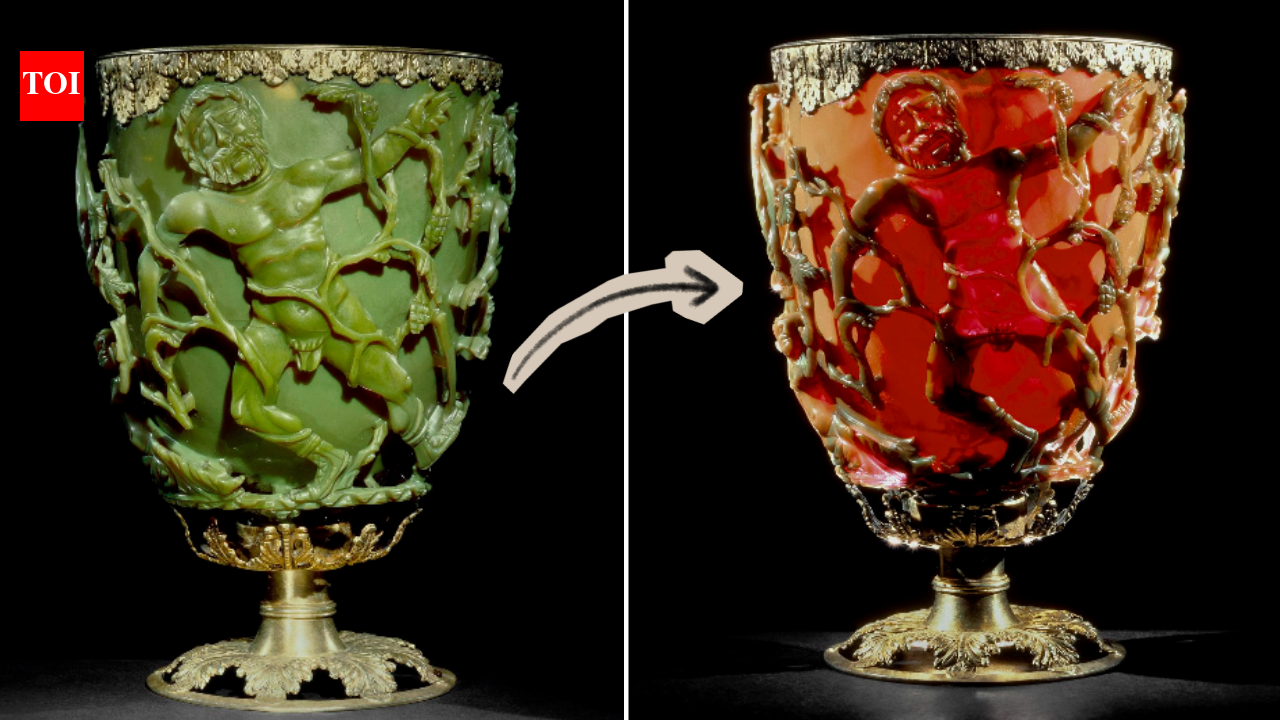
A drinking cup made around 1,600 years ago has a remarkable property: it can appear green when light falls on it and ruby red when light shines through it.
asserted
light → make → it
Now, researchers at the University of Sheffield have recreated the unusual glass effect, offering a new understanding of the technique used by ancient Roman glassmakers.
asserted
researchers → recreate → glassmakers
According to the official website of University of Sheffield, the team has successfully reproduced the effect of the famous Lycurgus Cup using a repeatable glass recipe.
uncertain
team → accord → recipe
The original artifact, held at the
British Museum
asserted
artifact → hold → the
, is made from a special type of glass known as ‘dichroic glass,’ which displays different colours depending on how light interacts with it.
asserted
light → make → it
The achievement follows extensive experiments by Dr Lisa Hollands, a technician in the university’s School of Chemical, Materials and Biological Engineering, working with Professor Caroline Jackson, an expert in Roman glass.
asserted
achievement → follow → glass
Why does the Roman cup change colour?
asserted
cup → change → colour
Photo credit: University of Sheffield
The British Museum dates the Lycurgus Cup to the fourth century AD.
asserted
Museum → date → AD
Its collection record identifies it as a Late Roman drinking cup made of glass, with silver-gilt fittings around its rim and base.
asserted
record → identify → rim
The cup’s green-to-red colour change is linked to tiny amounts of gold and silver in the glass.
asserted
change → link → glass
According to the University of Sheffield, these metals formed nanoparticles, particles thousands of times smaller than a grain of sand that interact with light in unusual ways.
uncertain
that → accord → ways
When light reflects off the cup, the glass appears jade green.
asserted
glass → reflect → cup
When light passes through it, the glass takes on a ruby-red appearance.
asserted
glass → pass → appearance
The effect depends on the position of the light source and the way the glass absorbs and scatters different wavelengths of light.
asserted
glass → depend → light
The nanoparticles are smaller than the wavelengths of visible light, and their size and shape affect the colours observed.
asserted
size → affect → colours
The precise composition and formation of these particles are important to producing the distinctive effect.
asserted
composition → produce → effect
The Lycurgus Cup is particularly notable because it is the only surviving example of a Roman glass cage cup known to display this exceptional colour-changing behaviour, according to the University of Sheffield.
uncertain
it → survive → Sheffield
Cage cups are elaborate vessels in which decorative glasswork is cut away from the body of the vessel, leaving figures and patterns connected by narrow bridges.
asserted
glasswork → cut → bridges
Years of experiments to recreate an ancient technique
The team worked to study what was known about Roman glassmaking and develop a base glass using modern materials intended to mimic those available to ancient craftsmen.
asserted
what → recreate → craftsmen
The greater challenge was getting small quantities of gold and silver into the glass in the right form.
asserted
challenge → get → form
The team tested different furnaces, starting materials and oxygen levels.
asserted
team → test → furnaces
The experiments even included adding sugar to the mixture.
asserted
experiments → include → mixture
Eventually, Hollands developed a recipe that produced glass appearing opaque green in reflected light and red when illuminated from behind.
asserted
that → develop → light
A modern sculpture inspired by the ancient cup
After the initial glass was exhibited at LightFest, the researchers commissioned glass artist Elliot Walker to create a contemporary sculpture using Hollands’ recipe.
asserted
researchers → inspire → recipe
Walker won season two of Netflix’s ‘Blown Away.’
asserted
Walker → win → Blown
The sculpture draws on the story depicted on the original cup and the form of the ancient Farnese Atlas sculpture.
asserted
sculpture → draw → sculpture
Walker explained that the design needed a blown-glass element to demonstrate the colour-changing effect clearly.
asserted
design → explain → effect
The new work is scheduled to be unveiled at Sheffield’s Millennium Gallery during the
University’s Festival of the Mind, running from November 6 to 15, 2026.
asserted
work → schedule → 2026
The university says the sculpture will subsequently go on permanent display at its Turner Museum of Glass.
asserted
sculpture → say → Glass
What the research could mean beyond art
The recreated glass has immediate decorative potential, but the research also has wider scientific relevance.
uncertain
research → mean → relevance
According to the University of Sheffield, the project forms part of work exploring materials that use light for applications in areas such as solar energy, quantum technologies and healthcare diagnostics.
uncertain
that → accord → energy
The knowledge gained may also contribute to the development of advanced glasses used to immobilise radioactive waste.
uncertain
knowledge → gain → waste
The Lycurgus Cup itself remains at the British Museum.
asserted
Cup → remain → Museum
Its collection record describes the vessel as a fourth-century Roman drinking cup decorated with scenes from the story of Lycurgus, the mythical king of Thrace.
asserted
record → describe → Thrace
In the myth shown on the cup, Lycurgus attacks Dionysus and his followers.
asserted
Lycurgus → show → Dionysus
Ambrosia, one of the god’s companions, is transformed into a vine that coils around and traps the king.
asserted
that → transform → king
The ancient vessel combines this elaborate decoration with an optical effect that still attracts scientific attention.
asserted
that → combine → attention
By recreating its colour-changing glass, the Sheffield team has brought researchers closer to understanding how a technique used by Roman craftsmen can be reproduced with modern materials and scientific knowledge.
asserted
technique → recreate → materials
 The Aporia