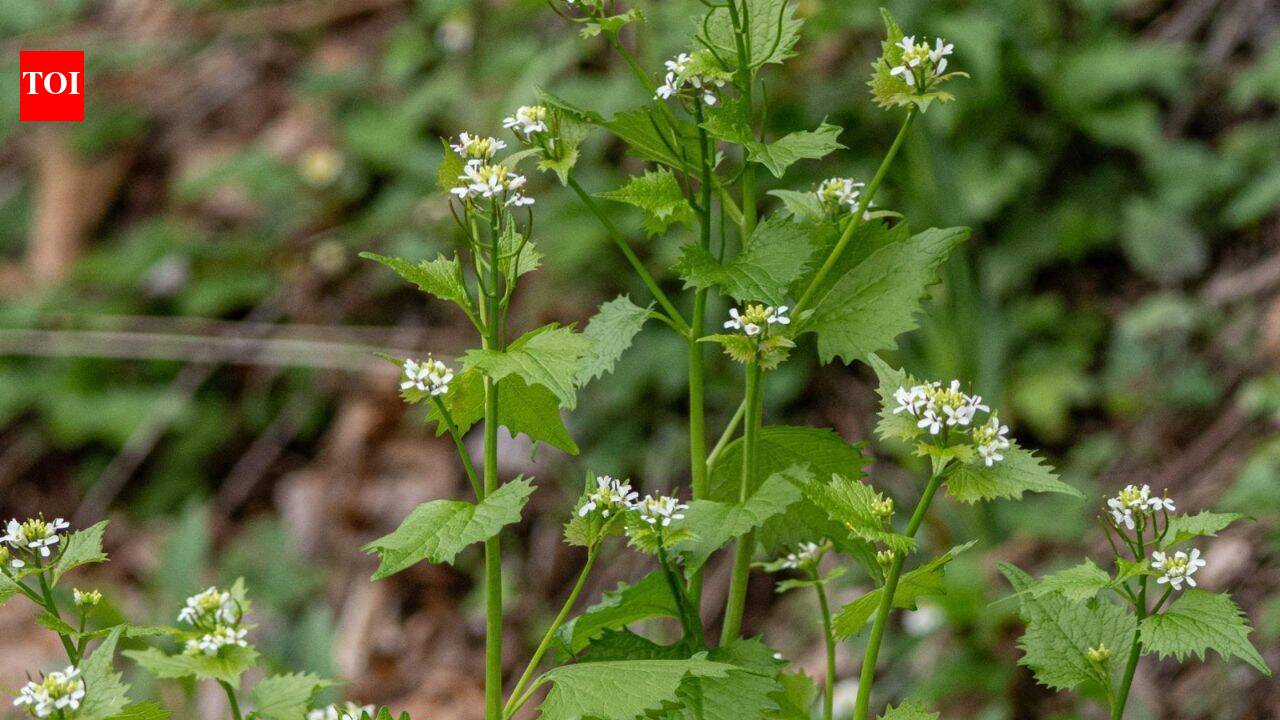
This plant was introduced to North America in the 1860s for its culinary and medicinal value, but has become a stubborn threat to woodlands throughout the continent.
asserted
plant → introduce → continent
Native to Europe and Asia, garlic mustard was first reported in Long Island, New York and has since spread to most US states and Canadian provinces.
asserted
mustard → report → states
The plant was once valued as a useful herb .
asserted
plant → value → herb
Now, it threatens native vegetation by competing for essential resources and disrupting relationships between plants and soil.
asserted
it → threaten → plants
Its ability to thrive in shaded forests has made it particularly difficult to control.
asserted
it → thrive → forests
How garlic mustard spread across North America
Garlic mustard, scientifically known as Alliaria petiolata, belongs to the mustard family and is native to Europe and parts of Asia.
asserted
mustard → spread → Asia
According to the US Forest Service’s Fire Effects Information System, the plant was first reported in North America in 1868 on Long Island, New York.
uncertain
plant → accord → Island
It subsequently became established across much of the northeastern and midwestern United States.
asserted
It → establish → States
The University of Maryland explains that European immigrants introduced garlic mustard during the 1860s for several practical purposes.
asserted
immigrants → explain → purposes
They used its leaves as a culinary herb, valued it for medicinal applications and planted it to help control soil erosion.
asserted
They → use → erosion
However, the plant eventually spread beyond the places where it was originally cultivated.
asserted
it → spread → places
Michigan Natural Features Inventory reports that garlic mustard has reached at least 37 US states and 6 Canadian provinces.
asserted
mustard → report → states
8 US states also list it as a noxious weed.
asserted
states → list → weed
Its distribution reflects its ability to establish itself in a variety of environments.
asserted
distribution → reflect → environments
The US Forest Service records its presence in deciduous woodlands and disturbed areas across large parts of the US, with additional occurrences in western states and Alaska.
asserted
Service → record → states
What makes garlic mustard difficult to contain
One of the plant’s greatest advantages is its ability to grow in shaded environments.
asserted
One → make → environments
Many invasive plants struggle to establish themselves beneath a forest canopy, where sunlight is limited.
asserted
sunlight → struggle → canopy
Garlic mustard, however, can thrive in these conditions.
asserted
mustard → thrive → conditions
The species grows in the layer of vegetation beneath taller trees.
asserted
species → grow → trees
It tolerates different soil conditions but generally performs well in moist, well-drained ground.
asserted
It → tolerate → ground
Garlic mustard can also grow in gardens and other open spaces, which means it is a problem for more than just natural forests, according to the University of Maryland.
uncertain
it → grow → Maryland
It can be spread by water, wind, animals, insects and human activity.
asserted
It → spread → water
Its life cycle helps it maintain a foothold in affected areas.
asserted
it → help → areas
The plant is a biennial, meaning it completes its life cycle over 2 years.
asserted
it → mean → years
During the first year, it develops a low cluster of leaves close to the ground.
asserted
it → develop → ground
In the second year, it produces an upright flowering stem before setting seed and dying.
asserted
it → produce → seed
Young plants can emerge early in the year, before many native woodland plants begin growing.
asserted
plants → emerge → year
This early start gives garlic mustard an opportunity to occupy space and use available resources before its competitors become active.
asserted
competitors → give → resources
How does the plant affect native woodland life
Garlic mustard threatens woodland ecosystems by forming dense patches that compete with native plants for sunlight, moisture, nutrients and growing space.
The US Forest Service says the contest poses a major threat to native plants and animals.
asserted
contest → affect → plants
When garlic mustard spreads across the forest floor, other plants may struggle to obtain the resources they need to survive.
uncertain
they → spread → resources
Garlic mustard can also release chemicals through its roots that affect communities of mycorrhizal fungi.
asserted
that → release → fungi
These fungi help many plants obtain nutrients from the soil.
asserted
plants → help → soil
Disrupting these relationships can have consequences beyond the immediate area occupied by the invader.
asserted
Disrupting → disrupt → invader
These fungal communities are important to numerous native species, including economically valuable trees.
asserted
communities → include → trees
The plant may also affect wildlife that depends on particular native species.
uncertain
that → affect → species
The Michigan Natural Features Inventory links garlic mustard to local losses of toothworts, plants that provide the primary food source for the caterpillars of the West Virginia white butterfly.
asserted
that → link → butterfly
Chemicals associated with garlic mustard have also been implicated in the failure of eggs laid on the invasive plant to hatch.
asserted
Chemicals → associate → plant
Why can one plant create a lasting problem
asserted
plant → create → problem
Garlic mustard produces large numbers of seeds, allowing small infestations to expand rapidly when left unmanaged.
asserted
infestations → produce → seeds
The University of Maryland indicates that an individual plant can produce as many as 15,000 seeds, although estimates vary.
asserted
estimates → indicate → seeds
…and 15 more, not listed.
 The Aporia