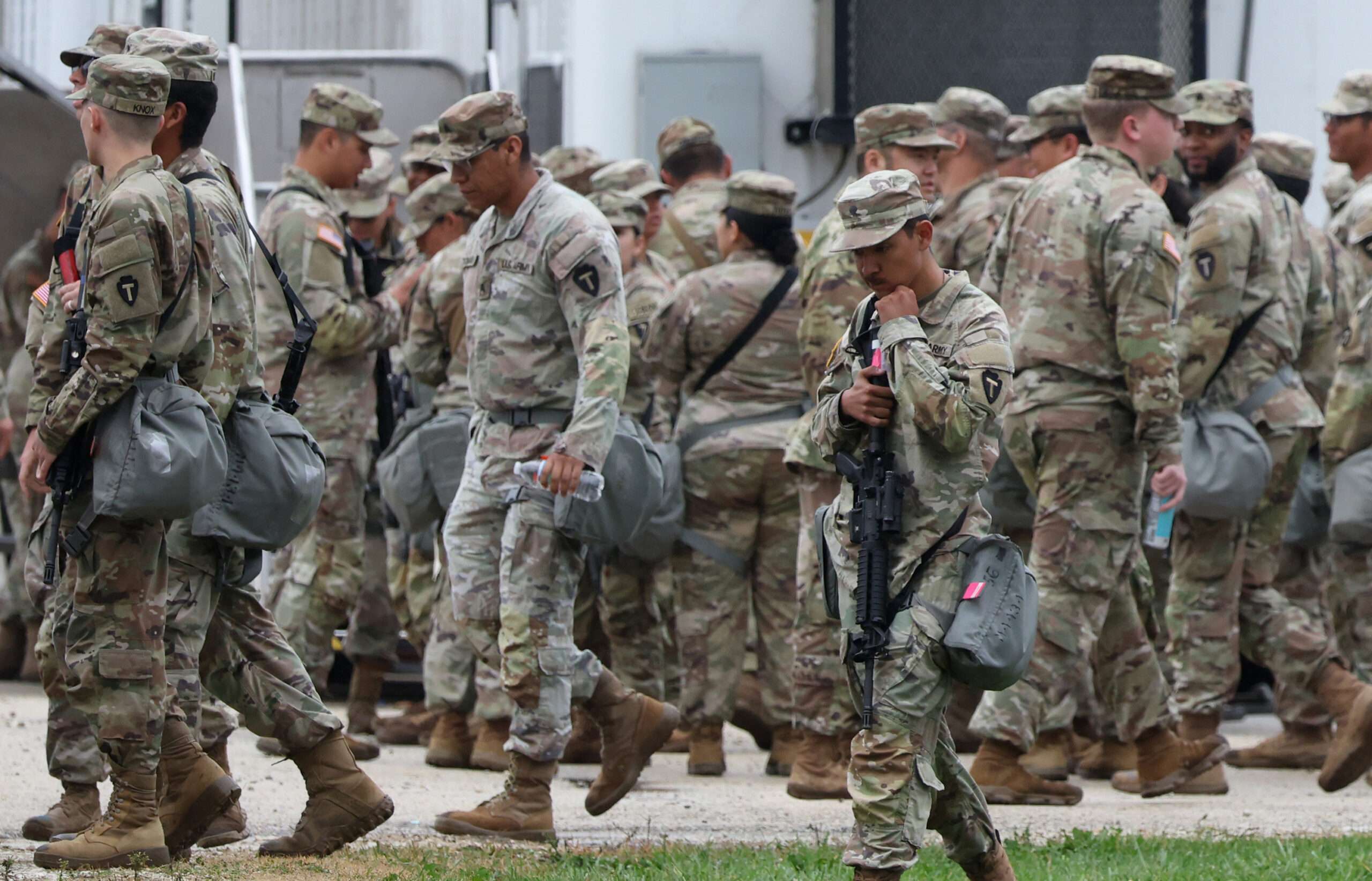
On October 23, in the case of Newsom v. Trump, the US Court of Appeals for the Ninth Circuit ruled Donald Trump's June 2025 federalization of the National Guard in Los Angeles was likely illegal.
asserted
federalization → rule → Angeles
This decision has little immediate effect, because the National Guard deployment ended months ago, after the Supreme Court ruled against Trump in a related Illinois case.
asserted
Court → have → case
But it has important implications for judicial review of executive invocation of emergency powers to use the military domestically.
asserted
it → have → military
Among other things, it emphasizes that such actions are reviewable, and the president should get only limited deference.
asserted
president → emphasize → deference
It also adopts a properly restrictive definition of "rebellion" (which is one of the conditions that might justify federalization of the National Guard).
uncertain
that → adopt → Guard
Trump federalized the Guard in response to anti-ICE protests.
asserted
Trump → federalize → protests
The district court ruled his action was illegal and issued an injunction blocking it.
asserted
action → rule → it
But the Ninth Circuit lifted the preliminary injunction, in a decision I criticized at the time.
asserted
I → lift → time
The relevant statute 10 U.S.C. Section 12406, can only be used to federalize state forces in one of the following situations:
1) the United States, or any of the Commonwealths or possessions, is invaded or is in danger of invasion by a foreign nation;
(3) the President is unable with the regular forces to execute the laws of the United States
Last year, the Ninth Circuit ruled (incorrectly, I think) that Trump's action might have been permissible under Subsection 3: a situation where "the President is unable with the regular forces to execute the laws of the United States."
uncertain
President → use → States
As the Ninth Circuit acknowledges in their most recent decision, this basis for Trump's actions was undermined by the Supreme Court's December ruling in the related case of Trump v. Illinois, which held that Subsection 3 can only be invoked when the president is authorized to use regular federal military forces to enforce the law, and those forces are inadequate.
asserted
forces → acknowledge → law
These circumstances do not apply to anti-ICE protests in Los Angeles and Chicago.
asserted
circumstances → apply → Angeles
No one claims that the situation in Los Angeles amounted to an "invasion" by a "foreign nation."
uncertain
situation → claim → nation
Thus, in its most recent decision the Ninth Circuit considered whether Trump's actions were authorized by Subsection 2, which allows federalization of the guard when "there is a rebellion or danger of a rebellion against the authority of the Government of the United States."
asserted
which → consider → States
The majority opinion by Judge Jennifer Sung holds that the determination that there is a "rebellion" is subject to judicial review and can be invalidated " if it "did not reflect a colorable assessment within a range of honest judgment."
asserted
it → hold → judgment
I think this is overly deferential.
asserted
this → think → ?
For reasons I outlined in an article published last year, there should be little or no deference when the executive invokes extraordinary emergency powers.
asserted
executive → outline → powers
Still, the Ninth Circuit standard is far from a blank check, and does allow invalidation of executive actions where the claim of rebellion is blatantly wrong - as it was here.
uncertain
it → allow → rebellion
Following the district court, the Ninth Circuit defined "rebellion" as "a violent, armed, organized, open and avowed uprising against the government as a whole."
asserted
Circuit → follow → whole
This differentiates "rebellion" from smaller-scale violence or other violations of law.
asserted
This → differentiate → law
I think that definition is largely correct.
asserted
definition → think → ?
The court summarizes a wide range of historical evidence supporting it.
asserted
court → summarize → it
The Ninth Circuit also concluded that events in Los Angeles did not even come close to meeting that standard.
asserted
events → conclude → standard
If anything, both this issue and the definition of "rebellion" are easier calls than the court suggests.
uncertain
court → suggest → rebellion
But her opinion was joined by Judge Eric Miller, a conservative Trump appointee and onetime clerk for Supreme Court Justice Clarence Thomas.
asserted
opinion → join → Thomas
This suggests the issue here cuts across ideological and jurisprudential lines.
uncertain
issue → suggest → lines
Judge Mark Bennett, another Trump appointee, dissented, but mostly on procedural grounds.
asserted
Bennett → dissent → grounds
Judge Bennett did also take issue with the majority's conclusion that if Trump's federalization of the National Guard exceeded his statutory authority, it also violated the Tenth Amendment, which reserves to the states or to "the people," those "powers not delegated to the United States by the Constitution."
asserted
which → take → Constitution
He argues that the power to call forth the National Guard is delegated to Congress by the Calling Forth Clause of the Constitution, which gives Congress power "[t]o provide for calling forth the Militia to execute the Laws of the Union, suppress Insurrections and repel Invasions."
asserted
which → argue → Invasions
But in situations where Congress has not exercised that authority, states retain total control over their militia (of which the National Guard is the principal modern example), and that control is protected by the Tenth Amendment.
asserted
control → exercise → Amendment
Overriding it without proper constitutional authority qualifies as unconstitutional "commandeering" of state government forces.
asserted
Overriding → override → forces
As the majority explains:
The federal government—whether the President or Congress—violates the Tenth Amendment by commandeering state personnel to enforce or administer federal law.
asserted
government → explain → law
Printz v. United States, 521 U.S. 898, 925 (1997) (Under the Tenth Amendment, "the Federal Government may not compel the States to implement, by legislation or executive action, federal regulatory programs.").
uncertain
Government → compel → programs
If, for example, the President commandeered state police to help federal officers enforce federal immigration laws, that would violate the Tenth Amendment….
asserted
that → commandeer → Amendment
California National Guard members are state personnel, unless properly federalized…
asserted
members → federalize → ?
The President purported to convert the Guard into federal personnel by issuing federalization orders.
asserted
President → purport → orders
If those federalization orders had been valid, then the President would have deployed federal officers in Los Angeles, and no commandeering of state personnel would have occurred.
asserted
commandeering → deploy → personnel
But because the President lacked authority to federalize the California National Guard, the federalization orders were invalid, and the deployed Guard members remained state personnel….
asserted
members → lack → Guard
In other words, because the deployed members of the California National Guard were not properly federalized, they remained the legal equivalent (for Tenth Amendment purposes) of the state police.
asserted
they → deploy → police
And because the challenged executive orders compelled those state officers to help federal officers enforce federal law, the orders violated the Tenth Amendment….
asserted
orders → challenge → Amendment
The Tenth Amendment protects States against overreach by the "Federal Government," whether "by legislation or executive action."
asserted
Amendment → protect → legislation
…and 7 more, not listed.
 The Aporia