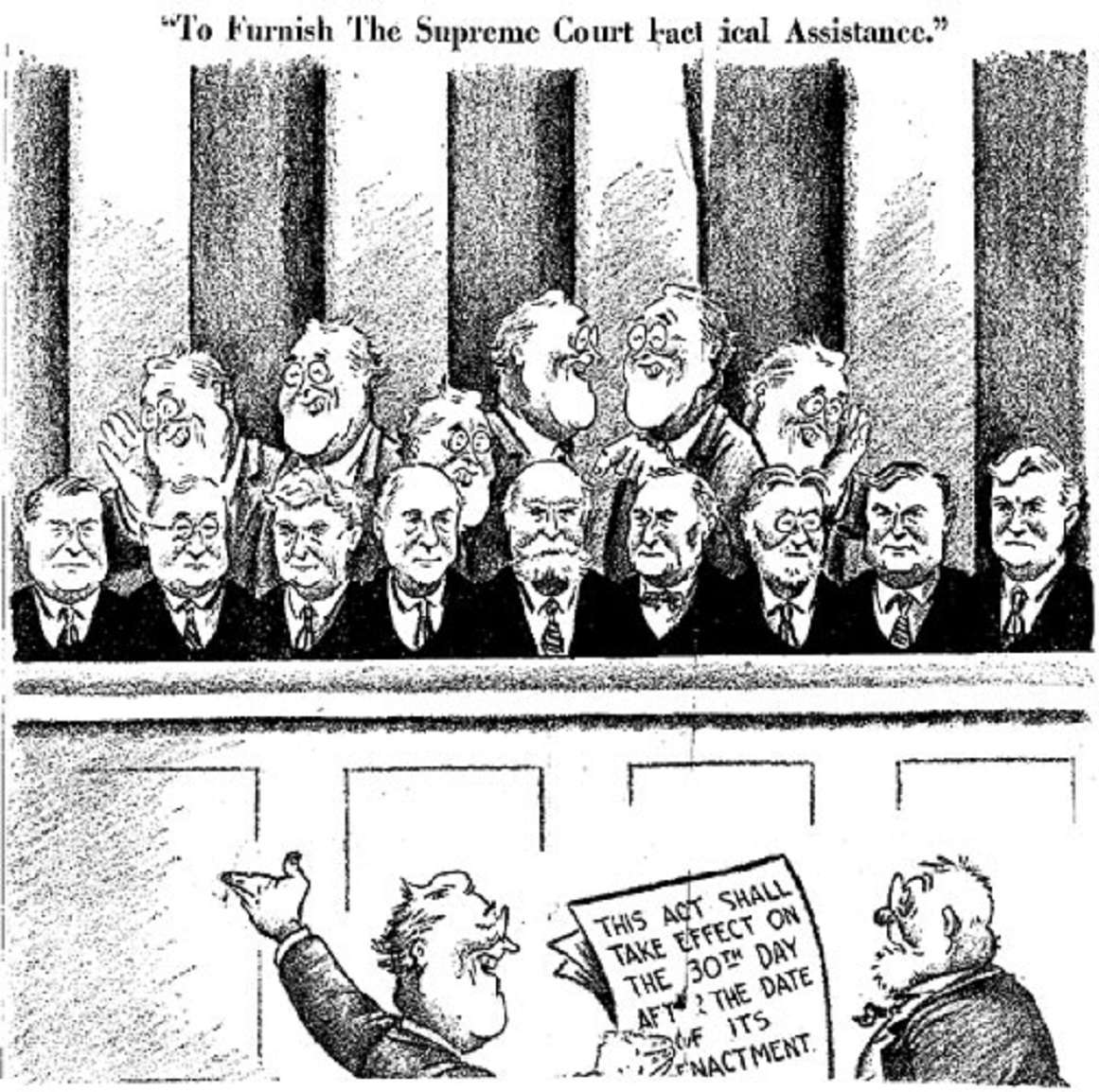
Georgetown law Professor Steve Vladeck is one of the leading critics of the conservative majority on the Supreme Court.
asserted
Vladeck → lead → Court
But in an insightful recent post on his substack, he outlines key reasons why "court expansion" is a bad response to its flaws.
asserted
expansion → outline → flaws
[I]t seems to me that those who are fully onboard the expansion-or-bust train should have to do more than simply assert that having four new Democratic appointees on the Court in 2029 would be a self-evidently "good" thing.
asserted
having → seem → 2029
If nothing else, proponents of expansion should have to answer the following four questions:
- How do we avoid touching off a race to the bottom, where each time one party controls the House, Senate, and presidency, it expands the Court to ensure an ideologically and politically sympathetic majority?
- If a race to the bottom is unavoidable, how do we avoid further (and potentially fatal) erosion of public confidence in the Court—which will quite transparently be little more than a lever of power for whichever party last had such a trifecta?
asserted
party → have → trifecta
- If eroding public confidence in the Court is a feature, and not a bug, how do we insulate against the same erosion of public confidence in lower federal courts?
- What is the case for why expansion is a better way to achieve the desired reforms than alternatives that would (or, at least, should) avoid many of these forward-looking concerns?
asserted
that → erode → concerns
He adds that court-packing could easily "permanently undermine judicial review as an institution."
uncertain
packing → add → institution
The rest of his piece (which is behind a paywall) offers far from reassuring answers to these questions.
asserted
which → offer → questions
I have offered similar criticisms of court-packing in a long series of articles and blog posts, most recently in a June Lawfare article where I explained (among other things) why the Supreme Court's recent decision in Louisiana v. Callais doesn't justify packing, and in a July UnPopulist article critiquing a court-packing proposal advanced by Andy Craig.
asserted
decision → offer → Craig
In these pieces, I explain why the Court's record of checking dangerous abuses of government power - though not without serious flaws - is considerably better than many critics claim.
uncertain
critics → explain → flaws
In addition, I argue that court-packing is likely to undermine effective judicial review - not only by the Supreme Court, but also by lower courts.
asserted
packing → argue → courts
Like Vladeck, I think some of the issues that concern critics of the Court can be more effectively addressed in other ways.
asserted
that → think → ways
For example, in the Lawfare article, I explain how Congress can fix the flaws of the Callais decision by banning or restricting gerrymandering.
asserted
Congress → explain → gerrymandering
It could also enact a binding ethics code for the justices.
uncertain
It → enact → justices
Justice Alito was wrong to suggest otherwise, back in 2023.
asserted
Alito → suggest → 2023
That said, if your main goal is a sweeping reversal of much of the Court's recent jurisprudence, there may be no easy way to achieve that quickly without court-packing or something like it.
uncertain
goal → say → it
I would argue that any benefits that might achieve are outweighed by the enormous costs of destroying judicial review.
uncertain
that → argue → review
In addition, if your objection to the Court's recent decisions is that they often don't do enough to constrain unconstitutional actions by other branches of government or by the states, court-packing is likely to make that problem worse, not better.
asserted
problem → do → states
Destroying judicial review won't impose tighter constraints on the executive or bring back Roe v. Wade.
asserted
Destroying → destroy → Wade
To the contrary, it would largely destroy any hope of doing so.
asserted
it → destroy → hope
In another recent piece, I assessed "non-packing" rationales for increasing the size of the Supreme Court.
asserted
I → assess → Court
There, I argue that these rationales are mostly weak; and, to the extent they have merit, there are better ways to address them than an expansion that amounts to court-packing.
asserted
that → argue → packing
I even outline possible ways to increase the size of the Court without creating an opportunity for court-packing (this would require allowing the party that doesn't hold the White House to pick some of the new justices).
asserted
that → outline → justices
 The Aporia