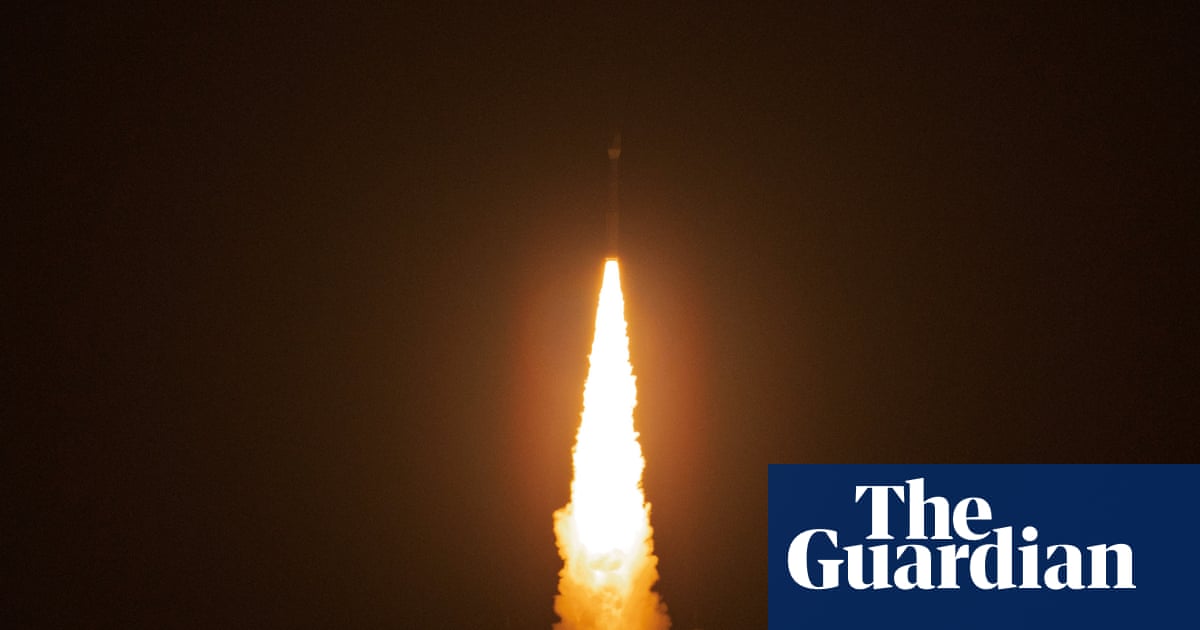
The US military has publicly confirmed for the first time that it has deployed weapons in space, according to a statement by Secretary of the Air Force Troy Meink at an annual conference. While details about these "on-orbit" weapons were not provided, experts suggest they could include both kinetic and non-kinetic means aimed at disabling adversaries' capabilities. China responded critically to this announcement, warning against escalating competition in space that could turn it into a battlefield. This disclosure is seen by analysts as likely to intensify an arms race among the US, Russia, and China.
Written by the local model on 2026-09-16,
using this article's own text rather than the other coverage of the
same event.
The US has deployed weapons in space, the US military has confirmed, in an extraordinary public announcement that analysts warn will accelerate a high-risk arms race with Russia and China in Earth’s orbit.
asserted
analysts → deploy → orbit
US secretary of the air force, Troy Meink, announced that Washington had active “on-orbit” weapons, meaning they had been deployed and were currently circling the globe.
asserted
they → announce → globe
“Today, we continue to ensure we remain ready to meet the challenges of evolving threats wherever they exist,” Meink said on Monday at the annual Air, Space, Cyber Conference.
asserted
Meink → continue → Conference
“This is why the United States now has, on orbit, space-control weapons.”
asserted
States → have → weapons
Meink said he would not go into the “specifics” of the weapons.
asserted
he → say → weapons
However, a US Space Force spokesperson said that space control can refer to “employing kinetic [combat] and non-kinetic means to affect adversary capabilities”.
asserted
control → say → capabilities
The statement added that “these capabilities can be employed for offensive and defensive purposes”.
asserted
capabilities → add → purposes
Responding to the US announcement, China’s foreign ministry said Washington was “preparing for war in outer space”, and warned against turning space “into a battlefield, as well as an arms race there”.
asserted
Washington → respond → battlefield
It has been an open secret that the US, Russia and China are working on space weapons, which could include signal jammers to disable other satellites or more “kinetic” options including those that fire projectiles.
uncertain
that → work → projectiles
Still, space experts warn a public confirmation of such capabilities in orbit for the first time could accelerate a risky arms race.
uncertain
confirmation → warn → race
Astronomer Jonathan McDowell who has spent decades compiling a list of rocket launches, told the Guardian it was reasonable to assume Washington had such weapons in space, likely jammers, as it had already deployed several satellites with secret payloads.
asserted
it → spend → payloads
He said that after the announcement, Russia and China would now “respond in kind” and deploy their own weapons.
asserted
Russia → say → weapons
“In the long run, I find it questionable whether this is in the US national interest, and for sure we will see comparable systems from China, if they don’t already have them,” he said.
asserted
he → find → them
Even radio jamming would be a big escalation of military activity in space, said McDowell, who worked at the Harvard-Smithsonian Center for Astrophysics until he retired this year.
asserted
he → say → Astrophysics
Victoria Samson, the Secure World Foundation’s chief director of space security and stability, told the Defence One website that the US now has to accept that the Chinese and Russians will do the same.
asserted
Chinese → tell → same
“Well, that’s huge, because I don’t think any US government official has ever said that before,” she said.
asserted
she → ’ → that
While the militarisation of space began in the 1950s with both Washington and Moscow exploring ways to destroy satellites, there have been attempts over the decades to preserve the emptiness around Earth for peaceful means.
asserted
Washington → begin → means
In 1967, superpowers and other countries signed the Outer Space Treaty, which banned weapons of mass destruction in orbit.
asserted
which → sign → orbit
The end of the cold war in 1989 brought a moment of cooperation – including the in-orbit assembly of the International Space Station by multiple nations – but the 21st century has seen space gradually become a potential battlefield.
asserted
space → bring → nations
Russia sparked international criticism in 2021 when it struck one of its defunct satellites in orbit in a test of a ground-based anti-satellite missile.
asserted
it → spark → missile
The blast created thousands of pieces of orbital debris.
asserted
blast → create → debris
As satellites zip around the Earth at thousands of miles an hour, the fear is that an orbital confrontation will lead to a domino effect where the space near Earth becomes cluttered with tiny, high-speed bits of metal.
asserted
space → zip → metal
McDowell, the astronomer, said that in the US, the mentality of working towards the solely peaceful use of space is changing.
asserted
mentality → say → space
“The US sees conflict in space as something that is conceptually normalised, whereas 20 years ago it was ‘no, we will never want to do that’,” he said.
asserted
he → see → that
“I think this is wrong,” he added.
asserted
he → think → ?
“I also think it is still not too late to change course on this.
asserted
it → think → this
To work mainly with China, because they are the real competitors in space now.
asserted
they → work → space
I hope the US establishment takes a step back and rethinks some of this.”
asserted
establishment → hope → this
Agence France-Presse contributed to this report
asserted
Presse → contribute → report
 The Aporia