A shark went astray and captured Korea's heart - will she finally make it back to sea?

Read the original at BBC News ↗
Cite

Kwon, J. (2026, October 24). A shark went astray and captured Korea's heart - will she finally make it back to sea? BBC News. https://www.bbc.co.uk/news/articles/c9zrdknlmpdlo?at_medium=RSS&at_campaign=rss

Dated from the outlet's own feed. Check the original for its byline.

BBC News · collected 2026-10-24 · by Jake Kwon

Quick Summary

In September, a large dusky shark appeared in a canal near Busan’s busy port, prompting marine biologist Kim Hyun-woo and his team to attempt a rescue. Initially using an electrical deterrent device, officials later shifted strategies when the five-hour method proved ineffective. As news spread, more than 1.6 million people visited the site, turning Bukangi into a local celebrity with merchandise sales and a city mascot designation. The shark’s presence generated significant public interest and economic benefit for Busan.
Written locally by qwen2.5:14b on 2026-10-25, using this article's own text rather than the other coverage of the same event (that is the story summary below).

AI analysis runs on qwen2.5:14b, locally

Story summary

On October 21, South Korean officials struggled for hours to free a 3-meter-long female dusky shark, nicknamed Bukangi, from a canal in the port city of Busan. The shark had been trapped there since September 18 and had become a local celebrity, attracting over 1.6 million visitors. Rescuers used a floating platform and net to guide the shark through the narrow waterway but by late afternoon, it remained at the mouth of the canal instead of swimming out to open sea. The next day, October 22, the shark surprisingly returned to the canal after earlier attempts had led it back into open waters; it swam under a preventative net set up to stop its return.

Meanwhile, a group of self-appointed guardians, mostly YouTubers, patrolled the waterfront nightly for a month to protect the stranded shark from disturbances by curious visitors. Their efforts were widely recognized and appreciated online, with some videos receiving hundreds of thousands of views. Despite these attempts, as of October 24, Bukangi had not yet successfully made it back to open sea.

Written for “Shark Stranded In South Korean Canal” on 2026-10-25, grounded in this article and the 4 other(s) covering the same event.
Why this leaning score
This article does not take a side on a contested political question, so it has no leaning score. That is an answer rather than a gap: a match report or a rescue can be warmly or critically written without being left or right, and scoring it anyway is how approval of a subject gets recorded as a political position.
No political leaning scored for article 104911 · logged 2026-10-25

Story

📰 Shark Stranded In South Korean Canal
Environment · 5 article(s) covering the same event. Compare every outlet's account →

Compared with similar articles

This article reads unscored and hedges 12% of its claims. Each row says how that neighbour differs.
Toronto Star
⚖️ leaning not scored 🔴 0% hedged 0 of 3 📰 publisher trust 64
“Both articles describe the same incident involving a trapped shark in Busan canal and rescue efforts.”
Euronews
⚖️ leaning not scored 🔴 17% hedged 1 of 6 📰 publisher trust 60
“Both articles describe the same incident involving a stranded shark in Busan, South Korea, with rescue attempts and large crowds gathering to watch.”
Al Jazeera
⚖️ leaning not scored 🔴 0% hedged 0 of 3 📰 publisher trust 60
“Article A describes the shark returning to the canal after a failed rescue attempt, while Article B focuses on the initial sighting and the rescue effort before its return.”
The Guardian
⚖️ leaning not scored 🔴 5% hedged 2 of 43 📰 publisher trust 66
“Article A discusses the successful rescue of the shark after more than a month, while Article B describes initial efforts and context before the rescue.”
How this article was measured signals, leaning charts, publisher record, byline, topics and claims

Signals How these are calculated →

Claims extracted
68
sentences that state something as happening or true
Uncertain
12%
8 of 68 hedged ("reportedly", "may", "according to")
Leaning
not political
takes no side on a contested political question
Publisher signals
69/100
BBC News's corrections and hedging, across everything collected from it. Not a measure of accuracy.
Outlets on this story
5
Environment
Same framing elsewhere
1
articles that frame the event the way this one does
Analyzed 2026-10-25 · how these are computed

How this is being covered How these are calculated →

Article leaning vs. publisher reliability
Source leaning vs. consistency

Publisher

BBC News · 4230 article(s) · 5 correction(s) detected
Running correction rate · 5 correction(s)

Who wrote this

Jake Kwon
3 article(s) here · 1 carrying a prediction
🔮 Still, Kim feared someone in the crowd might jump or fall into the canal.
🔮 The list included US President Donald Trump, former US Vice-President Mike Pence, Shinzo Abe, as well as the mayors of Seoul and Busan.
🔮 Starbucks Korea had in May launched a coffee tumbler promotion called "Tank Day" on the anniversary of the 1980 Gwangju Uprising, where hundreds were believed to have been killed by military forces.
Also by Jake Kwon
Nothing else under this byline is closely related to this article, so these are simply their most recent.

Topics

Bukangi Busan South Korea South Korea's the National Institute of Fisheries Science

Subjects

Bukangi PERSON · 8× Kim PERSON · 4× Busan GPE · 2× Choi Yoon PERSON · 1× Kim Hyun-woo PERSON · 1× Kim Joo-eun PERSON · 1× Korean NORP · 1× South Korea GPE · 1× South Korea's GPE · 1× the National Institute of Fisheries Science ORG · 1×

Narrative

South Korea is no stranger to sharks but one this size, in a shallow, concrete canal right by the world's seventh busiest port, was unheard of - until now. With an excited crowd already gathering at the waterfront, his team from the National Institute of Fisheries Science had to move fast.
framing: assertive · carried by 1 article(s) · first seen 2026-10-25
🔮 Still, Kim feared someone in the crowd might jump or fall into the canal.

Claims (68 extracted, 8 hedged)

- Published As soon as a large shark was spotted in a canal in Busan - a bustling shipping hub and beach city on South Korea's south-eastern tip - marine biologist Kim Hyun-woo was drafted in to rescue it. asserted
woo → publish → it
He got the call in mid-September, on his way home from a business trip tracking shoals of mackerel to aid fishing vessels. asserted
He → get → vessels
Despite being one of the country's leading shark experts, he never thought he'd be asked by the coastguard to actually save one. asserted
he → lead → one
South Korea is no stranger to sharks but one this size, in a shallow, concrete canal right by the world's seventh busiest port, was unheard of - until now. With an excited crowd already gathering at the waterfront, his team from the National Institute of Fisheries Science had to move fast. asserted
team → gather → Science
The first task was to determine the species. asserted
task → determine → species
The star of the 1975 blockbuster Jaws, the great white shark, is known to attack and kill humans. asserted
star → know → humans
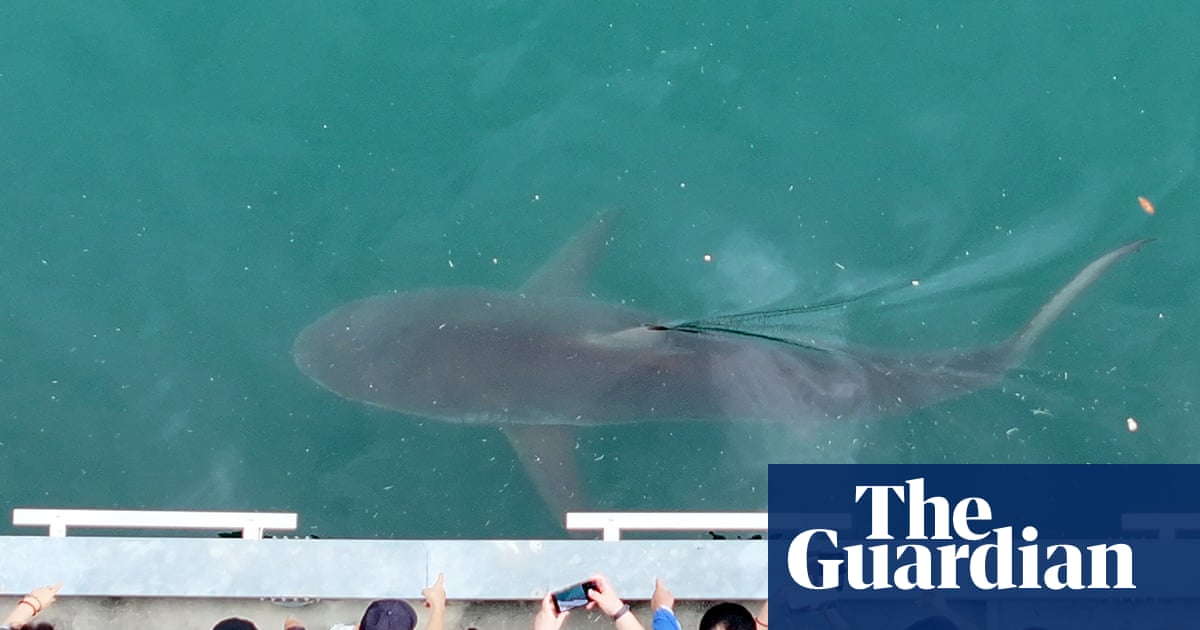
The specimen in Busan was found to be a female dusky shark, a species linked only to two deadly attacks. asserted
specimen → find → attacks
Still, Kim feared someone in the crowd might jump or fall into the canal. uncertain
someone → fear → canal
The shark had to return to sea. asserted
shark → have → sea
A small coastguard ship made an initial attempt using an electrical deterrence device, which generates a weak current that sharks avoid. asserted
sharks → make → that
They're usually used after sightings near popular beaches. asserted
They → use → beaches
But after five hours, officials determined this particular shark was too large and fast for the device. asserted
shark → determine → device
Kim changed tack, deciding instead to wait for the shark to let herself out. asserted
shark → change → herself
But that did not happen. asserted
that → happen → ?
As authorities looked for ways to guide her out of the canal, the stranded creature went viral. asserted
creature → look → canal
Just hours after she appeared, the council had sent everyone in the city an emergency text alert, urging pedestrians and residents to "exercise caution for their safety". asserted
council → appear → safety
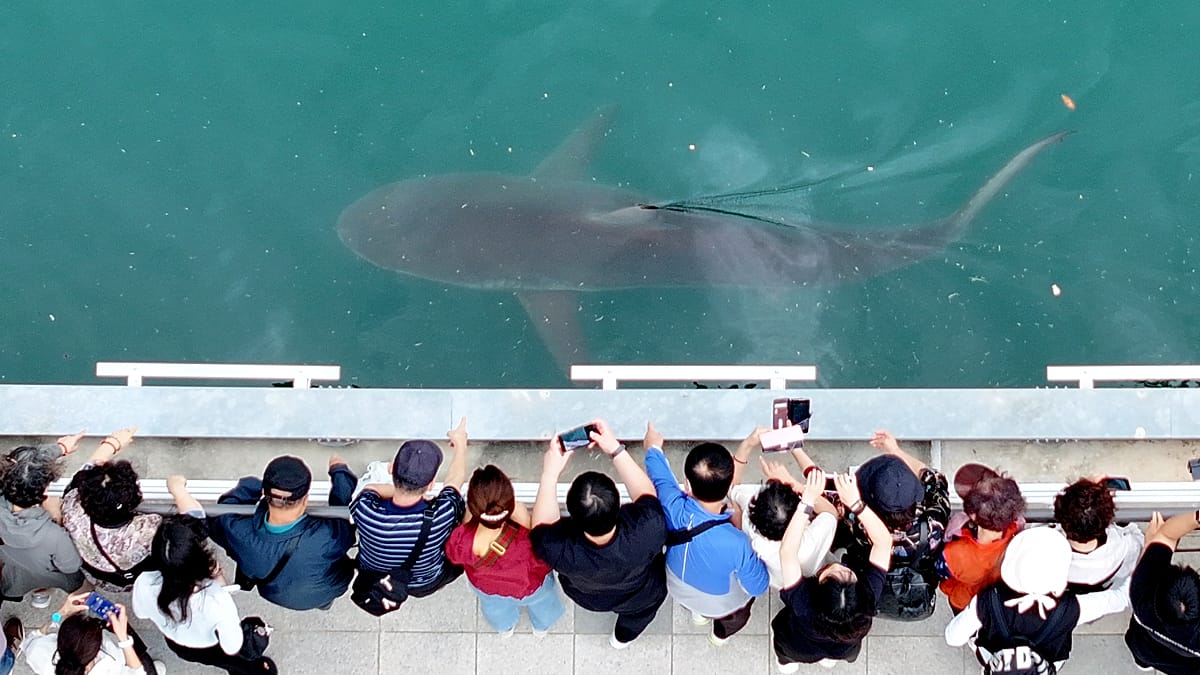
People rarely visited the park along the canal but because of the message, the place was soon brimming with people eager to spot the shark. asserted
place → visit → shark
Adoring fans named her Bukangi, from "buk hang", the Korean name of the nearby harbour. asserted
fans → adore → harbour
Within days, a business trademarked it and Bukangi pins, plushies and t-shirts began selling online. asserted
pins → trademark → it
City authorities joined in, livestreaming the shark and making her their official mascot. asserted
her → join → shark
A banner was hung at the entrance of the canal, asking the public to sign a petition "on behalf of Bukangi" to demand the national government's support for the construction of a new 30,000-seater baseball stadium by the canal. Shark spotting became a team effort among locals and visitors. asserted
spotting → hang → locals
The unspoken rule was that children were given the front row, and whoever saw Bukangi had to point her out to newer arrivals. asserted
saw → give → arrivals
Some self-appointed defenders even patrolled the canal at night to make sure no-one was shining torches or lasers at Bukangi. asserted
one → appoint → Bukangi
More than 1.6 million visitors ultimately flocked to the canal. asserted
visitors → flock → canal
The local mayor said the shark brought "the kind of publicity even billions of dollars cannot buy" to the port. asserted
billions → say → port
"It's really rare these days for people to come together," said Kim Joo-eun, who came to see the shark with her two nieces. asserted
who → come → nieces
"I feel that Bukangi brought us all together, cheering for her… asserted
Bukangi → feel → her
But officials couldn't leave Bukangi in the canal. asserted
officials → leave → canal
As September drew to an end, she hadn't been seen feeding for days and was spotted with bloody abrasions on her snout from bumping into the concrete walls. asserted
she → draw → walls
Prominent marine biology professor, Choi Yoon told local media that experts were particularly worried about a "critical" injury around the shark's eye. asserted
experts → tell → eye
At the end of September, Kim's team mounted another rescue attempt. asserted
team → mount → attempt
The marine biologist looked back to a 2004 incident in Massachusetts, when water jets were used to drive a great white shark away from a shallow pond. asserted
jets → look → pond
But when the team tried this on Bukangi, she kept circling back. asserted
she → try → Bukangi
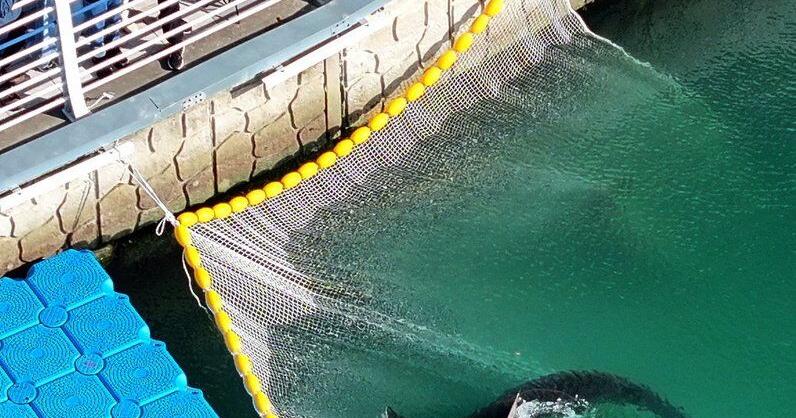
On 2 October, they decided to install a net spanning the width of the canal to stop her from returning. asserted
they → decide → her
She managed to swim around the net and was back within hours. asserted
She → manage → hours
At this point, Kim started thinking the shark might have problems with her snout's electromagnetic sensors, which she uses for navigation. uncertain
she → start → navigation
Or she might have become confused by the loud noises emitted by ships in the harbour. uncertain
she → confuse → harbour
The reason Bukangi was even in the canal may be a sign of warming seas, the oceans ministry suggests. uncertain
ministry → warm → seas
It believes she may have followed plentiful fish to warmer waters. uncertain
she → believe → waters
Some 50 large sharks were recorded off South Korea's east coast in the first half of the year; four times as many as last year. asserted
sharks → record → year
…and 28 more, not listed.

💬Give feedback
🕘History 🎫Support