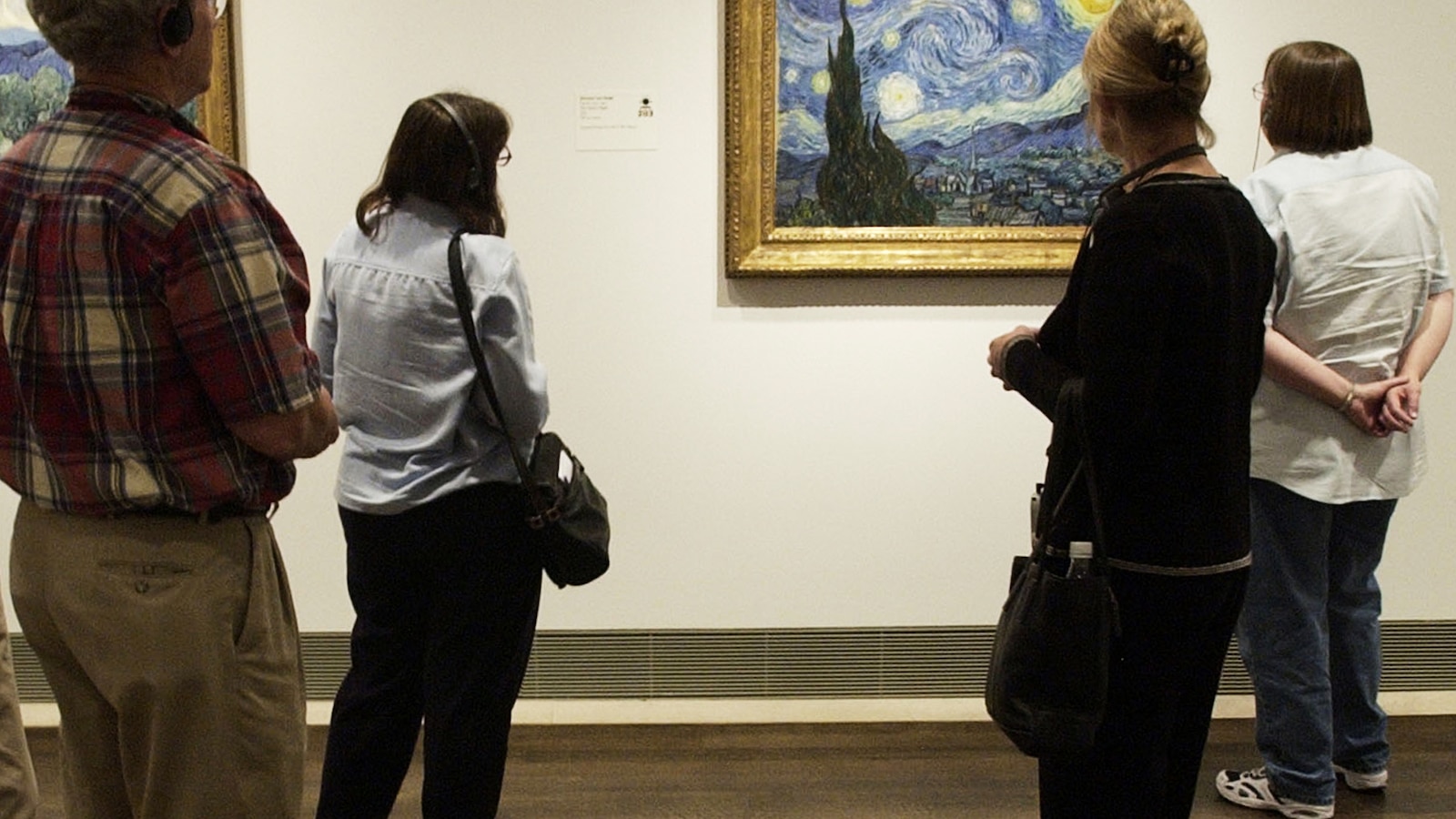
One of the most famous images in modern art was long believed to be a celestial vision born of the brilliant, bereft mind of Dutch painter Vincent van Gogh.
asserted
One → believe → Gogh
However, new research suggests Van Gogh’s “The Starry Night” is more depiction than imagination and may have been based on a real summer sky at daybreak.
uncertain
Night → suggest → daybreak
Researchers from Kyung Hee University in Yongin, South Korea say Van Gogh may have actually seen the heavenly bodies he committed to canvas from his vantage at the asylum in Saint-Rémy-de-Provence, where he was recovering from one among a constellation of mental health crises.
uncertain
he → say → crises
“Observation and imagination have commonly been treated as an either/or, yet ‘The Starry Night’ shows the two coexisting on one canvas,” said the study’s authors, whose work was published in Nature this week.
asserted
work → treat → Nature
The presumed date for the creation of the work was previously thought to be June of 1889, based on a letter Van Gogh sent to his brother Theo on June 18 in which he describes working on “a new study of a starry sky” and Van Gogh’s subsequent July breakdown, an episode that rendered him unable to paint for several weeks.
asserted
him → presume → weeks
However, researchers hypothesize that if Van Gogh had painted the scene around July 22 of 1880, the moon, Venus, and the Hyades star cluster depicted in the painting would have matched the night sky he saw from his asylum window, making the painting an impression of reality rather than pure imagination.
asserted
painting → hypothesize → reality
To prove this possibility, researchers located a ridge southwest of the asylum that matched an earlier Van Gogh sketch.
asserted
that → prove → sketch
“I was standing where Vincent had stood 130 years earlier,” said Elijah Jeong-hyun Kim, the study’s first author and an astronomer at Kyung Hee University.
asserted
Kim → stand → University
Using astronomy software, Kim and his team recreated an image of the dawn sky for each day in June and July of 1889.
asserted
Kim → use → 1889
“To bring the question into science, which needs quantitative data, we had to measure the degree of resemblance between the star patterns in the painting and the real sky, using shape geometry and statistics,” Kim said.
asserted
Kim → bring → geometry
In Van Gogh’s painting, the moon sits above Venus, so researchers narrowed their focus to three dawns when this arrangement was present.
Of the three possible dates, July 22 was the closest match, with a daybreak sky reflecting the arrangement of the waning crescent moon, Venus, and the Hyades seen in the painting.
asserted
sky → sit → painting
Researchers acknowledge these results are not conclusive, noting that Van Gogh likely combined his views of the sky over several days.
asserted
Gogh → acknowledge → days
The study is published in the journal Scientific Reports.
asserted
study → publish → journal
However, the researchers acknowledged the results were not conclusive, with Kim noting that Van Gogh may have combined skies from several days to create the final painting.
uncertain
Gogh → acknowledge → painting
Other experts remain unconvinced.
asserted
experts → remain → ?
Representatives from the Van Gogh Museum in Amsterdam, who were not involved in the study, maintain that Van Gogh painted The Starry Night in June 1889.
asserted
Gogh → involve → June
According to the museum, Van Gogh created the piece on a canvas delivered in early June, sent a sketch to his brother Theo on July 2, and suffered a severe breakdown around July 22 that halted his work for over a month.
“Van Gogh was not concerned with exact likenesses,” a museum spokesperson said.
uncertain
spokesperson → accord → likenesses
“The positions of the celestial bodies depicted can therefore not form a reliable basis for dating the work.”
asserted
positions → depict → work
Scientists believe van Gogh’s emboldened brushstrokes appear calculated to account for patches of invisible, uneven airflow, known as turbulence, that would change the night sky’s appearance.
asserted
that → believe → appearance
Researchers identified what they called “hidden turbulence” in van Gogh’s style.
asserted
they → identify → style
The artist appears to have compensated for principles in fluid dynamics that did not come about until almost 100 years later.
asserted
that → appear → dynamics
The spatial work and intentional brightnesses were found to be in alignment with the actual movements of the atmosphere within the scale of its motion-fueled energy — known scientifically as Kolmogorov’s law of 1940.
asserted
work → find → 1940
 The Aporia