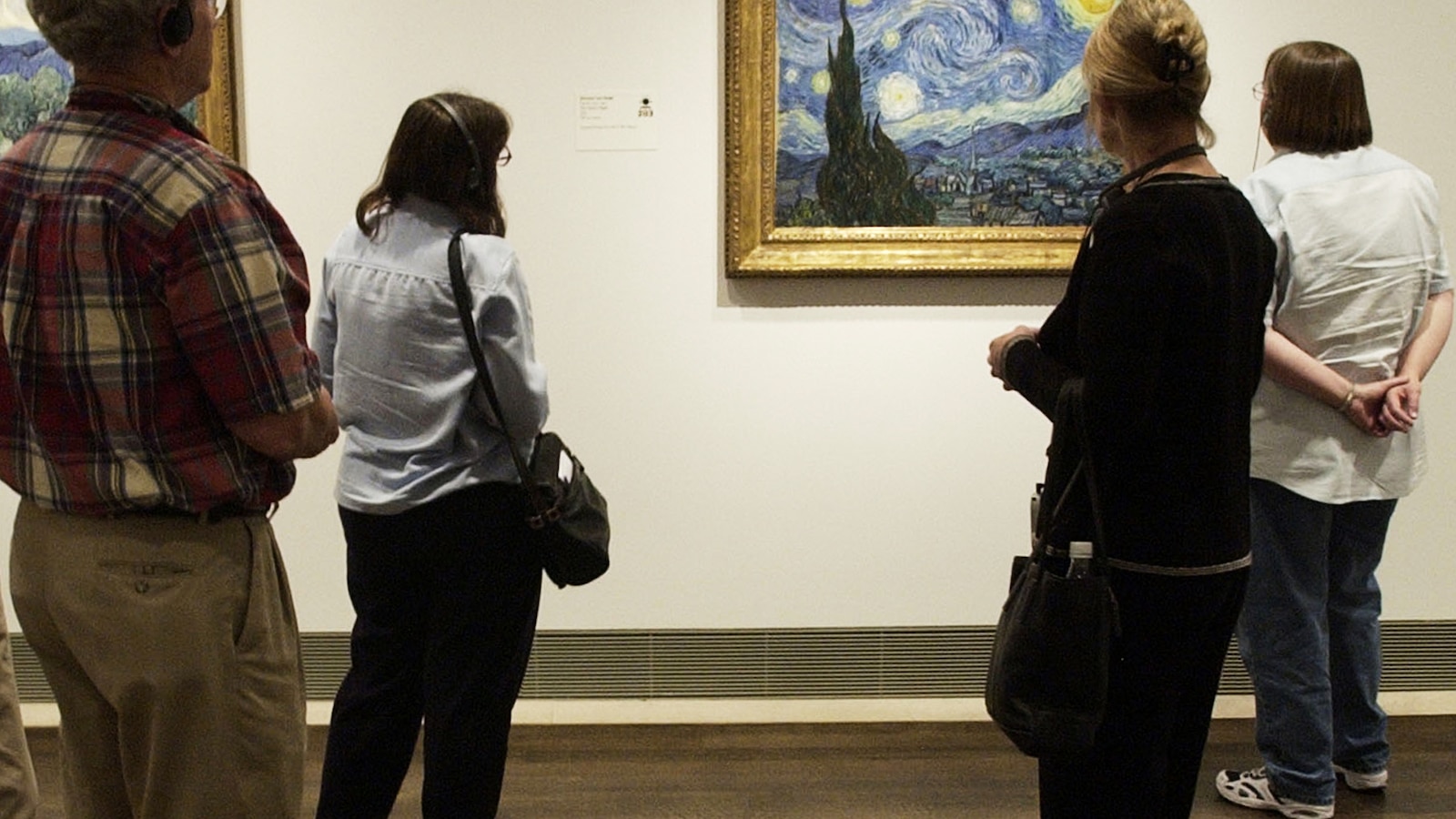
New study traces van Gogh's famed 'Starry Night' to an actual night sky from 1889

Read the original at ABC News (US) ↗
Cite

writer, M. D. A. a. (2026, October 22). New study traces van Gogh's famed 'Starry Night' to an actual night sky from 1889. ABC News (US). https://abcnews.com/Technology/wireStory/new-study-traces-van-goghs-famed-starry-night-137478827

Dated from the outlet's own feed. Check the original for its byline.

ABC News (US) · collected 2026-10-22 · by MARCIA DUNN AP aerospace writer

Quick Summary

Scientists have used forensic astronomy to determine that Vincent van Gogh's painting "The Starry Night" likely depicts the night sky from around July 22, 1889, rather than June as previously thought. The study, published in Scientific Reports and led by Elijah Jeong-hyun Kim of Kyung Hee University in South Korea, matches the celestial features in the painting with a specific predawn sky over Saint-Remy de Provence. This includes a crescent moon and Venus alongside the Hyades star cluster, which aligns better with July than June 1889. The researchers argue that van Gogh may have painted what he actually observed from his asylum window rather than relying on imagination alone.
Written locally by qwen2.5:14b on 2026-10-22, using this article's own text rather than the other coverage of the same event (that is the story summary below).

AI analysis runs on qwen2.5:14b, locally

Story summary

Researchers from South Korea have identified the exact night sky depicted in Vincent van Gogh's The Starry Night, matching it to a predawn scene over Saint-Remy-de-Provence, France, on July 22, 1889. The study, published in Scientific Reports, used statistical analysis and historical weather records to confirm that the five central stars of the painting correspond closely with the Hyades star cluster. This finding suggests that van Gogh may have painted what he actually saw from his window at the asylum rather than a purely imagined scene, challenging previous assumptions that placed the painting's creation in June 1889.

Written for “Van Gogh Starry Night Sky Identified” on 2026-10-23, grounded in this article and the 1 other(s) covering the same event.

Story

📰 Van Gogh Starry Night Sky Identified
Science · 2 article(s) covering the same event. See how they differ ↓

Compared with similar articles

This article reads unscored and hedges 17% of its claims. Each row says how that neighbour differs.
Daily Mail · 0.92 cosine similarity
⚖️ leaning not scored 🔴 18% hedged 5 of 28 📰 publisher trust 64
“Both articles report on a scientific study that identifies the exact night sky depicted in Van Gogh's 'The Starry Night', published on the same day.”
How this article was measured signals, leaning charts, publisher record, byline, topics and claims

Signals How these are calculated →

Claims extracted
30
sentences that state something as happening or true
Uncertain
17%
5 of 30 hedged ("reportedly", "may", "according to")
Leaning
not political
takes no side on a contested political question
Publisher signals
59/100
ABC News (US)'s corrections and hedging, across everything collected from it. Not a measure of accuracy.
Outlets on this story
2
Science
Same framing elsewhere
1
articles that frame the event the way this one does
Analyzed 2026-10-22 · how these are computed

How this is being covered How these are calculated →

Article leaning vs. publisher reliability
Source leaning vs. consistency

Publisher

ABC News (US) · 1068 article(s) · 2 correction(s) detected
Running correction rate · 2 correction(s)

Who wrote this

MARCIA DUNN AP aerospace writer
2 article(s) here · 1 carrying a prediction
🔮 Their findings indicate that rather than being a product of van Gogh’s imagination, “The Starry Night” may have been inspired by what he saw as he gazed heavenward from his French asylum 137 years ago.
🔮 In the end, there wasn't enough fuel remaining to boost the aging Swift to a higher, longer-lasting orbit so it could continue observing the cosmos.
Also by MARCIA DUNN AP aerospace writer
Nothing else under this byline is closely related to this article, so these are simply their most recent.

Topics

CAPE CANAVERAL Fla. France French South Korean

Subjects

Kim PERSON · 7× Van Gogh PERSON · 7× Aragon ORG · 4× France GPE · 2× van Gogh’s PERSON · 2× CAPE CANAVERAL GPE · 1× Fla. GPE · 1× Vincent van Gogh's PERSON · 1× Vincent van Gogh’s PERSON · 1× van Gogh's PERSON · 1×

Narrative

The researchers tested and verified their methods on night skies in other paintings, making for what Aragon considers “a careful and genuinely interdisciplinary study.” Since van Gogh painted in a studio at the asylum from sketches and memory, “the sky is likely a composite of many nights as the authors themselves acknowledge," Aragon said.
framing: assertive · carried by 1 article(s) · first seen 2026-10-22
🔮 Their findings indicate that rather than being a product of van Gogh’s imagination, “The Starry Night” may have been inspired by what he saw as he gazed heavenward from his French asylum 137 years ago.

Claims (30 extracted, 5 hedged)

New study traces van Gogh's famed 'Starry Night' to an actual night sky from 1889 Scientists have traced Vincent van Gogh's “The Starry Night” to a celestial scene that suggests a new date for one of the world's most famous paintings CAPE CANAVERAL, Fla. -- uncertain
that → trace → paintings
Scientists doubling as art detectives have traced Vincent van Gogh’s “ The Starry Night ” to a celestial scene that suggests a new date for one of the world’s most famous paintings. uncertain
that → double → paintings
Their findings indicate that rather than being a product of van Gogh’s imagination, “The Starry Night” may have been inspired by what he saw as he gazed heavenward from his French asylum 137 years ago. uncertain
he → indicate → asylum
A South Korean team reported Thursday that after years of forensic astronomy and research into the Dutch artist, they have matched his masterpiece to a predawn sky over France’s Saint-Remy de Provence right around July 22, 1889. asserted
they → report → July
That’s a month later than the long-accepted time frame for the postimpressionist painting depicting a crescent moon and Venus surrounded by a sky of swirling stars with a village nestled below and cypress trees looming on one side. asserted
trees → ’ → side
Art historians have long dated the painting to June 1889, soon after Van Gogh checked into the asylum. asserted
Gogh → date → asylum
He’d cut off his left ear several months earlier during an argument with painter Paul Gauguin. asserted
He → cut → Gauguin
A team led by Elijah Jeong-hyun Kim, the CEO of a Seoul telescope maker, is now disputing that date in a study appearing in the journal Scientific Reports. asserted
team → lead → journal
The sky that is most similar to the painting occurred around July 22, 1889, said Kim, who is also a doctoral candidate at Kyung Hee University. asserted
who → occur → University
He noted that the few days before and after could have inspired van Gogh as well. uncertain
days → note → Gogh
Something always changes. asserted
Something → change → ?
I believe Vincent noticed those changes and put them into the painting,” Kim said in an email. asserted
Kim → believe → email
He added: “I am confident that July 22 is the better date. asserted
July → add → ?
I will bet on this date.” asserted
I → bet → date
The latest study addresses “a real puzzle” that in mid-June 1889, the moon was not the thin crescent painted by van Gogh, said Jose Luis Aragon at the National Autonomous University of Mexico. asserted
Aragon → address → Mexico
He has studied “The Starry Night” as a physicist, but did not take part in the new research. asserted
He → study → research
“Still, I would see the July date as an intriguing hypothesis rather than a settled answer,” Aragon said in an email. asserted
Aragon → see → email
Long fascinated by van Gogh’s art, Kim traveled to France in 2019, the first time in mid-June and the second around July 22. asserted
Kim → fascinate → July
He found brilliant stars rising in July’s predawn sky, unlike June. asserted
stars → find → June
Kim and his team discovered through further celestial sleuthing that around July 22, 1889, the shape of the moon before dawn appeared like the one in the painting, with the Hyades star cluster in the constellation Taurus rising in the east alongside Venus. asserted
cluster → discover → Venus
The sky should have been clear enough for van Gogh to see all this, based on their weather analyses. asserted
Gogh → see → analyses
Van Gogh is thought to have suffered a seizure around that time in July. asserted
Gogh → think → July
But Kim and his team contend that the seizure occurred later in July, based on their analyses of letters between the painter and one of his brothers. asserted
seizure → contend → brothers
Some of those letters refer to cicadas, another clue that points toward the hotter July, according to Kim. uncertain
that → refer → Kim
The researchers tested and verified their methods on night skies in other paintings, making for what Aragon considers “a careful and genuinely interdisciplinary study.” Since van Gogh painted in a studio at the asylum from sketches and memory, “the sky is likely a composite of many nights as the authors themselves acknowledge," Aragon said. asserted
Aragon → test → nights
“What I find most convincing is the broader message: The painting is not pure fantasy. asserted
painting → find → What
Van Gogh watched the real sky very closely," Aragon said. asserted
Aragon → watch → sky
Despite all his research, Kim has never seen “The Starry Night” at the Museum of Modern Art in New York. asserted
Kim → see → York
“Now that the paper is out, I really have to go and see ‘The Starry Night’ in person, don’t I?” he said. asserted
he → have → person
The Associated Press’ health and science coverage receives financial support from the AP Fund for Journalism and private foundations. asserted
coverage → receive → Journalism

💬Give feedback
🕘History 🎫Support