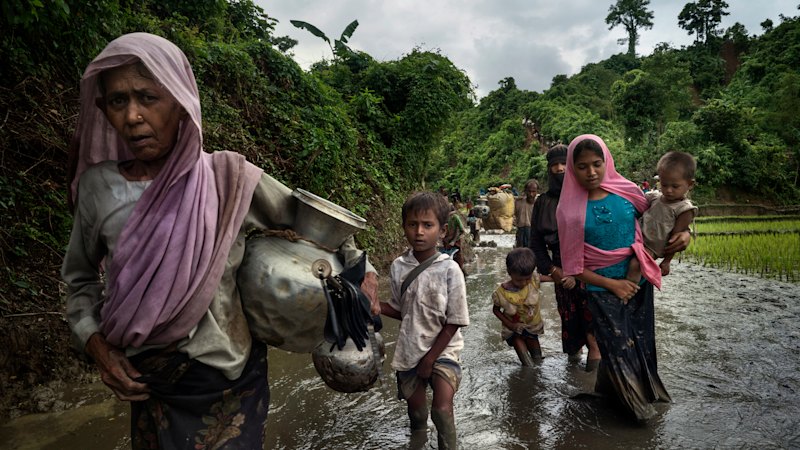
Photo via The Guardian

The ruling against Myanmar makes proving genocide more feasible | Kenneth Roth

Read the original at The Guardian ↗
Cite

Roth, K. (2026, November 23). The ruling against Myanmar makes proving genocide more feasible | Kenneth Roth. The Guardian. https://www.theguardian.com/commentisfree/2026/nov/23/myanmar-genocide-ruling

Dated from the outlet's own feed. Check the original for its byline.

The Guardian · collected 2026-11-23 · by Kenneth Roth

Quick Summary

Kenneth Roth discusses an ICJ ruling that Myanmar committed genocide against the Rohingya, recognizing the atrocities that led to the deaths of at least 10,000 Rohingya and the displacement of over 700,000 more to Bangladesh. Roth argues that this ruling strengthens the case for similar findings against Israel regarding Palestinians, despite objections from the Trump administration. The article focuses on the legal definition of genocide and how intent can be inferred from conduct, emphasizing the impact of the ruling on future international legal cases.
Written by AI on 2026-11-23, from this article's own text only (the story summary below draws on all the coverage).
See how they differ ↓

AI analysis

Story summary

The International Court of Justice (ICJ) ruled on November 19, 2026, that Myanmar committed genocide against its Rohingya minority during the military's 2017 clearance operations in northern Rakhine State, marking the first time a state has been found responsible for genocide under the 1948 Genocide Convention. The ICJ President, Yuji Iwasawa, stated that Myanmar had violated its obligations under the convention by committing genocide against the Rohingya group. The ruling found that Myanmar not only failed to prevent genocide but also failed to punish perpetrators and enact laws required by the convention, and destroyed evidence in breach of the court’s 2020 interim order. This landmark decision could have significant implications for international law and pressure Myanmar to address the atrocities committed against the Rohingya.

Written for “Myanmar Genocide Ruling” on 2026-11-23, grounded in this article and the 54 other(s) covering the same event.
Why this leaning score
The article's own words the score was based on. Each is quoted verbatim and was checked against the article text before being stored, so you can find it in the original.
Reading Leans strongly left (beta estimate) Confidence high
Leaning: leans strongly left for article 173402 (high confidence, 6 verified quotes) · logged 2026-11-23

How they differ

20 outlets covered “Myanmar Genocide Ruling”.

What each outlet says

One AI summary per outlet of its latest article on this story, written from that article alone and checked against it. Open the article for the outlet's own words.

The GuardianThis outlet23 Nov

Kenneth Roth discusses an ICJ ruling that Myanmar committed genocide against the Rohingya, recognizing the atrocities that led to the deaths of at least 10,000 Rohingya and the displacement of over 700,000 more to Bangladesh. Roth argues that this ruling strengthens the case for similar findings against Israel regarding Palestinians, despite objections from the Trump administration. The article focuses on the legal…

The ruling against Myanmar makes proving genocide more feasible | Kenneth Roth (this article)7 articles from The Guardian on this story
Al Jazeera20 Nov

The International Court of Justice has ruled that Myanmar committed genocide against the Rohingya minority, a decision that followed a 2017 military crackdown which resulted in thousands of deaths and nearly a million Rohingya refugees fleeing to Bangladesh. The article explores the significance of this ruling and considers whether it could have implications for Israel’s actions in Gaza, as discussed by experts…

What are the implications of the ICJ Rohingya genocide ruling? →12 articles from Al Jazeera on this story
The Hindu21 Nov

On November 19, 2026, the International Court of Justice ruled that Myanmar committed genocide against the Rohingya during its military operations in 2017. The court ordered Myanmar to investigate and prosecute those responsible, prevent future violations, and allow the safe return of displaced Rohingya while restoring their property and compensating them. The judgment found that Myanmar failed to prevent genocide…

The Rohingya | Vindication for a persecuted people →7 articles from The Hindu on this story
Deutsche Welle20 Nov

The International Court of Justice ruled that Myanmar committed genocide against the Rohingya community in 2016 and 2017, ordering Myanmar to prevent future crimes, provide legal protections, and offer reparations to victims. The ruling came after The Gambia filed a case with the ICJ in 2016, accusing Myanmar of a deliberate campaign of violence against the Rohingya. Rohingya activists like Lucky Karim and Wai Wai…

Myanmar genocide ruling: Rohingya say struggle for justice not over →3 articles from Deutsche Welle on this story
The Straits Times20 Nov

The International Court of Justice ruled that Myanmar committed genocide against the Rohingya, a decision that legal experts believe could strengthen South Africa’s genocide case against Israel over the Gaza conflict. The court’s judgment, which found Myanmar guilty of multiple violations of the 1948 Genocide Convention, establishes a legal precedent that genocidal intent can be established alongside military…

Myanmar genocide judgment may bolster Gaza case against Israel →3 articles from The Straits Times on this story
BBC19 Nov

The International Court of Justice (ICJ) ruled that Myanmar committed genocide against the Rohingya people, a verdict described as historic. The court found that Myanmar violated the 1948 Genocide Convention, with at least 10,000 Rohingya killed during attacks in 2017. The decision also impacts ongoing genocide cases, such as South Africa's case against Israel, by clarifying the standard of evidence needed to prove…

Bowen: Myanmar genocide verdict is historic and could have far-reaching implications →3 articles from BBC on this story
Show 14 more outlets
Toronto Star20 Nov

Rights groups are pushing for military and economic sanctions against Myanmar following a decision by the International Court of Justice, which ruled that Myanmar committed genocide against the Rohingya minority in 2017. The court ordered Myanmar to allow Rohingya refugees to return safely, pay reparations, and prosecute those involved in genocide, but Myanmar’s government is unlikely to comply. The United Nations…

Rights groups urge sanctions after top UN court finds Myanmar committed genocide against Rohingya →3 articles from Toronto Star on this story
Zeteo19 Nov

This article is an opinion piece by Prem, discussing the perceived instability in the United States following recent system outages and breaches affecting major organizations and government bodies. The author argues that despite these crises, the U.S. society is barely held together not by competent leadership but in spite of it, due to the incompetence of the current cabinet. The piece critiques the responses given…

First Draft – Now We Know What Stands Between Trump’s U.S. and Total Collapse: A Cabinet of Idiots →2 articles from Zeteo on this story
CBC20 Nov

The International Court of Justice ruled that Myanmar committed genocide against the Rohingya Muslim minority, a decision celebrated as recognition of their suffering but criticized for its lack of practical impact due to Myanmar's disregard of international rulings. The ICJ ordered Myanmar to provide reparations and allow Rohingya refugees to return to their villages, but most Rohingya villages have been destroyed…

International court's ruling on Myanmar genocide means little for victims, but much for future cases →2 articles from CBC on this story
Dawn23 Nov

Legal experts suggest that the International Court of Justice's ruling that Myanmar committed genocide against the Rohingya will strengthen South Africa’s case against Israel for alleged genocide in Gaza. The court found Myanmar guilty of genocide due to actions such as killing, sexual violence, and forced displacement of the Rohingya, setting a legal precedent that genocidal intent can coexist with military…

Analysis: Myanmar genocide judgment may bolster Gaza case against Israel →2 articles from Dawn on this story
ABC News (AU)20 Nov

Myanmar has rejected the International Court of Justice's ruling that its security forces committed genocide against the Rohingya Muslim minority as "unfair." The court's decision, made yesterday, holds Myanmar responsible for the atrocities against the Rohingya. Meanwhile, Rohingya refugees in Bangladesh have welcomed the verdict, although it is uncertain when they will be able to return to their homes in Myanmar.

Myanmar calls international court ruling on Rohingya genocide 'unfair' →2 articles from ABC News (AU) on this story
Daily Mail16 Nov

Legal and military experts warn that Britain could face genocide accusations under a looser definition of the term, which the International Court of Justice may endorse in its upcoming judgment on Myanmar. The Policy Exchange think tank report highlights potential risks for Britain regarding historical events like the Irish potato famine and the Mau Mau rebellion, and current concerns about Russia and Iran…

Britain at risk of Ireland or Kenya 'genocide' claims under looser definition, say experts - as they warn about Russia and Iran weaponising allegations →
NPR19 Nov

The International Court of Justice ruled that Myanmar committed genocide against the Rohingya minority, marking the first time a state has been held responsible for genocide by the U.N.'s top court. The decision, brought by Gambia under the 1948 Genocide Convention, found that Myanmar’s military campaign in 2017 was systematic and included the killing of around 10,000 Rohingya and the burning of 392 villages. The…

The U.N.'s top court rules Myanmar committed genocide against the Rohingya →
Sydney Morning Herald19 Nov

The International Court of Justice (ICJ) has ruled that Myanmar is guilty of genocide against Rohingya Muslims, marking the first time the court has convicted a state under the 1948 Genocide Convention. The ICJ ordered Myanmar to cease all ongoing violations, prosecute those responsible, and provide reparations. The court’s decision, handed down in a 9-6 vote, is significant given Myanmar’s likely non-compliance due…

‘Intention to purge’: Myanmar found guilty of genocide against Rohingya in landmark ruling →
Semafor19 Nov

The International Court of Justice has ruled that Myanmar is guilty of genocidal intent against the Rohingya, following atrocities that led to the killing of about 10,000 Rohingya nearly a decade ago and the displacement of up to 700,000 more to Bangladesh. The court’s decision notes that Myanmar’s military committed widespread violence including sexual assaults and attacks on children. This ruling could set a…

ICJ finds Myanmar guilty of 'genocidal intent' against Rohingya →
The Independent19 Nov

The International Court of Justice ruled that Myanmar committed genocide against the Rohingya people, marking the first time a state has been found guilty of genocide. Gambia brought the case in 2019, alleging that Myanmar’s military offensive, which forced over 730,000 Rohingya to flee to Bangladesh, constituted genocide. The court found that Myanmar’s security forces conducted mass killings, rape, and destruction…

Myanmar committed genocide against Rohingya people, UN’s top court rules →
Euronews20 Nov

The International Court of Justice (ICJ) ruled that Myanmar is guilty of genocide against the Rohingya minority, marking the first such ruling in the ICJ’s 80-year history. The court found Myanmar’s security forces responsible for widespread violence, including killings and sexual assaults, and the systematic destruction of Rohingya villages. The ICJ ordered Myanmar to provide compensation for damages and facilitate…

Myanmar guilty of genocide against Rohingya UN court rules →
Time20 Nov

The International Court of Justice ruled that Myanmar committed genocide against the Rohingya Muslim minority, marking the first time a state has been found responsible for genocide in the court's history. The court’s decision, issued Thursday, cites the murder of at least 10,000 people, including up to 2,109 children under five, and the displacement of over 700,000 Rohingya in 2017. Myanmar’s government has denied…

What Comes Next After Historic Myanmar Genocide Ruling →
Global News20 Nov

The International Court of Justice ruled that Myanmar committed genocide against the Rohingya Muslim minority during the military’s 2017 “clearance operations” in Rakhine state, with nine out of fifteen judges agreeing on the verdict. Myanmar’s government, now led by former military leader Min Aung Hlaing, dismissed the ruling as unfair, while Rohingya activists and the militant group ARSA hailed it as a critical…

UN court finds Myanmar guilty of Rohingya genocide in landmark judgement →
The Free Press20 Nov

The International Court of Justice recently ruled that Myanmar is guilty of genocide in a case initiated by The Gambia. However, the article argues that this ruling, focusing on Myanmar’s treatment of the Rohingya Muslims, may undermine the court’s legitimacy and set a precedent that could be used arbitrarily against other nations, including Israel. The author suggests that the ruling was less about the Rohingya…

How the Campaign Against Israel Rewrote the Law of Genocide →

Where they agree and split

Agreed

AI · cited, from two or more outlets

  • The ICJ's ruling is the first time a state has been found to have committed genocide by an international court.34
  • The ICJ ruled that Myanmar committed genocide against the Rohingya group in northern Rakhine State.35
Quoted from the coverage (1)

Myanmar must also allow the “safe and dignified return to their place of residence and the reunification of families for the Rohingya displaced as a result of Myanmar’s wrongful acts,” it said.

7 outlets

Framing

How the first headlines put it

  • Deutsche Welle's headline focuses on the upcoming ruling and what to know about the case, while BBC's headline states the ICJ's ruling that Myanmar committed genocide against the Rohingya minority.13
  • Zeteo's headline emphasizes the historical significance of the ruling for the Rohingya people and global justice, while The Hindu's headline highlights the vindication for a persecuted people.26
Words to watch (2)

Photos: Genocide ruling spotlights human toll of 2017 Rohingya crisis Al Jazeera

ICJ to rule on Rohingya ‘genocide’: Refugee crisis, timeline of the case, and more The Hindu

The full story: what happened, how it changed, and all 55 articles →

Compared with similar articles

This article reads leans strongly left and hedges 16% of its claims. Each row says how that neighbour differs.
The Sydney Morning Herald
Leans right further right than this Hedges 8 of 43 claims Outlet record 61/100

Story

Myanmar Genocide Ruling
World · 55 article(s) covering the same event. Compare every outlet's account →
How this article was measured signals, leaning charts, publisher record, byline, topics and claims

Signals How these are calculated →

Claims extracted
58
sentences that state something as happening or true
Uncertain
16%
9 of 58 hedged ("reportedly", "may", "according to")
Leaning
Leans strongly left
of the writing, not the subject · beta estimate
Publisher signals
63/100
The Guardian's corrections and hedging, across everything collected from it. Not a measure of accuracy.
Outlets on this story
55
World
Same framing elsewhere
1
articles that frame the event the way this one does
Analyzed 2026-11-23 · how these are computed

How this is being covered How these are calculated →

Article leaning vs. publisher reliability
Source leaning vs. consistency

Publisher

The Guardian · 2707 article(s) · 10 correction(s) detected
Running correction rate · 10 correction(s)

Who wrote this

Kenneth Roth
4 article(s) here · 1 carrying a prediction
She also evidently hoped that by ingratiating herself with the military, it might allow her to become president despite a constitutional ban because her husband and two sons are British.
The Democrats’ midterm victory was resounding, but it will not be enough to re-establish the rule of law in the United States.
Any objective observer would see that Trump’s war of choice against Iran has inflated energy prices, because Iran predictably responded by restricting shipments in the strait of Hormuz, through which much of the Middle East’s oil and gas flows.
In early September, 128 governments met to approve a report that could serve as the foundation for a binding treaty.
Also by Kenneth Roth
Nothing else under this byline is closely related to this article, so these are simply their most recent.

Topics

Bangladesh Gaza ICJ Myanmar Rohingya

Subjects

Myanmar GPE · 8× Rohingya NORP · 8× ICJ ORG · 3× Bangladesh GPE · 2× Serbia GPE · 2× Gaza GPE · 1× Israel GPE · 1× Muslim NORP · 1× Palestinians NORP · 1× the Donald Trump administration ORG · 1×

Narrative

Similar to its Myanmar counterpart, the Israeli army gratuitously killed and harmed Palestinian civilians – indiscriminately bombing neighborhoods, attacking Hamas fighters knowing that there would be disproportionate civilian dead and wounded, shooting hungry Israelis as they ran for food, bombing housing blocks knowing many civilians remained inside, and creating conditions of starvation and deprivation that were incompatible with sustaining life.
framing: assertive · carried by 1 article(s) · first seen 2026-11-23
She also evidently hoped that by ingratiating herself with the military, it might allow her to become president despite a constitutional ban because her husband and two sons are British.

Claims (58 extracted, 9 hedged)

The international court of justice (ICJ) decision last Thursday that Myanmar committed genocide against the Rohingya recognizes the plight of one of the world’s most persecuted minorities. asserted
Myanmar → commit → minorities
It also resonates in Gaza, where the same court is now more likely to find that Israel committed genocide against Palestinians. asserted
Israel → resonate → Palestinians
That possibility has incensed the Donald Trump administration, but it should think twice before attacking another international tribunal. asserted
it → incense → tribunal
The case stems from the Myanmar military’s brutal “clearance operations” in 2017 when it used murder, torture, rape and arson to kill at least 10,000 Rohingya and to send more than 700,000 fleeing to neighboring Bangladesh. asserted
700,000 → stem → Bangladesh
The Rohingya are a Muslim minority that has long faced severe discrimination in Myanmar, whose dominant Bamar ethnic group tends to be Buddhist and have lighter skin. asserted
group → face → skin
Myanmar has 135 recognized ethnic groups but refuses to accept the Rohingya as the 136th. asserted
Myanmar → have → 136th
A 1982 law denied most Rohingya citizenship despite their deep roots in the country. asserted
law → deny → country
Even Aung San Suu Kyi, awarded the Nobel peace prize in 1991 as an icon of her country’s quest for democracy, refused to call them Rohingya. asserted
Kyi → award → them
She preferred the disparaging appellation “Bengali” to suggest they were foreigners who immigrated from Bangladesh. asserted
who → prefer → Bangladesh
In 2019, she traveled to the Hague to defend the Myanmar military from the genocide charge. asserted
she → travel → charge
Her actions reflected her fellow citizens’ vilification of the Rohingya. asserted
actions → reflect → Rohingya
She also evidently hoped that by ingratiating herself with the military, it might allow her to become president despite a constitutional ban because her husband and two sons are British. uncertain
husband → hop → ban
Instead, the military overthrew the country’s fledgling democracy in 2021 and has detained her ever since. asserted
military → overthrow → her
Genocide is defined in a widely ratified treaty. asserted
Genocide → define → treaty
The Myanmar case, like many others, hinged on whether certain atrocities were committed with genocidal intent – that is, the intent to destroy a protected group, in this case a religious and ethnic minority, “in whole or in part”. asserted
that → hinge → part
There was ample proof that the Myanmar army committed systematic murder, torture, rape, and arson against the Rohingya, but did it have the requisite intent? asserted
it → be → intent
In theory, genocidal intent can be proved by the statements of senior officials, but most are smart enough to use less incendiary language. asserted
most → prove → language
As a result, intent usually must be inferred from conduct. asserted
intent → infer → conduct
In rulings on genocide cases brought by Bosnia and Croatia against Serbia, the ICJ held in 2007 and 2015 that such a deduction could be made if “the only reasonable inference to be drawn from that conduct is one of genocidal intent”. uncertain
inference → bring → intent
That suggested to some that genocidal intent could not be found to coexist with another intent. uncertain
intent → suggest → intent
That view seemed built on genocides designed to kill a group “in whole”. asserted
view → build → whole
For example, after a certain point during the Holocaust and the genocide in Rwanda, the aim was to kill every possible Jew or Tutsi. asserted
aim → kill → Jew
That might arise when genocide is not the sole goal of mass atrocities but a means to another end, such as ethnic cleansing. uncertain
genocide → arise → cleansing
According to this interpretation, the ICJ’s Serbia rulings would perversely suggest that the commission of the crime against humanity of mass forced displacement might serve as a defense to allegations of genocidal intent. uncertain
commission → accord → intent
That made no sense. asserted
That → make → sense
In the Myanmar case, the court, by a vote of nine to six, interpreted this standard more sensibly. asserted
court → interpret → standard
Citing general principles of criminal law, it ruled that dual intents were possible. asserted
intents → cite → law
“Genocidal intent may exist alongside other intentions, provided that such intentions are not incompatible with the existence of genocidal intent,” it explained. uncertain
it → exist → intent
In other words, its earlier ruling that genocidal intent must be shown to be the “only reasonable inference” from a course of conduct should not be read to mean that genocide is the sole intent. asserted
genocide → show → conduct
Rather, it meant there should be no reasonable understanding of the evidence that disproves genocidal intent, even if there was also a parallel intent. asserted
that → mean → intent
The Myanmar government claimed its intent was not to commit genocide but to mount a counterinsurgency operation against a rebel group in the part of western Myanmar where most Rohingya lived. asserted
Rohingya → claim → Myanmar
The court discounted that explanation because the army committed atrocities even in places where there was no insurgency and engaged in gratuitous atrocities such as raping women, killing children, burning villages and attacking fleeing civilians. asserted
army → discount → civilians
Myanmar also asked the court to consider the possibility, never admitted, that its aim was forced displacement, not genocide. asserted
aim → ask → possibility
That paralleled the ICJ’s finding from the evidence against Serbia that it did not have genocidal intent. asserted
it → parallel → intent
But in the latest case, the court held that so long as the only reasonable inference from the evidence was that Myanmar intended to commit genocide, it didn’t matter that the evidence reasonably supported the conclusion that Myanmar also sought to forcibly displace the Rohingya or to fight an insurgency. asserted
Myanmar → hold → insurgency
That ruling must have sent shivers down the spines of Israeli officials. asserted
ruling → send → officials
Anticipating it, Trump’s ambassador to the United Nations last month threatened the ICJ judges with sanctions akin to those already imposed on international criminal court judges if they “were to lower the legal threshold for proving genocide”. asserted
they → anticipate → genocide
(The ICJ mainly resolves civil disputes between states, including on how to apply the Genocide Convention, while the ICC prosecutes individuals.) asserted
ICC → resolve → individuals
But the ICJ didn’t lower the standard. asserted
ICJ → lower → standard
It interpreted the standard in the most sensible way possible to ensure that the commission of parallel mass atrocities does not become a defense to genocide. asserted
commission → interpret → genocide
…and 18 more, not listed.
Give feedback · no sign-in needed

No sign-in needed for now. Your note is sent without a name, so it cannot be answered.

History Support