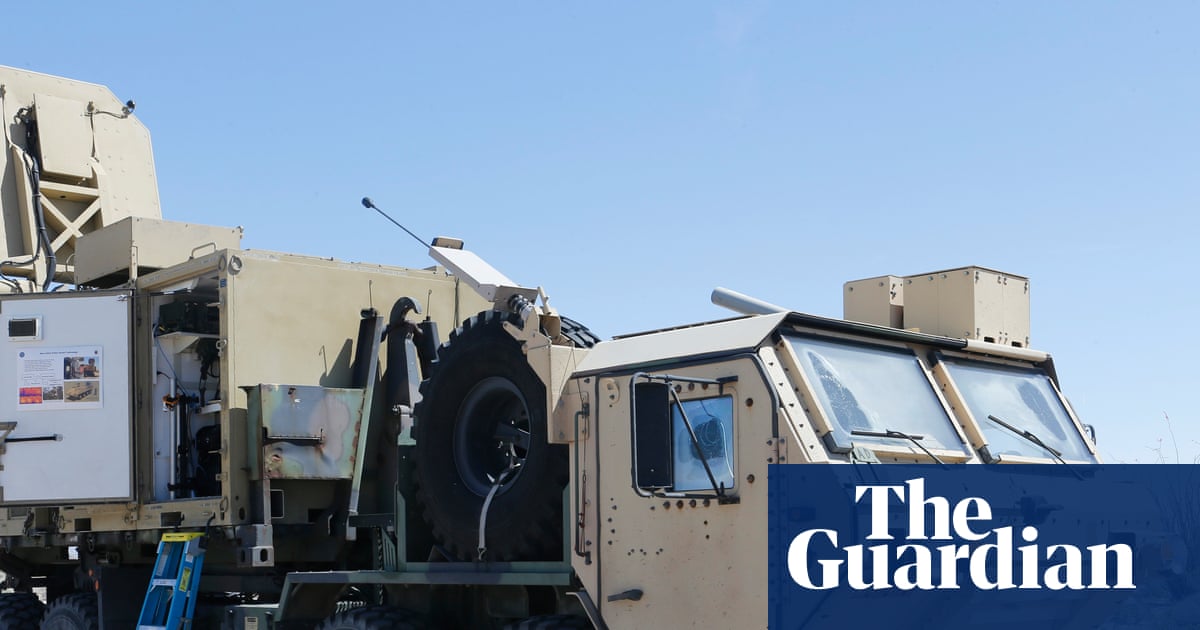
Pete Hegseth has reportedly given DHS permission to test ‘heat ray’ for use at US-Mexico border

Read the original at The Guardian ↗
Cite

Baio, A. (2026, October 22). Pete Hegseth has reportedly given DHS permission to test ‘heat ray’ for use at US-Mexico border. The Guardian. https://www.theguardian.com/us-news/2026/oct/22/heat-ray-mexico-border-dhs

Dated from the outlet's own feed. Check the original for its byline.

The Guardian · collected 2026-10-22 · by Ariana Baio

Quick Summary

Pete Hegseth, US secretary of defense, signed a memo last month allowing the Department of Homeland Security (DHS) to test the Active Denial System, a non-lethal weapon that emits an intense heat beam causing people to move away reflexively, for seven months at the US-Mexico border. The DHS can request further use if needed and plans to evaluate its effectiveness in enhancing security while saving lives, though specific uses remain unclear. The system has been considered before but never deployed; it produces a 95 gigahertz beam penetrating about 1/64th of an inch into the skin, creating discomfort that lasts around 10-15 minutes.
Written locally by qwen2.5:14b on 2026-10-22, using this article's own text rather than the other coverage of the same event (that is the story summary below).

AI analysis runs on qwen2.5:14b, locally

Story summary

Pete Hegseth, the US secretary of defense, reportedly signed a memo in September 2026 allowing the Department of Homeland Security (DHS) to test a non-lethal "heat ray" known as the Active Denial System at the US-Mexico border. This weapon uses an energy beam that causes intense heat on skin, leading people to instinctively move away from it. The DHS will have access to the Pentagon's system for seven months and can extend its use if needed.

A spokesperson for Customs and Border Protection (CBP) stated that they are evaluating new technology aimed at saving lives while enhancing national security. However, details about how the Active Denial System will be used remain unclear. When contacted by CNN, the Pentagon referred questions to the DHS, which provided the CBP statement.

Written for “Pete Hegseth And DHS Heat Ray Testing” on 2026-10-22, grounded in this article and the 0 other(s) covering the same event.
Why this leaning score
The article's own words the score was based on. Each is quoted verbatim and was checked against the article text before being stored, so you can find it in the original.
Reading Leans right (beta estimate) Confidence high
Leaning: leans right for article 99494 (high confidence, 2 verified quotes) · logged 2026-10-22

Story

📰 Pete Hegseth And DHS Heat Ray Testing
Politics · 1 article(s) covering the same event.

Compared with similar articles

Nothing to compare against. No article is close enough to this one for the pipeline to have linked or judged the pair.
How this article was measured signals, leaning charts, publisher record, byline, topics and claims

Signals How these are calculated →

Claims extracted
19
sentences that state something as happening or true
Uncertain
26%
5 of 19 hedged ("reportedly", "may", "according to")
Leaning
Leans right
of the writing, not the subject · beta estimate
Publisher signals
69/100
The Guardian's corrections and hedging, across everything collected from it. Not a measure of accuracy.
Outlets on this story
1
Politics
Same framing elsewhere
1
articles that frame the event the way this one does
Analyzed 2026-10-22 · how these are computed

How this is being covered How these are calculated →

Article leaning vs. publisher reliability
Source leaning vs. consistency

Publisher

The Guardian · 1562 article(s) · 4 correction(s) detected
Running correction rate · 4 correction(s)

Who wrote this

Ariana Baio
32 article(s) here · 1 carrying a prediction
🔮 The new memo, seen by CNN, states that the DHS will be solely responsible for the system’s “employment, use and development of tactics, techniques and procedures”.
🔮 Neil Bush said he sees Talarico as “a principled, pragmatic leader” who has a “willingness to listen to those with whom he disagrees”.
🔮 The new press secretary declined to explain why she took just three questions, but said going forward she would be “very well prepared on the briefing” and “would love, and do love, questions”.
🔮 The notice said law enforcement officials were working to intercept additional mail, but it is possible some could reach their destination.
🔮 Jodi Hunt, a self-described single-issue voter, probed Talarico’s pro-choice stance, asking: “How would you convince me as a Catholic voter that I can trust you would protect the most innocent among us?”
🔮 Mayor Zohran Mamdani and the leader of the New York City council have agreed to ban horse-drawn carriages from the city, a popular tourist attraction that has faced widespread scrutiny.
2026-10-14 · assertive framing · New York City moves to ban horse-drawn carriages
🔮 The case could potentially end in a 4-4 split because Justice Samuel Alito recused himself, citing a conflict of interest.
🔮 “In advance of your upcoming travel to Greece, I request an immediate review of Ambassador Guilfoyle’s actions and a clarification of what steps have and will be taken to avoid undue influence and even the appearance of a conflict of interest.
🔮 Trump, who picked Paxton to run as the Republican in the Texas Senate race, will join Paxton at a rally in San Antonio on Wednesday evening.
🔮 Other election deniers have planted seeds of doubt about the predicted outcome of the 2026 midterm elections.
Also by Ariana Baio
Nothing else under this byline is closely related to this article, so these are simply their most recent.
All 32 articles by Ariana Baio →

Topics

CBP CNN DHS Pentagon the Active Denial System

Subjects

DHS ORG · 6× CBP ORG · 3× CNN ORG · 3× Pentagon ORG · 3× the Washington Post ORG · 2× Customs and Border Protection ORG · 1× Hegseth PERSON · 1× National Defense University ORG · 1× Pete Hegseth PERSON · 1× the Department of Homeland Security ORG · 1×

Narrative

A spokesperson for Customs and Border Protection (CBP) said in a statement it was “continually evaluating new technology, especially technology that can save lives while simultaneously enhancing national security effectiveness”.
framing: mixed · carried by 1 article(s) · first seen 2026-10-22
🔮 The new memo, seen by CNN, states that the DHS will be solely responsible for the system’s “employment, use and development of tactics, techniques and procedures”.

Claims (19 extracted, 5 hedged)

Pete Hegseth, the US secretary of defense, reportedly signed a memo last month permitting the Department of Homeland Security (DHS) to test a non-lethal “heat ray” for potential use at the US southern border. uncertain
Hegseth → sign → border
The “heat ray”, known as the Active Denial System, is a military-grade weapon that shoots an energy beam causing “a sensation of intense heat on the surface of the skin”, according to a 2009 National Defense University case study on the weapon. uncertain
that → know → weapon
The sensation “creates an intolerable sensation and reflexive movement” such as ducking or running. asserted
sensation → create → sensation
In a memo, first obtained by CNN, Hegseth authorized a “temporary loan” of the Active Denial System to the DHS for seven months beginning in September. asserted
Hegseth → obtain → September
The DHS can request further use of the Pentagon system if needed. asserted
DHS → request → system
A spokesperson for Customs and Border Protection (CBP) said in a statement it was “continually evaluating new technology, especially technology that can save lives while simultaneously enhancing national security effectiveness”. asserted
that → say → effectiveness
When asked for comment, the Pentagon referred the Guardian to the DHS, which shared the CBP statement. asserted
which → ask → statement
It is unclear what the DHS plans to use the Active Denial System for exactly, but the memo permits the department to use it for potential operations at the US-Mexico border. uncertain
memo → plan → border
The US military initially brought the system to Afghanistan nearly 20 years ago, but it was quickly returned home without ever being used, the Washington Post reported. asserted
Post → bring → Afghanistan
Previously, CBP officials reportedly considered using the Active Denial System in areas with a large number of illegal crossings or for crowd dispersal, but it was never deployed. uncertain
it → consider → dispersal
When used, the Active Denial System can produce an invisible beam of 95 gigahertz that penetrates about 1/64th of an inch into the skin, causing a burning sensation. asserted
that → use → sensation
(The system is technically not a “heat ray” because it uses millimeter waves, not infrared, Forbes reported in 2020.) asserted
Forbes → use → 2020
Pentagon officials have compared the feeling to a blast of heat when opening a hot oven, according to CNN. uncertain
officials → compare → CNN
The feeling is temporary, lasting between 10 and 15 minutes. asserted
feeling → last → ?
In 2012, the Marine Corps announced that the system was compliant with international legal obligations of the US, and officials said they felt “comfortable” that it was safe. asserted
it → announce → US
The new memo, seen by CNN, states that the DHS will be solely responsible for the system’s “employment, use and development of tactics, techniques and procedures”. asserted
DHS → see → tactics
It also states that no Department of Defense personnel shall operate it. asserted
personnel → state → it
During the first Trump administration, officials sought to use the Active Denial System, first in 2018 to stop migrants from crossing the border, the New York Times reported. asserted
Times → seek → border
Later, in 2020, the administration also sought it to control protests in Washington DC after the killing of George Floyd, the Washington Post reported. asserted

Post → seek → Floyd
💬Give feedback
🕘History 🎫Support