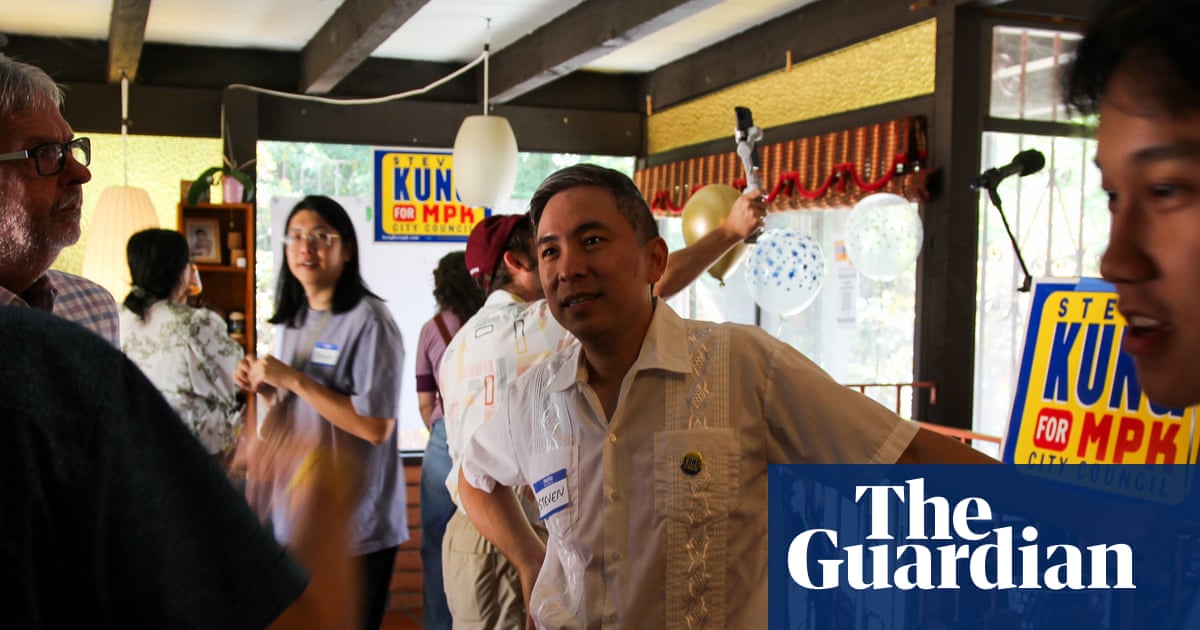
After four months of teach-ins and canvassing, Steven Kung helped Monterey Park, just east of Los Angeles, become the first US city to ban datacenter construction.
asserted
Park → help → construction
Now, the organizer is running for city council – and he’s taking on an incumbent who supported the development of the sprawling facility.
asserted
who → run → facility
“The datacenter coming to my neighborhood turned my life upside down,” said Kung.
asserted
Kung → come → life
“I saw that there’s a dismantling of democracy at a local level.”
asserted
I → see → level
The datacenter revolt that has united the country – building coalitions between environmentalists and Nimbys, conservatives and democratic socialists – is turning a host of community organizers into political hopefuls.
asserted
that → unite → hopefuls
In an election year that’s seen first-time candidates prevail against powerful moderate Democrats, dozens of datacenter activists are gunning for offices held by people they feel have disregarded their concerns about affordability, the environment and tech overreach.
asserted
they → see → affordability
Kung sees his political bid as an extension of the datacenter resistance; imagery from his campaign – a red dragon dismantling a facility with its tail – features prominently in his election mailers.
asserted
imagery → see → mailers
And he’s not the only organizer who fought for the historic ban now taking a stab at elected office: Amy Wong, co-founder of San Gabriel Valley Progressive Action, is running for city council in nearby Alhambra.
asserted
Wong → ’ → Alhambra
“The datacenter fight has illustrated the power of the people to shape their environment,” Kung said.
asserted
Kung → illustrate → environment
Turning activists into candidates
Furor against AI-powered developments has continued to mount over the past year.
asserted
Furor → turn → year
In the first three months of 2026 alone, residents delayed or cancelled $130bn worth of projects, according to research from Data Center Watch.
uncertain
residents → delay → Watch
And seven in 10 Americans oppose construction close to where they live, according to a Gallup poll from March.
uncertain
they → oppose → March
The Working Families Party has been harnessing this populist anger to win local elections.
asserted
Party → harness → elections
In December, the organization began recruiting local datacenter activists to run for office.
asserted
organization → begin → office
More than 50 candidates have signed up and the organization expects that number to “double or triple” for next year’s races as recent victories from high-profile progressives who want to ban datacenters have injected fresh momentum into the movement, according to Ravi Mangla, the national press secretary.
uncertain
who → sign → Mangla
The vast majority of applicants are first-time candidates who “felt moved to run because of what’s happening in their communities”, he said.
asserted
he → feel → communities
Most of the recruits are based in Michigan, Texas and Indiana – states with a high density of datacenters – with many more hailing from swing states that could decide control of Congress, Mangla said.
uncertain
Mangla → base → Congress
Jackie McGuire, a cybersecurity professional in Arizona, said she had never considered representing her hometown of Marana until late last year, when she learned about its plan to build a facility on 600 acres of farmland.
asserted
she → say → farmland
The cost would exceed $120bn.
asserted
cost → exceed → 120bn
In Marana, a community of about 60,000 on the outskirts of Tucson, residents sounded the alarm on the project’s water usage, noise pollution and potential impact on their electricity bills, in addition to a general lack of transparency from local government.
asserted
residents → sound → government
In December, a clip of McGuire testifying against the developer, Beale Infrastructure, at a public meeting went viral on Instagram, and her following surged.
asserted
following → testify → Instagram
After several months of watching town officials repeatedly subvert the will of the people, including rejecting a datacenter referendum, McGuire decided to campaign for office.
asserted
McGuire → watch → office
In July, she ran for town council with a slate of anti-datacenter organizers.
asserted
she → run → organizers
In part, because she had some name recognition, she was the only one to win a seat.
asserted
she → have → seat
“I got into the race pretty last minute because we needed a majority on the town council,” McGuire said.
asserted
McGuire → get → council
“Unfortunately, we were not able to secure that, but that doesn’t mean we’re dead in the water.”
asserted
we → secure → water
As an elected official, McGuire said she’ll continue to push for a referendum requiring voter approval of datacenter projects.
asserted
she → elect → projects
Why datacenters animate voters
asserted
datacenters → animate → voters
Datacenters have become a galvanizing issue in the midterms, Mangla said, because they embody the unchecked growth of corporate greed while the prices of groceries and basic goods have surged.
asserted
prices → become → groceries
“We’ve seen it as an issue of working people against powerful oligarchs who want to override local concerns and draw resources from communities,” he said.
asserted
he → see → communities
“It’s something we see mobilizing and animating people all around the country, especially in the midwest and south where the growth of datacenters is especially prevalent.”
asserted
growth → ’ → datacenters
Datacenter backlash was a deciding factor in an Oregon senate primary election in July, when Myrna Muñoz, an educator, upset the incumbent, Janeen Sollman, who had backed a controversial bill that would have traded more farmland for industrial development.
asserted
that → decide → development
(Muñoz is expected to prevail in the general election in a solid Democratic district.)
asserted
Muñoz → expect → district
Muñoz, who campaigned against the facilities, said she hadn’t realized how many were under development in Hillsboro, considered the birthplace of the state’s tech industry, until she launched her campaign in March.
asserted
she → campaign → March
The city approved 17 new projects, on top of more than 30 existing sites, just before the city enacted a moratorium in late July.
asserted
city → approve → July
“These 17 centers that got through have tax abatements until 2050,” Muñoz said.
asserted
Muñoz → get → 2050
“They’re taking away money from my children and grandchildren.”
asserted
They → take → children
Muñoz, with four other Oregon legislators, is backing a three-year, statewide moratorium on new datacenters, in addition to more regulations on current projects.
asserted
Muñoz → back → projects
Saul Levin, the program director for the Center for Nonviolent Conflict Research, said the anti-datacenter movement has mobilized everyday people from farmers to teachers to beauty salon workers who are “irate about what’s going on” in their communities.
asserted
what → say → communities
Candidates are banking on that same energy to bring voters to the polls.
asserted
Candidates → bank → polls
…and 7 more, not listed.
 The Aporia