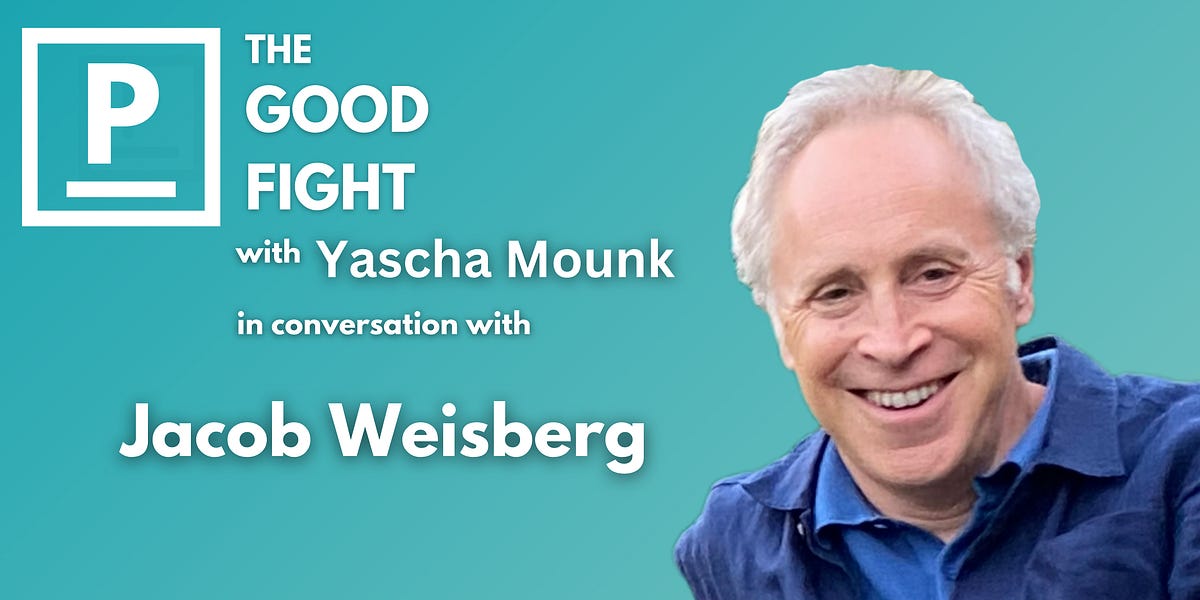
Jacob Weisberg on the Contagion of Cowardice

Persuasion · collected 2026-09-15 · by Yascha Mounk commentary
Read the original at Persuasion ↗

Summary

Jacob Weisberg discusses his book "Profiles in Cowardice" during a podcast conversation with Yascha Mounk. The book examines instances where American institutions failed to resist President Trump's actions more effectively in his second term compared to his first. They explore examples of individuals like Jeff Bezos and Brad Karp, analyzing how societal dynamics influence courage and cowardice, and ponder if Harvard’s stance against the Trump administration could mark a pivotal moment for institutional resistance. Weisberg draws parallels between current political cowardice and historical instances, such as John F. Kennedy's early reluctance to stand up to Joseph McCarthy in the Senate.
Written by the local model on 2026-09-15, using this article's own text rather than the other coverage of the same event (that is the story summary below).

Signals How these are calculated →

Claims extracted
299
claim-shaped sentences
Uncertain
8%
25 of 299 hedged
Leaning
Leans left
expected in commentary, which argues a position
Correction & hedging signals
not measured
these signals count newsroom corrections; Commentary has none to count
Outlets on this story
1
Politics
Narrative spread
1
articles carrying this framing
Analyzed 2026-09-15 · how these are computed

AI analysis (generated at analysis time, not now)

Story summary

In an interview with Yascha Mounk for Persuasion, Jacob Weisberg discusses his new book "Profiles in Cowardice," which examines the lack of resistance from American institutions during former President Donald Trump's second term compared to his first. Weisberg argues that while some figures loyal to Trump resisted criticism publicly, many did so out of a desire for loyalty and favorable media coverage rather than principle. He points to Harvard’s response to the Trump administration as potentially significant in fostering institutional resistance. Weisberg serves as Chair at The Committee to Protect Journalists and contributes regularly to the New York Review of Books, highlighting his involvement with major journalism organizations.

Written for “Cowardice in Leadership” on 2026-09-15, grounded in this article and the 0 other(s) covering the same event.
Why this leaning score
The article's own words the score was based on. Each is quoted verbatim and was checked against the article text before being stored, so you can find it in the original.
Score -0.35 Confidence medium
Leaning score -0.35 for article 9686 (medium confidence, 2 verified quotes) · logged 2026-09-15

Story

📰 Cowardice in Leadership
Politics · 1 article(s) covering the same event. This is the one the site leads with.

How this is being covered How these are calculated →

Article leaning vs. publisher reliability
Source leaning vs. consistency

Compared with similar articles

Nothing to compare against. No article is close enough to this one for the pipeline to have linked or judged the pair.

Publisher

Persuasion · 33 article(s) · 0 correction(s) detected
No corrections detected for this publisher. That may mean careful reporting, or simply that nothing has been checked.

Who wrote this

Yascha Mounk
8 article(s) here · 1 carrying a prediction
🔮 In this week’s conversation, Yascha Mounk and Jacob Weisberg discuss why American institutions proved far less resistant to Trump in his second term than his first, what figures like Jeff Bezos and Brad Karp reveal about the social nature of courage and cowardice, and whether Harvard’s response to the Trump administration could become a turning point for institutional resistance.
2026-09-15 · assertive framing · Jacob Weisberg on the Contagion of Cowardice
🔮 There’s a kind of melancholy, I think, that people feel for the good old days, for a world that was maybe slower, where the worth that they had relative to their environment was a little bit clearer than in the world today.
2026-09-12 · assertive framing · Judith Dada on the Rise of the AfD
🔮 If I had to give you a thesis, it would be that Donald Trump is a unique figure in our politics, that there aren’t a lot of other people like him, because of his relationship to America for decades and decades, not just as a television game show host, but as somebody who lived on Page Six, somebody who wrote The Art of the Deal, someone who’s been on all of these luminaries and talk shows.
2026-09-08 · assertive framing · Sarah Longwell on How Democrats Can Defeat Trump
🔮 In your book you suggest that it depends on a set of circumstances, such as how set the institutional environment is in which they operate and what the likely replacement would be like.
2026-09-05 · assertive framing · Jared Diamond on Whether Leaders Make History
🔮 We’re on vacation this week, so are rerunning a fun “beach read” episode exploring if your nearest and dearest could be psychopaths. Miss us already?
2026-08-31 · assertive framing · Abigail Marsh on Psychopaths (Rerun)
🔮 In an event exclusively for readers of American Purpose and Persuasion, Yascha Mounk will be interviewing Francis Fukuyama about his life and thought at 5pm on Sunday, September 6 at The Abbey Centre, London.
2026-08-24 · assertive framing · The Eras of Francis Fukuyama: How States Form
🔮 In this week’s conversation, Yascha Mounk and Francis Fukuyama discuss why building things with your hands is an antidote to dependence on big tech, whether AI will erode the practical skills future generations need to survive, and what hobbyist robotics has in common with Ukraine’s battlefield ingenuity.
2026-08-24 · assertive framing · The Eras of Francis Fukuyama: Building Things
Also by Yascha Mounk
Judith Dada on the Rise of the AfD
2026-09-12 · Persuasion
Nothing else under this byline is closely related to this article, so these are simply their most recent.
All 8 articles by Yascha Mounk →

Topics

American Pushkin Industries Senate The Committee to Protect Journalists the New York Review of Books

Subjects

Trump PERSON · 7× JFK PERSON · 4× Senate ORG · 4× Jacob Weisberg PERSON · 3× Jeff Bezos PERSON · 3× American NORP · 2× Joe McCarthy PERSON · 2× John F. Kennedy PERSON · 2× Kennedy PERSON · 2× Yascha Mounk PERSON · 2×

Narrative

Trump didn’t have the discipline in the first term, didn’t have the preparation—he was surprised to be elected, and ended up turning to Republican establishment names to staff a lot of his administration, which is why he had a lot of people willing to do the right thing, as opposed to the second term, when the only qualification was loyalty and looking good on Fox News, and essentially no one he’s appointed has stood up to him. But I do think the point about social context and the countervailing pressures and incentives really matters.
framing: assertive · carried by 1 article(s) · first seen 2026-09-15
🔮 In this week’s conversation, Yascha Mounk and Jacob Weisberg discuss why American institutions proved far less resistant to Trump in his second term than his first, what figures like Jeff Bezos and Brad Karp reveal about the social nature of courage and cowardice, and whether Harvard’s response to the Trump administration could become a turning point for institutional resistance.
2026-09-15 · Persuasion
Jacob Weisberg on the Contagion of Cowardice · assertive framing

Claims (299 extracted, 25 hedged)

He serves as Chair of The Committee to Protect Journalists and is a regular contributor to the New York Review of Books. asserted
He → serve → Books
In this week’s conversation, Yascha Mounk and Jacob Weisberg discuss why American institutions proved far less resistant to Trump in his second term than his first, what figures like Jeff Bezos and Brad Karp reveal about the social nature of courage and cowardice, and whether Harvard’s response to the Trump administration could become a turning point for institutional resistance. uncertain
response → discuss → resistance
This transcript has been condensed and lightly edited for clarity. asserted
transcript → condense → clarity
There’s a famous book by John F. Kennedy, which I must admit I’ve never read, called Profiles in Courage, in which he profiles all of the various people that he admires and who he thinks have bettered America and perhaps the world with their courage. You have inverted the premise of this for a book that speaks more naturally to our own historical moment, Profiles in Cowardice. asserted
that → ’ → Cowardice
Well, I think so, and just to spend a minute on Kennedy because it is a really interesting book—it’s a book about the Senate. asserted
it → think → Senate
And John F. Kennedy as a young senator, I think, was really troubled by his own failure of courage. asserted
I → think → courage
He’d been a war hero, and everyone knows the story of PT-109, how he rescued his fellow sailors, and his physical courage was unquestionable. asserted
courage → know → sailors
But when Joe McCarthy was running rampant, JFK took a dive in the Senate on the vote to censure him. asserted
JFK → run → him
He got out of voting. asserted
He → get → voting
He never said how he would have voted. asserted
he → say → ?
He never stood up to Joe McCarthy. asserted
He → stand → McCarthy
My read on it is that he wanted to write this book to give himself more courage, to try to understand what courage in politics was. asserted
courage → want → politics
He wrote about eight senators going back to the early days of the Republic, not all of whom he would have agreed with on substantive issues, but who took important decisions against their own interests, who were willing to risk or sacrifice their political careers for principles, often constitutional principles, that they believed in deeply. asserted
they → write → that
I think it worked for JFK. asserted
it → think → JFK
So the book is sort of a trope in Washington—people talk about “profiles in courage” when someone is willing to do something, which they very seldom are, against their political interest. asserted
they → talk → interest
Often even the ironic use of the phrase has become a bit of a trope, right? asserted
use → become → trope
The Trump era is a series of “profiles in courage” because look at how cowardly everybody is being. asserted
everybody → look → courage
This idea that courage today is in such short supply that you look at the United States Senate and say it’s a series of “profiles in courage,” as an ironic, knowing wink, contrasting this moment with that of Kennedy. asserted
it → look → Kennedy
It’s kind of a received idea today. asserted
It → ’ → ?
I look at a series of American institutions—institutions of civil society, law, academia, business and finance, tech, and then Congress, the Supreme Court, media, and so on. asserted
I → look → society
What really prompted me was that at the beginning of Trump’s second term, the first part of 2025, the contrast to Trump’s first term was so marked. asserted
contrast → prompt → term
I focused on people in this book who were different in Trump Two than they were in Trump One. asserted
they → focus → Trump
Trump threatened him, tried to blackmail him, and actually caused tremendous financial harm to Amazon by taking away a Pentagon cloud computing contract. asserted
Trump → threaten → contract
It was a $20 billion contract—I think it was the largest contract in the history of the US military—and Trump took it away from Amazon to punish Bezos for the coverage he got in the Washington Post. asserted
he → think → Post
Bezos didn’t waver. asserted
Bezos → waver → ?
He said the right thing, he did the right thing. asserted
he → say → thing
In Trump Two, he was in Mar-a-Lago on bended knee, ready to capitulate. asserted
he → capitulate → knee
Even before Trump was elected, you knew it was going to be different. asserted
it → elect → ?
That paradigm, I think, applies to so many people in institutions—certainly to Brad Karp, who I write about, the managing partner at Paul Weiss, in my illustration of what happened at the big commercial law firms. asserted
what → think → firms
Same thing: in Trump One, he sent Paul Weiss lawyers to the airports in New York to try to help Muslim immigrants who might be denied entry. uncertain
who → send → entry
In Trump Two, he made a deal in five days to essentially give in to Trump’s unlawful demands, demanding a range of favors from them in response to things that were entirely within their rights to do as a law firm. asserted
that → make → firm
I want to dig back into some of those particular people over the course of this conversation, but let’s think about what produces a moment of courage, and what produces an atmosphere in which people who are capable of courage in different moments end up not being courageous. asserted
who → want → moments
One story you could tell is one of moral decline—that in the past people were courageous, they had principles, there was a kind of public spirit with which they grew up, and unfortunately we’ve lost that over time, and now everything is worse. uncertain
everything → tell → time
It’s often tempting to think that, given how awful so much of our politics is. asserted
much → ’ → politics
But it’s interesting that at the beginning of the conversation you mentioned JFK being haunted by his failure of courage during the McCarthy era. asserted
JFK → ’ → era
And when you look at American history in those decades, you might say that there was quite a lot of courage in how to confront the Great Depression at a certain point. uncertain
you → look → point
Then there was this moment of complete dereliction of duty when people let McCarthy run wild, and then things got better. asserted
things → be → duty
So clearly it’s not a secular story of fifty years ago, seventy years ago, things were much better and everybody was virtuous, and then over time it declined, because we see that kind of oscillation. asserted
we → ’ → oscillation
We see the difference between the McCarthy era and ten or fifteen years later. asserted
We → see → era
We see the difference between Trump One and Trump Two. asserted
We → see → Trump
…and 259 more, not listed.

💬 Give feedback
🕘 History 🎫 Support