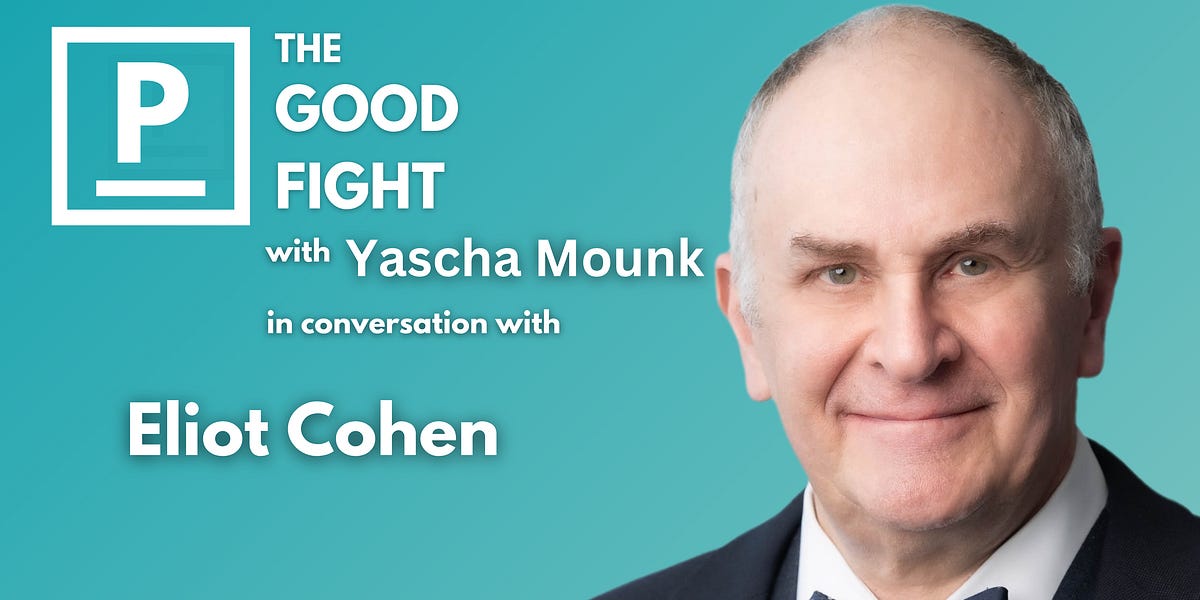
Eliot Cohen on Why America Keeps Losing Wars It Should Win

Read the original at Persuasion ↗
Cite

Mounk, Y. (2026, October 17). Eliot Cohen on Why America Keeps Losing Wars It Should Win. Persuasion. https://www.persuasion.community/p/eliot-cohen

Dated from the outlet's own feed. Check the original for its byline.

Persuasion · collected 2026-10-17 · by Yascha Mounk commentary

Quick Summary

Eliot A. Cohen discusses the importance of genuine strategic thinking in a conversation with Yascha Mounk, emphasizing its relevance to understanding conflicts like the current U.S.-Iran tensions. Cohen argues that despite having advanced military capabilities and well-trained soldiers, America's failures in recent wars stem from poor strategy rather than tactical or operational shortcomings. The dialogue explores how historical figures such as Winston Churchill’s wartime memoranda illustrate effective strategic thinking.
Written locally by qwen2.5:14b on 2026-10-17, using this article's own text rather than the other coverage of the same event (that is the story summary below).

AI analysis runs on qwen2.5:14b, locally

Story summary

Eliot Cohen, an expert on military and strategic affairs, argues in his latest book "The Strategist" that the U.S. failure to win wars it should have won, such as against Iran, stems from a lack of effective strategy rather than inadequate military capability. In an interview with Yascha Mounk for Persuasion, Cohen discusses the importance of genuine strategic thinking and highlights how America's approach to conflicts like the ongoing war with Iran lacks a coherent strategy for victory or even a ceasefire. He questions whether regime change in Iran remains a realistic goal if it hasn't occurred yet and suggests the need for alternative theories to secure crucial waterways like the Strait of Hormuz, which is vital for global oil transportation. Cohen emphasizes that understanding the concept of "strategy" is crucial because nearly every state's borders have been shaped by war, making strategic thinking essential in today’s world.

Written for “Eliot Cohen On American War Losses” on 2026-10-18, grounded in this article and the 0 other(s) covering the same event.

Story

📰 Eliot Cohen On American War Losses
Politics · 1 article(s) covering the same event.

Compared with similar articles

Nothing to compare against. No article is close enough to this one for the pipeline to have linked or judged the pair.
How this article was measured signals, leaning charts, publisher record, byline, topics and claims

Signals How these are calculated →

Claims extracted
289
sentences that state something as happening or true
Uncertain
7%
20 of 289 hedged ("reportedly", "may", "according to")
Leaning
not political
takes no side on a contested political question
Publisher signals
not measured
these signals count newsroom corrections; Commentary has none to count
Outlets on this story
1
Politics
Same framing elsewhere
1
articles that frame the event the way this one does
Analyzed 2026-10-17 · how these are computed

How this is being covered How these are calculated →

Article leaning vs. publisher reliability
Source leaning vs. consistency

Publisher

Persuasion · 82 article(s) · 0 correction(s) detected
No corrections detected for this publisher. That may mean careful reporting, or simply that nothing has been checked.

Who wrote this

Yascha Mounk
15 article(s) here · 1 carrying a prediction
🔮 I begin the book by saying you undoubtedly live in a state that may be at war, or whose borders have certainly been shaped by war.
🔮 Might they even win the Senate?
2026-10-03 · assertive framing · Galen Druke on the Midterms
🔮 Then this guy put up his hand and said, Professor Furedi, are you saying that democracy is good in and of itself, and you would even respect democracy if it went against your views?
2026-09-29 · assertive framing · Frank Furedi on the Case for Populism
🔮 Once they did that, you were entering into a game in which there was a struggle for supremacy and over who would create their version of the state.
🔮 A series of elections held today are unlikely to receive the same attention but may be even more revelatory about Germany’s dire state.
2026-09-21 · assertive framing · The Last Nail in the Coffin for Friedrich Merz
🔮 In fact, you’ve argued at times that we may already have reached something like artificial general intelligence.
2026-09-19 · assertive framing · Jerry Kaplan on Why AI Won’t Kill Us All
🔮 In this week’s conversation, Yascha Mounk and Jacob Weisberg discuss why American institutions proved far less resistant to Trump in his second term than his first, what figures like Jeff Bezos and Brad Karp reveal about the social nature of courage and cowardice, and whether Harvard’s response to the Trump administration could become a turning point for institutional resistance.
2026-09-15 · assertive framing · Jacob Weisberg on the Contagion of Cowardice
🔮 There’s a kind of melancholy, I think, that people feel for the good old days, for a world that was maybe slower, where the worth that they had relative to their environment was a little bit clearer than in the world today.
2026-09-12 · assertive framing · Judith Dada on the Rise of the AfD
🔮 If I had to give you a thesis, it would be that Donald Trump is a unique figure in our politics, that there aren’t a lot of other people like him, because of his relationship to America for decades and decades, not just as a television game show host, but as somebody who lived on Page Six, somebody who wrote The Art of the Deal, someone who’s been on all of these luminaries and talk shows.
2026-09-08 · assertive framing · Sarah Longwell on How Democrats Can Defeat Trump
🔮 In your book you suggest that it depends on a set of circumstances, such as how set the institutional environment is in which they operate and what the likely replacement would be like.
2026-09-05 · assertive framing · Jared Diamond on Whether Leaders Make History
Also by Yascha Mounk
The Three-Party Problem
2026-10-05 · The Dispatch
Galen Druke on the Midterms
2026-10-03 · Persuasion
Frank Furedi on the Case for Populism
2026-09-29 · Persuasion
Nothing else under this byline is closely related to this article, so these are simply their most recent.
All 15 articles by Yascha Mounk →

Topics

America American China Iran the United States

Subjects

America GPE · 3× American NORP · 3× China GPE · 2× Eliot Cohen PERSON · 2× Iran GPE · 2× Iranian NORP · 2× Yascha Mounk PERSON · 2× the United States GPE · 2× Arleigh Burke PERSON · 1× Eliot A. Cohen PERSON · 1×

Narrative

If you’re saying the only really realistic theory of victory is still effective regime change in Iran, and it doesn’t look like we’re about to get regime change in Iran—I certainly would be very happy to see the theocratic regime of Iran collapse, or now I guess it’s some weird mixture between a theocratic regime and just a kind of military junta of the Revolutionary Guard—but if we’re saying that is unlikely to happen, don’t we need to have some other theory of victory, or at least some other theory of ceasefire, some way of securing the Strait of Hormuz with a lasting agreement, or some other way of bringing this war to a close?
framing: assertive · carried by 1 article(s) · first seen 2026-10-17
🔮 I begin the book by saying you undoubtedly live in a state that may be at war, or whose borders have certainly been shaped by war.
2026-10-17 · Persuasion
Eliot Cohen on Why America Keeps Losing Wars It Should Win · assertive framing

Claims (289 extracted, 20 hedged)

His latest book is The Strategist: How to Think About War and Politics. asserted
book → think → War
In this week’s conversation, Yascha Mounk and Eliot Cohen discuss what genuine strategic thinking requires, why America’s war with Iran represents a failure of strategy rather than of military capability, and what Winston Churchill’s wartime memoranda reveal about what good strategy actually looks like. asserted
strategy → discuss → what
This transcript has been condensed and lightly edited for clarity. asserted
transcript → condense → clarity
Why is this term “strategy,” which people throw around in all kinds of contexts, often very loosely, actually very important if you’re trying to understand the world, and if you’re using it rigorously? asserted
you → throw → it
Well, I think you have to go back to the origins of the word, which come from the Greek, strategos, general. asserted
which → think → Greek
We live in an age of war. asserted
We → live → war
I suppose that’s really my central point. asserted
that → suppose → ?
I begin the book by saying you undoubtedly live in a state that may be at war, or whose borders have certainly been shaped by war. uncertain
borders → begin → war
That’s true of pretty much all of us. asserted
That → ’ → us
I think what’s happened is that the word “strategy” has gotten so diluted, and the considerations of it really so bloated, that people have in some ways lost the ability to think about it. asserted
people → think → it
So what I wanted to do was to write a book, a relatively brief book, that would not be a massive tome, to try to focus people on the original meaning of the word. asserted
that → want → word
Because if there’s one thing particularly Americans have learned, but plenty of others have as well, you can have the most advanced weapons, you can have very professional and skilled soldiers, you can have perfectly sound tactics, and you can still fail. asserted
you → ’ → tactics
Perhaps I’ll start with that, and we might be able to come back to it, because I want to get into some of the interesting, meaty theoretical concepts in your book. uncertain
I → start → book
But what’s striking about the Iran war at the moment is that America continues to be militarily supreme compared to any of its competitors—certainly compared to any of the competitors that have been fighting in the Iranian theater. asserted
that → ’ → theater
China may be catching up to the United States on various military metrics, but China’s not directly involved in this war. uncertain
China → catch → war
And yet, despite the fact that very few American soldiers have died, America has superior planes, superior operations, is able to carry out these very impressive, technologically sophisticated operations—this looks like one of the biggest humiliations for the United States in a long time, and it comes after other humiliations, from the Iraq War to the Vietnam War and so on. asserted
it → die → War
So, should we lay the fault for all of that at the feet of strategy? asserted
we → lay → strategy
Is it Trump’s total lack of strategy going into this war which explains this? asserted
which → go → this
The fact that American installations suffered as much damage as they did, that American aircraft suffered as much damage on the ground as they did—that is really more of a kind of military-technical result of people failing to take precautions which, in some ways, you just can’t understand. asserted
you → suffer → ways
But it does seem to me that the big failures have really been at the strategic level, in a whole bunch of ways. asserted
failures → seem → ways
Failing, I think, to operate within a real strategic context. asserted
I → fail → context
The Trump administration goes into this war having alienated almost all of our allies, when actually you really do need their support if you’re going to be in this conflict. asserted
you → go → conflict
It goes in, I think, failing to understand the Iranian regime—I’m not sure even now that it does. asserted
it → go → regime
I think it’s failing to have thought through what are the means it can really bring to bear to achieve what it wants, and really without having a clear—what I call—a theory of victory, an explanation for how all this is supposed to work. asserted
this → think → victory
Now, you could have had a much better strategic approach to the war, and that doesn’t necessarily mean that you succeed, but you have a much better chance. uncertain
you → have → chance
I guess I would also just say, on the Iran war specifically, we still don’t know what the final outcome is. asserted
outcome → guess → war
I do think a lot of people have been surprised by the way in which Trump has not simply walked away from it, which many friends of mine who share a similar view of the president that I do really expected—that he would, in the now-stock phrase, “chicken out.” asserted
he → think → phrase
So the end of the story has not been written. asserted
end → write → story
But yeah, I would say fundamentally, the major missteps that we’ve seen are very much strategic missteps. asserted
we → say → that
I wrote an ill-timed article back in January arguing that Trump doesn’t have a doctrine, but he has a playbook. asserted
he → write → playbook
And the playbook is that he goes for these rapid strikes, spectacular actions, that don’t risk many American lives, don’t cost a lot of money, and by the time people wake up, it’s kind of over. asserted
it → go → time
It’s very much not true for this. asserted
It → ’ → this
Now, I think I’m going to slightly defend my ill-timed article and say I think they believed it would be similar. asserted
it → think → article
They believed they had a plan that’s very similar to Venezuela, where they’re going to go in, use massive force, and decapitate the Iranian regime. asserted
they → believe → regime
They seem to have believed they had some kind of deal with Ahmadinejad, who was going to be able to go in and take over in the same way that Delcy Rodríguez had taken over in Venezuela. asserted
Rodríguez → seem → Venezuela
Presumably they thought, if it somehow doesn’t work, we just retreat—we’ve destroyed a bunch of Iranian facilities and planes, and that’s the end of it. asserted
that → think → it
But they don’t seem to have reckoned with the Iranian ability to close the Strait of Hormuz. asserted
they → seem → Hormuz
Now, ironically, Trump is in the same situation that he has repeatedly criticized George W. Bush for, which is to get into a war for which you don’t have an exit plan. asserted
you → criticize → plan
I would say I mostly agree with that, but not entirely. asserted
I → say → that
Let me spell out—well, first, I would say I agree that he does not have a deep understanding of military affairs, and I do think the Venezuela episode influenced how he thinks about this. asserted
he → let → this
…and 249 more, not listed.

💬Give feedback
🕘History 🎫Support