The Guardian
· collected 2026-09-15 · by Rachel Savage in Johannesburg
In February 2025, US President Donald Trump announced an executive order to accept Afrikaners from South Africa as refugees, leading many white South Africans who felt persecuted to apply for the program. However, since then, dozens of applicants have been denied refugee status, leaving them confused and frustrated despite believing they were victims of racial discrimination. After initially accepting 68 refugees in May 2025 and admitting over 13,000 Afrikaners by August, the US now faces backlash from those rejected, with some forming support groups like "Hope beyond the Letter" to cope with the rejections.
Written by the local model on 2026-09-16,
using this article's own text rather than the other coverage of the
same event (that is the story summary below).
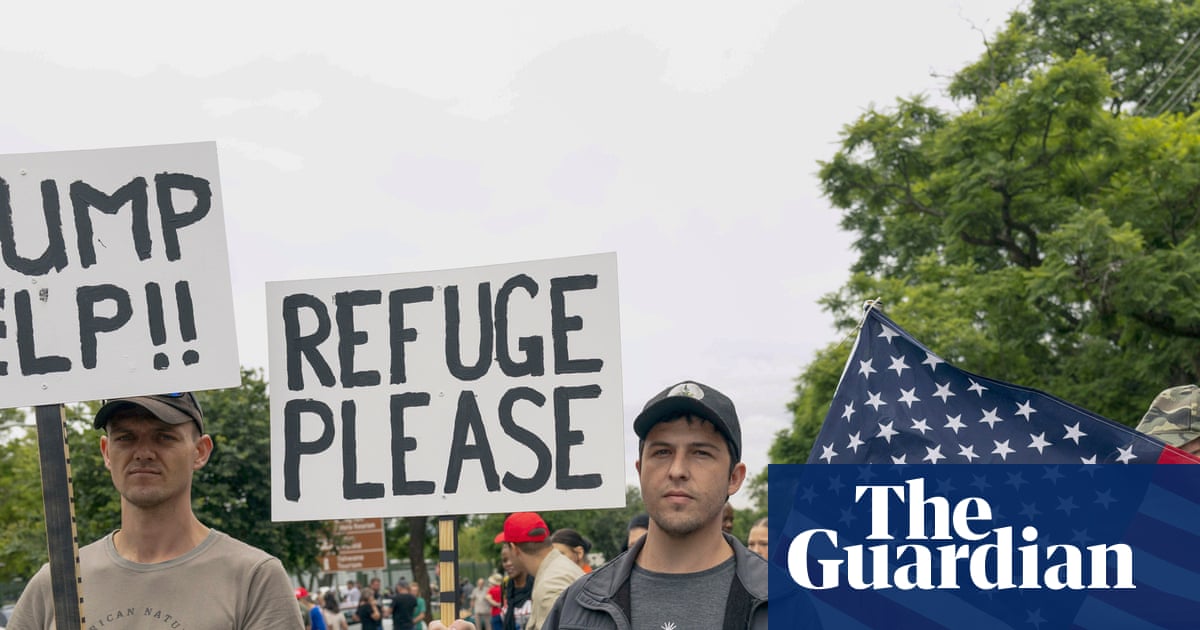
When Donald Trump announced in February 2025 that the US would accept Afrikaners from South Africa as refugees, many white South Africans who believed that they were victims of racism in their country thought that their prayers had been answered.
asserted
prayers → announce → country
However, in the past few months, dozens of applicants to the refugee programme have been rejected, with many left dismayed and confused as to why they would be left to face what Trump has falsely claimed is a “white genocide” in South Africa.
asserted
Trump → reject → Africa
After Trump’s February 2025 executive order announcing the resettlement programme, which was expanded to include members of a “racial minority”, the first group of 68 white South Africans arrived in the US that May.
uncertain
group → announce → US
The US also shut down the refugee programme for anyone else fleeing war and persecution.
asserted
US → shut → war
Since then, more than 13,000 have moved to the US, according to state department figures.
uncertain
13,000 → move → figures
Arrivals are also accelerating, with more than 2,600 admitted in August.
asserted
2,600 → accelerate → August
Afrikaners, descended from Dutch and French settlers, ruled South Africa during apartheid.
asserted
Afrikaners → descend → apartheid
The regime repressed the black majority, while keeping white people safe and wealthy.
asserted
regime → repress → people
Since the end of apartheid more than 30 years ago, affirmative action policies have helped to create a black elite and middle class.
asserted
policies → help → elite
But about 38% of black South Africans are unemployed, compared with 9% of white South Africans, according to official data.
uncertain
% → compare → data
Meanwhile, the “black economic empowerment” policies, along with high crime rates that affect everyone, have fostered a feeling among some white South Africans that they are now the victims of racial discrimination.
asserted
they → affect → discrimination
The racist far right has also long highlighted brutal murders of white South African farmers, claiming them as evidence of white people being targeted.
asserted
right → highlight → people
Official crime data does not show farmers or white people experiencing crime at higher rates.
asserted
farmers → show → rates
That has not stopped Trump amplifying these claims, in the face of the South African government’s furious rebuttals.
uncertain
Trump → stop → rebuttals
On 30 June, Facebook and WhatsApp groups for prospective and successful refugee applicants began to light up with news that people had begun to receive rejection letters.
asserted
people → begin → letters
“We are writing to inform you that, following review, USCIS [US Citizenship and Immigration Services] found your application to be ineligible for continued processing for resettlement to the United States at this time.
asserted
application → write → time
This cannot be appealed,” the letters said, according to multiple rejections seen by the Guardian.
uncertain
letters → appeal → Guardian
It is unclear how many have been found ineligible.
uncertain
many → find → ?
USCIS did not provide data on the total number of refugee applications and rejections.
asserted
USCIS → provide → applications
One WhatsApp group set up to support rejects, called Hope beyond the Letter, had 311 members as of 10 September, according to one of the administrators, who noted that the membership fluctuated.
uncertain
membership → set → administrators
While the ineligibility letters did not give reasons for rejection, some applicants were given more information after making Freedom of Information Act (FOIA) requests.
asserted
applicants → give → requests
The WhatsApp group administrator, a 64-year-old freelance TV professional, who did not want his identity disclosed, found that his case was initially “recommended for approval”.
asserted
case → want → approval
However, the recommendation was reversed because his ex-girlfriend, whom he had applied with, had a marijuana conviction.
asserted
he → reverse → conviction
“I cried like a baby,” he said, of receiving the rejection letter on 30 June, having finished the screening process in November.
asserted
he → cry → November
“It was something I actually believed was attainable.
asserted
I → believe → ?
I believed the hype.”
asserted
I → believe → hype
Pieter and Liesl (not their real names) were told they were “conditionally approved” as refugees last November.
asserted
they → tell → refugees
Both are Afrikaners who had a grandparent killed on a farm and were managing a farm when they applied to become refugees.
asserted
they → have → farm
Pieter said he was convicted of trespassing in 2014, for which he said he paid a fine and did not go to court.
asserted
he → say → court
He was granted multiple temporary visas to work on farms in the US between 2011 and 2024.
asserted
He → grant → 2011
The couple’s youngest daughter was born in the US and is a US citizen.
asserted
daughter → bear → US
In the response to their FoI request, they noticed that USCIS had recorded her nationality as South African and incorrectly said that she would be left behind if they moved to the US as refugees.
asserted
they → notice → refugees
They had already sold their house, car and many of their possessions when they received a rejection letter on 24 July.
asserted
they → sell → July
“We have to start all over again,” Pieter said.
asserted
Pieter → have → ?
Another applicant blamed not being able to speak in his native Afrikaans for what he claimed were misunderstandings that led to him and his wife being rejected.
asserted
him → blame → Afrikaans
The reasons given in response to their FoI request were “crime involving moral turpitude” and “commission of acts of torture or extra judicial killing”.
asserted
reasons → give → torture
The 67-year-old had admitted to shooting at least one black person when working as a security guard in 1995, but said it was in self-defence while responding to the mass break-in of an alcohol shop.
asserted
it → admit → shop
“I was thoroughly investigated by the authorities,” he said.
asserted
he → investigate → authorities
“I was not charged, because I did not break the law.”
asserted
I → charge → law
In an emailed response that did not address specific cases, the USCIS spokesperson Zach Kahler said: “The Department of Homeland Security is committed to resettling Afrikaner refugees who are being persecuted by the South African government.
“
asserted
who → email → government
…and 3 more, not listed.
 The Aporia