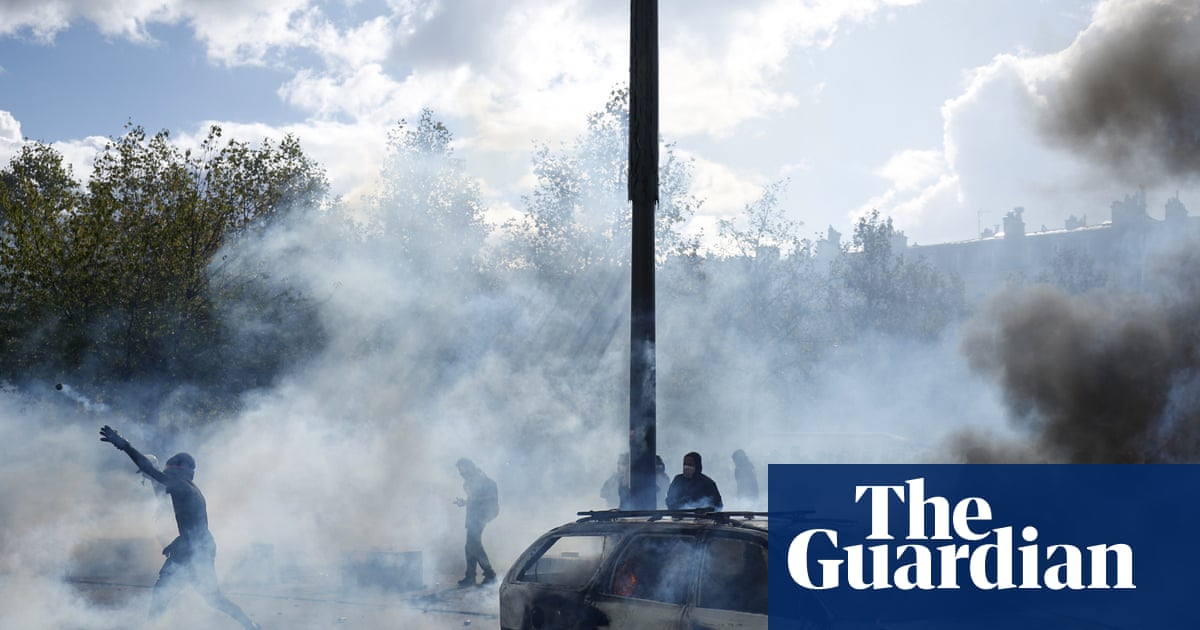
‘A powerful warning’: will Europe’s angry protests lead to real political change?

Read the original at The Guardian ↗
Cite

correspondent, A. K. E. c. a. (2026, October 21). ‘A powerful warning’: will Europe’s angry protests lead to real political change? The Guardian. https://www.theguardian.com/world/2026/oct/21/will-europe-protests-lead-to-real-political-change

Dated from the outlet's own feed. Check the original for its byline.

The Guardian · collected 2026-10-21 · by Ashifa Kassam European community affairs correspondent

Quick Summary

Across Europe, recent protests highlight widespread discontent among younger generations regarding affordable housing, social equality, and public service quality. In France and Italy, while media attention focused on violent fringe elements, the core issues stem from a perception that governments cannot or will not address these challenges effectively. Policy analyst Alberto Alemanno emphasizes that these demonstrations reflect a broader crisis of confidence in European institutions' ability to meet young people’s expectations for security, opportunity, and representation.
Written locally by qwen2.5:14b on 2026-10-21, using this article's own text rather than the other coverage of the same event (that is the story summary below).

AI analysis runs on qwen2.5:14b, locally

Story summary

Student-led protests demanding lower tuition fees, greater state investment in education, and protesting corruption in the education system joined a broader anti-government movement calling for Prime Minister Edi Rama’s resignation. Demonstrations turned violent with protesters throwing rocks at police who responded with water cannons and tear gas. The unrest began as an environmental protest over alleged corruption and has since escalated into significant political challenges to Rama, now entering its eighth day in Albania. Similar protests have erupted across Europe due to rising fuel costs, discontent with school conditions, declining public services, and unaffordable housing crises, mirroring a broader sentiment among younger generations that governments are unable or unwilling to address these issues effectively. These movements represent a powerful warning from Europe’s youth about the need for systemic political change. Authorities reported injuries to approximately 120 police officers and 45 demonstrators in Albania alone, although some cases may have gone unreported. Prime Minister Rama maintains that legitimate concerns are being hijacked by those deliberately causing violence during protests. Across Europe, tent camps protesting housing costs have also emerged in Spain and Portugal while Italy and France face violent clashes between protesters and security forces. These events highlight a growing perception among younger generations that political systems fail to address their core demands for affordable living conditions and social equality effectively. Despite the unrest, Albania remains committed to its goal of joining the European Union by 2030. Similar protests have also engulfed France, where issues include deteriorating school infrastructure and teacher shortages alongside rising costs affecting young people's livelihoods. These global trends reflect a broader dissatisfaction with governance capabilities concerning economic stability and social justice, particularly impacting youth populations struggling under current socio-economic pressures across multiple European nations. Political analysts see these events as pivotal moments testing the responsiveness of governments to urgent societal demands amid escalating public discontent over systemic issues like housing affordability, employment opportunities, and equitable access to essential services. The protests underscore a critical juncture where traditional political mechanisms face significant challenges from mobilized citizens seeking meaningful reform and policy shifts addressing contemporary socio-economic grievances.

Written for “Albanian Student Protests Turn Violent” on 2026-10-21, grounded in this article and the 38 other(s) covering the same event.
Why this leaning score
The model judged this article politically coded and scored it -0.65, but all 3 of its quote(s) are attributed speech - words the article quotes from someone, not the article's own narration, so the score is not published.
Written under an earlier scoring contract, which gave a paragraph rather than checkable quotes. Re-analysing this article replaces it.
Leaning score withheld for article 95784: attributed speech only · logged 2026-10-21

Story

📰 Albanian Student Protests Turn Violent
Politics · 39 article(s) covering the same event. Compare every outlet's account →

Compared with similar articles

This article reads unscored and hedges 6% of its claims. Each row says how that neighbour differs.
New York Post
⚖️ leaning not scored 🔴 0% hedged 0 of 11 📰 publisher trust 66
“Both articles describe violent anti-government demonstrations continuing for a week in Albania's capital, Tirana.”
New York Post
⚖️ Leans strongly right 🔴 14% hedged 1 of 7 📰 publisher trust 66
“While both articles discuss widespread protests and riots in France, ARTICLE A focuses specifically on the violent nature of the riots as an attack on civilization beyond just student grievances, while ARTICLE B provides a broader context comparing French protests to those in other European countries and mentions violence but does not focus solely on it.”
The Guardian
⚖️ Leans left 🔴 6% hedged 2 of 33 📰 publisher trust 66
“Article A describes a specific day's events and direct clashes, while Article B provides broader context and analysis over several days.”
New York Post
⚖️ Leans strongly right 🔴 8% hedged 2 of 24 📰 publisher trust 66
“While both articles discuss protests in France, Article A specifically describes a chaotic incident with large numbers of protesters and violent actions, while Article B provides an overview of broader European protest trends and mentions the French protests but focuses more on their context and implications.”
Al Jazeera
⚖️ Leans left 🔴 9% hedged 5 of 55 📰 publisher trust 60
“While both articles discuss widespread protests in France, Article A focuses specifically on a nationwide protest event with 550,000 participants, while Article B provides a broader overview of similar protests across Europe and mentions the violence on the fringes but does not specify a single occurrence.”
CBS News
⚖️ leaning not scored 🔴 0% hedged 0 of 1 📰 publisher trust 66
“Article A focuses specifically on the anti-government protests in France and President Macron's description, while Article B provides a broader context including multiple European countries.”
Al Jazeera
⚖️ Leans left 🔴 12% hedged 6 of 50 📰 publisher trust 60
“While both articles mention protests in Albania's capital, Tirana, ARTICLE B is a broader overview of protest movements across Europe and does not focus on the same specific incident as ARTICLE A.”
Al Jazeera
⚖️ Leans left 🔴 50% hedged 1 of 2 📰 publisher trust 60
“While both articles discuss youth-led protests across multiple European countries, they do not describe the exact same incident or occurrence.”
BBC News
⚖️ Leans left 🔴 9% hedged 4 of 46 📰 publisher trust 69
“Article A describes violent protests specifically occurring in multiple cities across Albania, while Article B mentions Albania's capital Tirana as part of a broader context of protests happening across Europe.”
Al Jazeera
⚖️ Leans left 🔴 0% hedged 0 of 2 📰 publisher trust 60
“While both articles discuss widespread student protests and unrest across Europe, they describe different phases or aspects of multiple ongoing events rather than a single specific incident.”
How this article was measured signals, leaning charts, publisher record, byline, topics and claims

Signals How these are calculated →

Claims extracted
35
sentences that state something as happening or true
Uncertain
6%
2 of 35 hedged ("reportedly", "may", "according to")
Leaning
withheld
no quote in the article backed the model's score
Publisher signals
66/100
The Guardian's corrections and hedging, across everything collected from it. Not a measure of accuracy.
Outlets on this story
39
Politics
Same framing elsewhere
1
articles that frame the event the way this one does
Analyzed 2026-10-21 · how these are computed

How this is being covered How these are calculated →

Article leaning vs. publisher reliability
Source leaning vs. consistency

Publisher

The Guardian · 2198 article(s) · 6 correction(s) detected
Running correction rate · 6 correction(s)

Who wrote this

Ashifa Kassam European community affairs correspondent
5 article(s) here · 1 carrying a prediction
🔮 The protests themselves, however, point to what seems to be a diverse response to a common crisis: the growing perception, particularly among younger generations, that governments are unable, or unwilling, to deliver when it comes to affordable housing, social equality and robust public services.
🔮 Just imagine what would happen to our society if more and more women disappear from public life.”
🔮 Barrot said his government would work to counter these efforts by foreign entities.
🔮 Tusk instead hinted that his government was intent on doing things differently, telling reporters that it would not prosecute those who helped to facilitate abortions.
🔮 Thursday’s decree also sets out that in cases where students show persistent problems with integrating or struggle to learn the language, their parents will be referred to social services and will have to take free literacy and Italian language classes.
Also by Ashifa Kassam European community affairs correspondent
Nothing else under this byline is closely related to this article, so these are simply their most recent.

Topics

Belgium France Italy Paris Spain

Subjects

France GPE · 7× Italy GPE · 3× Albania GPE · 2× Paris GPE · 2× Alberto Alemanno PERSON · 1× Belgium GPE · 1× Emmanuel Macron PERSON · 1× Portugal GPE · 1× Spain GPE · 1× Tirana GPE · 1×

Narrative

The protests themselves, however, point to what seems to be a diverse response to a common crisis: the growing perception, particularly among younger generations, that governments are unable, or unwilling, to deliver when it comes to affordable housing, social equality and robust public services.
framing: assertive · carried by 1 article(s) · first seen 2026-10-21
🔮 The protests themselves, however, point to what seems to be a diverse response to a common crisis: the growing perception, particularly among younger generations, that governments are unable, or unwilling, to deliver when it comes to affordable housing, social equality and robust public services.

Claims (35 extracted, 2 hedged)

In France, it was the piles of wheelie bins stacked up against school entrances that first hinted at the scale of student anger over crumbling classrooms and teacher shortages. asserted
that → stack → classrooms
In Spain, it was a tent camp that steadily grew in the heart of the capital as residents railed against soaring housing costs. asserted
residents → grow → costs
Similar scenes have since sprung up in Belgium, Italy and Portugal, and clashes have convulsed Albania’s capital of Tirana, hinting at an autumn of protests across Europe. asserted
clashes → spring → Europe
Much of the news coverage in recent days has focused on the violence that played out on the fringes of the protests in France and Italy. asserted
that → focus → France
The protests themselves, however, point to what seems to be a diverse response to a common crisis: the growing perception, particularly among younger generations, that governments are unable, or unwilling, to deliver when it comes to affordable housing, social equality and robust public services. asserted
it → point → housing
“This is the most powerful warning from Europe’s angry youth today, in France and across the continent,” the policy analyst Alberto Alemanno said. asserted
analyst → say → continent
The framing stands in sharp contrast to the many rightwing and far-right voices who have sought to exploit the violence in France and Italy, linking it without evidence to migration while brushing over protesters’ wider demands. asserted
who → stand → demands
Officials in France have dismissed any link between the violence and immigration. asserted
Officials → dismiss → violence
The country’s president, Emmanuel Macron, said on Sunday that the “unbridled violence” had been carried out by French people. asserted
violence → say → people
Alemanno, a professor of EU law at the HEC business school in Paris, said he had received an unprecedented number of calls from right-wing, xenophobic outlets in recent days, many of them seeking to fuel the idea of the protests as some sort of “pan-European revolt”. asserted
many → say → revolt
It is a narrative that he describes as misleading. asserted
he → describe → that
“The demonstrations have different causes and do not necessarily share political objectives,” he wrote this week. asserted
he → have → objectives
“Yet their rapid spread hints at a common weak point: too many young Europeans doubt that existing institutions can deliver the security, opportunity and voice they expect.” asserted
they → hint → security
The head of the Paris office of the European Council on Foreign Relations, Célia Belin, said some of those doubts were currently being reinforced in France. asserted
some → say → France
“Faced with the high discontent of young people in high school, the government has no answer for them,” she said, citing an administration squeezed financially by a high deficit and debt-to-GDP ratio and limited politically by the country’s deadlocked parliament. asserted
she → face → parliament
“Basically the answer is: ‘There’s no money, there is nothing we can do.’ asserted
we → ’ → ?
And that’s a huge problem.” asserted
that → ’ → ?
The view echoes that of the secretary general of France’s CGT union, Sophie Binet, after Saturday’s protests in which about half a million people turned up to rail against the rising cost of living and deteriorating public services. asserted
people → echo → living
Binet condemned the violence, but she noted that the government had little choice when it came to quelling the protests. asserted
it → condemn → protests
“Today’s mobilisation confirms the depth of the anger,” she said. asserted
she → confirm → anger
Albania has also been shaken by mass student demonstrations for the past week after protests initially prompted by a proposal to build a resort backed by Donald Trump’s family. asserted
Albania → shake → family
In Milan, people took to the streets to protest against the rising cost of living, giving voice to the deep inequalities that now course through a city where an estimated one in 12 people is reportedly a millionaire. uncertain
that → take → city
In Lisbon’s Rossio Square, housing campaigners set up camp on Saturday surrounded by banners that read “homeless generation” and “I just want a home to live in” and vowing to stay on as long as possible. asserted
I → set → home
It was an echo of the protests that have sprung up in Porto in recent weeks as residents push back against housing prices that more than doubled between 2015 and 2024, rising roughly twice as fast as the EU average. asserted
that → spring → average
The managing director for Europe at the consulting firm Eurasia Group, Mujtaba Rahman, said what had burst into public view was not a single, coordinated European movement. asserted
burst → consult → view
Instead the events of recent days had laid bare a “convergence of distinct national protest movements”, each with substantially different triggers. asserted
events → lay → triggers
“What links them is a growing perception that European governments are unable to deliver affordable housing, functioning public services and economic security, particularly for younger generations,” he said, citing a growing gap between public expectations and governments’ fiscal capacity. asserted
he → link → expectations
“This mismatch between political demands and economic reality is likely to remain and grow over time, which suggests further discontent and protests are likely over the medium term,” he said. uncertain
he → remain → term
Arancha González, the dean of the Paris School of International Affairs and a former Spanish foreign minister, went a step further when asked this month about the similarities between the housing protests in Spain and the school protests in France. asserted
González → go → France
“The reasons are different, but they share the same spark: the breakdown of the social contract,” she told the Italian newspaper Corriere della Sera. asserted
she → share → newspaper
“Young French people are protesting for education, young Spanish people for housing, but in Europe, the idea that economies generate wellbeing and social equality has been shattered. asserted
economies → protest → wellbeing
In Portugal, the campers were dislodged on Tuesday, leading to a fresh call for more housing protests. asserted
campers → dislodge → protests
Similar calls for protests in the coming days have been heard across France, Spain and Italy, hinting at the tremendous task that lies ahead for officials across Europe, said Alemanno. asserted
Alemanno → come → Europe
“They must protect peaceful demonstrators, hold those responsible for criminal acts accountable, and address the underlying pressures, from housing costs and insecure work to strained public services and an uncertain technological future,” he said. asserted
he → protect → services
“Europe’s democratic institutions will be judged not by how forcefully they condemn disorder, but by whether they can turn generational anger into tangible political change.” asserted
they → judge → change
💬Give feedback
🕘History 🎫Support