When Jess Miller’s council went head to head with a cashed-up data centre operator over 7000 square metres of open space, $70 million was the steep price to secure the land for a public sports ground.
asserted
million → go → ground
It’s a battle happening in cities around Australia: councils with modest budgets confronting a ferocious commercial market.
asserted
It → ’ → market
For the Melbourne-born City of Sydney councillor, though, the price was one worth paying.
asserted
price → bear → councillor
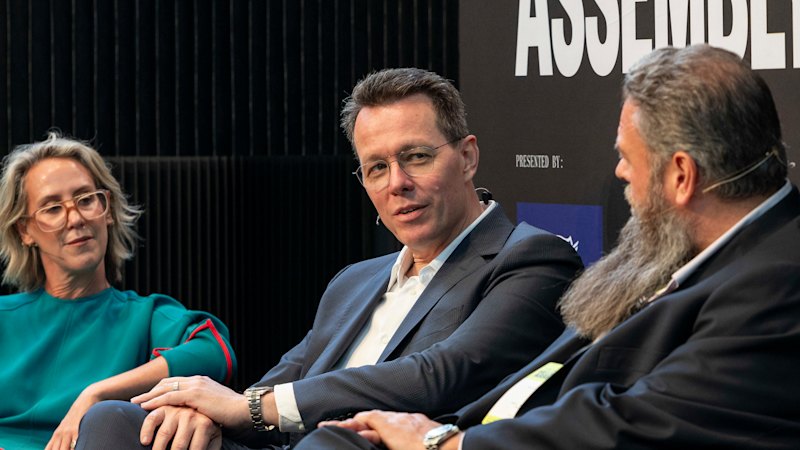
“It’s a decision that says this is so important that we’re willing to blow $70 million,” Miller told The Age’s Melbourne Assembly civic forum on Wednesday.
asserted
Miller → ’ → Wednesday
“The reason for that is so that the people living in the towers alongside this playing field [in Sydney], when they wake up every morning, they’re looking out onto a park, and they’re not looking at a data centre.”
asserted
they → live → centre
Miller said that with “all the money in the world”, her top investment would be community sport, which brings everyone together – regardless of their financial situation or background.
asserted
which → say → situation
Melbourne may be regarded as Australia’s sporting capital, but as the Assembly heard on Wednesday, there remains work to do at the grassroots level, both to retain that crown and to ensure the city remains a healthy and happy place to live.
uncertain
city → regard → crown
Kieren Perkins, swimming champion and chief executive of the Australian Sports Commission, said new suburbs in growth corridors were being deprived of sporting facilities and community spaces, and that the opportunity for kids to participate in a variety of sports was dramatically diminishing.
In his telling, sport in Melbourne has morphed into a “streamlined, hyper-competitive” and talent-obsessed version of its former self, with people more likely to gamble on games rather than participate in them.
asserted
people → say → them
“The way communities are starting to view the point of sport has shifted.
asserted
communities → start → sport
We’re becoming more consumers of it,” Perkins said.
asserted
Perkins → become → it
The challenge is even sharper for the arts sector, according to Kate Duncan, chief executive of Australian youth music charity The Push.
uncertain
challenge → accord → charity
“You don’t get the MCG and the tens of thousands of people that go there every weekend without the community clubs and junior youth participation underneath that, and we don’t always apply that same long-term logic to creativity and culture,” she said outside the Assembly.
asserted
she → get → Assembly
“We have so much to learn from sport in the way that we – as a state, as a city – value sport at a community level, right up to prestigious level.
asserted
we → have → level
The arts sector is reckoning with a worrisome reality, Duncan said: will Melbourne still be a vibrant cultural city by 2050, if today’s teenagers lose their connection to it?
asserted
teenagers → reckon → it
The Melbourne Assembly on Wednesday posed a similar question for sport: with urban sprawl, could sport face the same fate?
uncertain
sport → pose → fate
Common to sports and the arts is that much of their funding is sucked up by major events and infrastructure. When there’s little left for grassroots clubs and projects, young people come up against bigger roadblocks – the cost of access and fewer options to get involved, among them – especially if they are outside the inner city.
asserted
they → suck → city
The answer to getting the balance right lies with the community, Franco-Colombian urbanist Carlos Moreno says.
asserted
Moreno → get → community
In his keynote address on day three of the Melbourne Assembly, Moreno championed the concept of a “participatory budget”, wherein citizens aged seven and older can submit and vote on ideas for how public money is spent.
asserted
money → champion → ideas
The idea was adopted more than a decade ago in his home of Paris, where since 2014 the municipal government has funded thousands of projects, committing about 5 per cent of the city’s annual budget.
asserted
government → adopt → budget
The projects are labelled “fait avec les Parisiens”, or, made by Parisians, and include rooftop farms, children’s play areas, community art murals and bag storage for the homeless.
asserted
projects → label → homeless
Moreno pioneered the 15-minute city model – the origin of Melbourne’s “20-minute neighbourhood”.
asserted
Moreno → pioneer → neighbourhood
But at the Melbourne Assembly, he said the concept needs to go further, to enshrine “the right to proximity”, concentrating amenities and services around housing.
asserted
concept → say → housing
Related Article
“When you have a power outage, when you have the war in the [Strait of Hormuz], when you have floods, when you have a heatwave, when you have the paralysis of local places, proximity is the only possibility for continuing to have a connected quality of life,” he said.
asserted
he → have → life
Civic and industry leaders at the forum – which on its final day focused on the pillars of healthy places and people, presented in partnership with Bupa, and on sports and arts – debated whether to take a big-picture approach to Melbourne’s future or focus on small-scale interventions.
asserted
which → focus → interventions
The City of Sydney’s Jess Miller argued cities shouldn’t “let perfection get in the way of the good” and, if there are small interventions that can be made at a hyper-local scale, governments should grasp them – even if it’s a matter of starting with local bike tracks, so children can ride to local shops rather than their parents driving them.
Panellist Kelvyn Lavelle, meanwhile, argued rushing into decisions without a cohesive vision risked Melbourne straying from the principle of “intentionality” – one of Moreno’s crucial design tenets.
asserted
Melbourne → argue → tenets
Melbourne’s west, Australia’s fastest-growing region, should have a key part in that vision, Lavelle said.
asserted
Lavelle → grow → vision
Prosperity in the west meant prosperity for Melbourne as a whole.
asserted
Prosperity → mean → whole
“We’re having conversations around the city’s density and swimming in the Yarra, and the people in Melton have an aquatic centre for every 20,000 people,” the West of Melbourne Economic Development Alliance board member said.
asserted
member → have → Melbourne
City of Melbourne chief executive Alison Leighton said it did not have to be a question of “either/or”.
asserted
it → say → either
Instead, the city should take a wholistic and integrated approach to lift the standard of living.
asserted
city → take → living
Related Article
In a city where so many people were competing for funding ahead of the November state election, Melbourne needed to decide where its priorities lay, Yorta Yorta and Dja Dja Wurrung academic and artist Tiriki Onus said.
“If artists were to be making a living wage, I’d put up with potholes on the road,” the University of Melbourne pro vice chancellor (Indigenous) said.
asserted
chancellor → compete → Melbourne
Whatever the future looked like for Melbourne, though, Miller said the city should never lose its grit, for it was the source of creative tension.
asserted
it → look → tension
“It’s not always pleasant to look at,” she said.
asserted
she → ’ → ?
“But it makes the city feel real.”
Get the day’s breaking news, entertainment ideas and a long read to enjoy.
asserted
city → make → news
It’s easy to be caught up in pessimism about Melbourne.
asserted
It → ’ → Melbourne
But opportunities are opening up for workers and employers and an opportunity for “agglomeration”, where networks form and exciting things happen.
asserted
things → open → agglomeration
- Exclusive
The state opposition has promised a $578 million windfall from the sale of the Melbourne Wholesale Fruit and Vegetable Market should it win November’s election.
asserted
it → promise → election
Previously
With an ageing population and increasing temperatures, an urgent overhaul of the city and its urban spaces is needed, experts say.
asserted
experts → age → city
 The Aporia