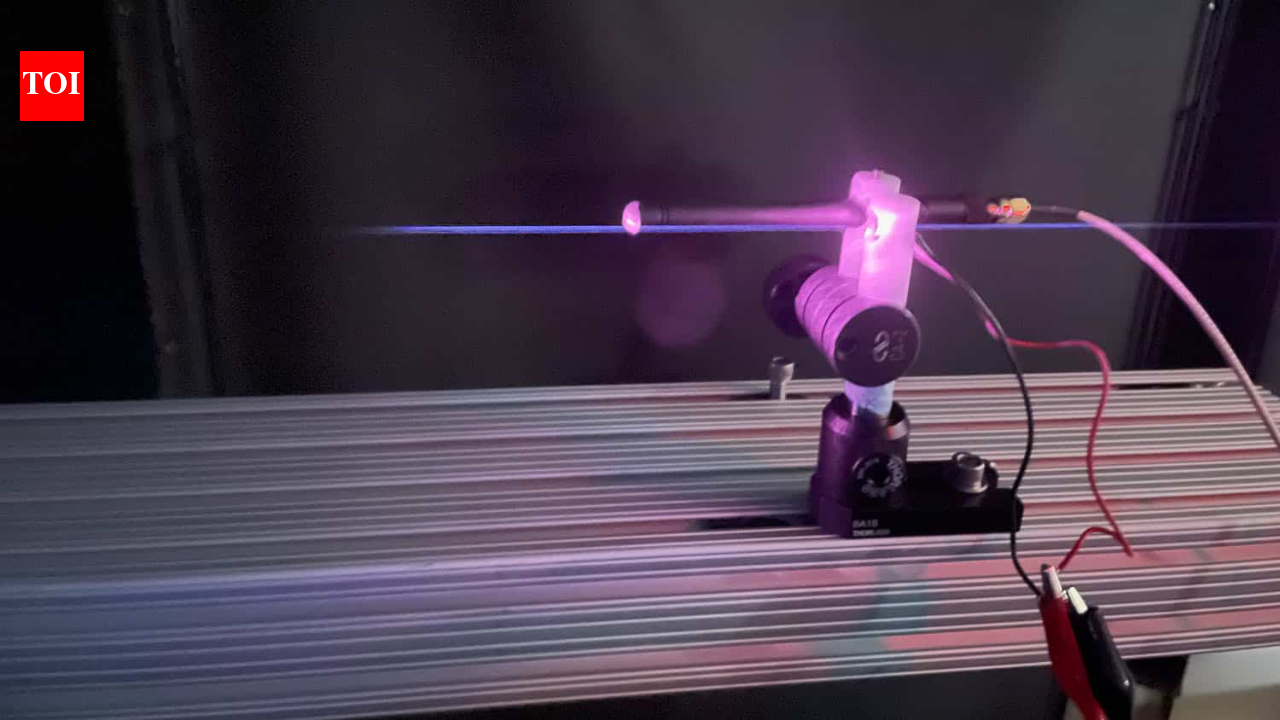
Researchers at North Carolina State University have demonstrated a laser-powered plasma antenna that transmits radio signals without a conventional metal radiating element.
asserted
that → demonstrate → element
Resembling a lightsaber, the device uses a laser to ionise air and create a thin plasma filament that transmitted a 30 MHz radio signal during laboratory tests.
asserted
that → resemble → tests
According to the study published in the IEEE Journal, titled ‘Laser-Induced-Plasma-Filament Antenna Transmitting 30 MHz VHF’, the received signal strength increased by approximately 2.5 times when the plasma filament was used as an antenna.
uncertain
filament → accord → antenna
The technology could eventually support reconfigurable antennas for satellites and aircraft, although further development is needed.
uncertain
development → support → satellites
How does the laser-powered plasma antenna work
The antenna relies on a process in which a laser beam ionises air, producing a narrow channel of plasma known as a laser-induced plasma filament.
asserted
beam → power → filament
The research paper explains that electrons become concentrated around the filament’s outer edges, giving the structure characteristics similar to those of a conventional electrical conductor.
asserted
electrons → explain → conductor
When electromagnetic energy is coupled into the filament, these electrons can support the propagation and radiation of electromagnetic waves.
asserted
electrons → couple → waves
The researchers used a laser with a pulse duration of 100 femtoseconds, a repetition rate of 1 kilohertz and a pulse energy of approximately 5 millijoules.
asserted
researchers → use → millijoules
A converging lens with a focal length of two metres was used to produce a plasma filament measuring approximately 20 centimetres in length and 0.1 millimetres in diameter.
asserted
lens → converge → diameter
These dimensions describe the experimental prototype rather than the larger antenna structures the researchers hope to develop in the future.
asserted
researchers → describe → future
Plasma antenna transmits radio signals without direct contact
One of the main challenges was introducing a radio-frequency signal into the plasma filament without disrupting its structure.
asserted
One → transmit → structure
A conventional metal connection would distort the filament and interfere with its formation, so the researchers developed a capacitively coupled antenna feed that transfers electromagnetic energy without making direct contact with the plasma.
asserted
that → distort → plasma
The feed consists of a metal structure that generates an electromagnetic field around the filament.
asserted
that → consist → filament
A radio-frequency generator supplies a 30 MHz signal to this structure, allowing the field to couple energy into the plasma.
asserted
field → supply → plasma
The resulting electromagnetic waves propagate along the filament and radiate outwards.
asserted
waves → result → filament
The feed itself also has radiation characteristics, making it necessary for the researchers to distinguish its contribution from that of the plasma antenna.
asserted
researchers → have → antenna
To test the arrangement, the team measured the received signal under two conditions.
asserted
team → test → conditions
First, the laser was blocked, leaving the radio-frequency feed operating without the plasma filament.
asserted
laser → block → filament
The researchers then repeated the measurements with the laser unblocked and the plasma filament present.
asserted
filament → repeat → measurements
A receiving antenna was positioned approximately five centimetres from the transmitter, with both antennas sharing the same linear polarisation and orientation.
asserted
antennas → receive → polarisation
How did researchers achieve 150% stronger radio signals
The experimental results showed that the received signal was stronger when the plasma filament was present and capacitively fed than when the laser was blocked.
asserted
laser → achieve → signals
According to the research paper’s abstract, the received signal strength increased by approximately 2.5 times, equivalent to a reported increase of 150%, compared with the feed-only configuration.
uncertain
strength → accord → configuration
The researchers reported that the measurements supported the feasibility of using a laser-induced plasma filament as an antenna capable of radiating its own electromagnetic field.
asserted
measurements → report → field
The conclusion of the paper states that the experiment represents the first demonstration of this concept to the authors’ knowledge.
asserted
experiment → state → knowledge
The work establishes a proof of concept for transmitting a 30 MHz radio-frequency signal; it does not demonstrate a fully developed antenna ready for operational use.
asserted
it → establish → use
The researchers noted that the laboratory-scale antenna had relatively low gain and lacked the beamforming precision required for operational synthetic-aperture radar systems or satellite and aircraft applications.
asserted
antenna → note → systems
Further work will focus on improving the antenna’s radiation performance, increasing the efficiency of the contactless feed and developing more accurate methods for characterising its electromagnetic properties.
asserted
work → focus → properties
How could plasma antennas improve satellite communications
The researchers are investigating whether laser-induced plasma filament antennas could eventually be used in satellites and aircraft.
uncertain
antennas → improve → satellites
Antenna length influences the frequencies at which radio waves can be transmitted and received, but changing the length of a conventional antenna can be difficult in applications where space, weight and mechanical deployment are important constraints.
asserted
space → influence → applications
Because the plasma filament is generated by a laser, its length can be controlled through the laser’s operating parameters.
asserted
length → generate → parameters
The NC State news release also describes the possibility of changing the filament’s direction by steering the laser beam.
asserted
release → describe → beam
This could provide a means of adjusting antenna orientation without physically moving a conventional antenna structure.
uncertain
This → provide → structure
However, these capabilities are potential applications of the technique rather than fully demonstrated operational functions of the current prototype.
asserted
capabilities → demonstrate → prototype
How could plasma antennas transmit and receive radio signals
The research paper discusses the longer-term possibility of producing plasma filaments several metres long or more for high-frequency and very-high-frequency applications, as well as very-low-frequency systems.
uncertain
antennas → transmit → applications
It also identifies the possibility of using the same configuration as a receiving antenna, based on electromagnetic reciprocity; this capability remains to be validated in future work.
asserted
capability → identify → work
The demonstration therefore establishes an initial step towards antennas whose radiating elements can be generated and reconfigured using laser-produced plasma.
asserted
elements → establish → plasma
The researchers' next task is to improve performance and address the technical limitations that remain before the technology can be considered for practical satellite or aircraft systems.
asserted
technology → improve → systems
 The Aporia