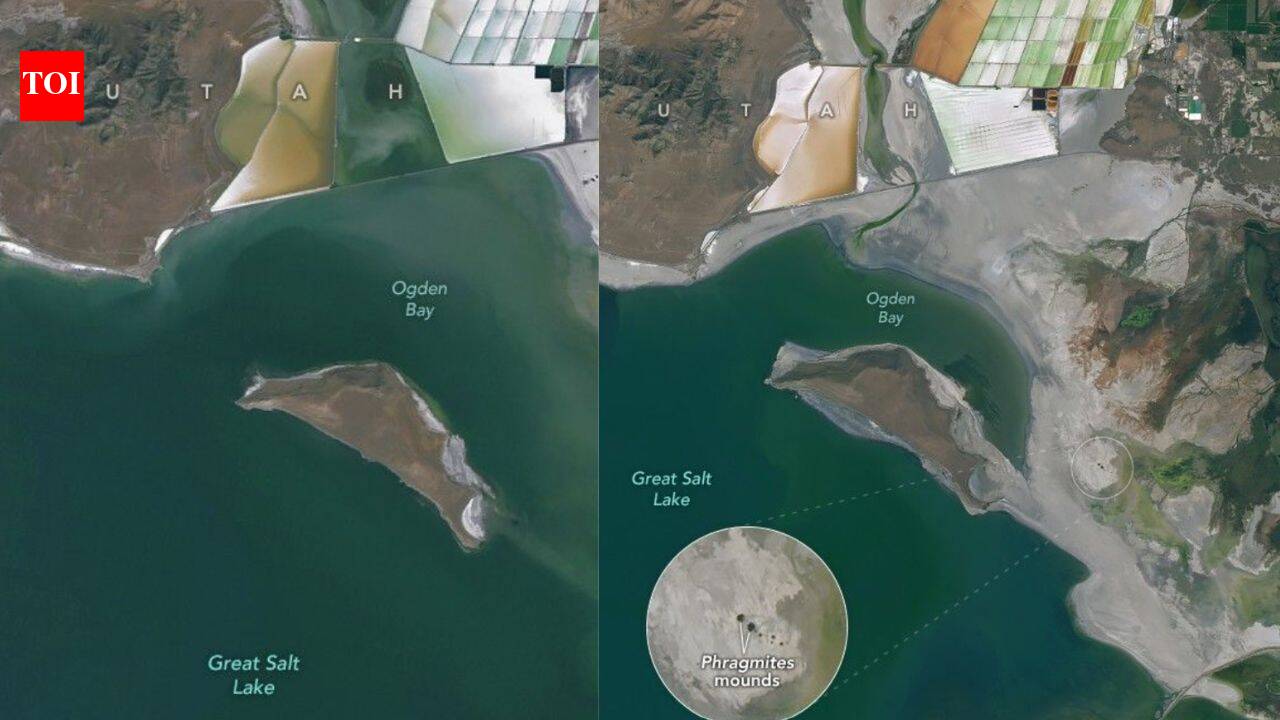
Satellite images from 2025 show dozens of circular mounds exposed by falling water levels.
asserted
images → show → levels
Satellite images revealed these features across Farmington Bay, Ogden Bay and Bear River Bay.
asserted
images → reveal → Bay
The mounds stood out from the surrounding dry lakebed, with dense reeds growing at their centres.
asserted
reeds → stand → centres
Researchers traced this unusual vegetation to freshwater springs flowing directly into the lake basin.
asserted
Researchers → trace → basin
The discovery points to an extensive underground freshwater reservoir that scientists had not previously recognised.
asserted
scientists → point → that
According to Nasa Earth Observatory, the springs may account for as much as 12% of the lake’s total water budget, far above the roughly 3% previously assumed by hydrologists.
uncertain
springs → accord → hydrologists
Satellite images uncover strange circular mounds at Great Salt Lake
As Great Salt Lake’s water levels fell, dozens of unusual circular features emerged along the eastern edge of its drying lakebed.
asserted
dozens → uncover → lakebed
They appeared in parts of Farmington Bay, Ogden Bay and Bear River Bay, where satellite images captured areas that had previously been underwater.
asserted
that → appear → areas
University of Utah researchers had encountered possible signs of these features years earlier while travelling by airboat through the lake’s shallow bays.
asserted
researchers → encounter → bays
They noticed circular patterns disturbing the water’s surface but could not explain their cause.
uncertain
patterns → notice → cause
As more of the lakebed became exposed, similar shapes appeared in images captured by Landsat and other satellites.
asserted
shapes → expose → Landsat
A Landsat 9 image taken on September 13, 2025, showed at least seven features clustered in Ogden Bay.
asserted
image → take → Bay
An image of the same area from September 15, 2011, showed how higher water levels had concealed them.
asserted
levels → show → them
PC: Nasa Earth Observatory
How did researchers investigate the mysterious mounds at Great Salt Lake
asserted
researchers → investigate → Lake
The unusual satellite images prompted researchers to organise field expeditions to investigate several features.
asserted
images → prompt → features
They travelled across thick patches of reeds to reach the centres of the vegetation-covered mounds, using snow bikes and garden tools to avoid damaging the exposed lakebed.
asserted
They → travel → lakebed
William Johnson, a geologist at the University of Utah, said, "It took some work to reach certain sites since we wanted to avoid using vehicles or other modern equipment that might damage the playa”.
uncertain
that → say → playa
Once at the sites, researchers installed piezometers and other monitoring equipment at different depths and distances from the centres of the features.
asserted
researchers → instal → features
These instruments helped them measure the pressure and salinity of the underlying water.
asserted
them → help → water
The measurements revealed a clear pattern.
asserted
measurements → reveal → pattern
Groundwater was salty towards the edges of the mounds but fresher near their centres, where phragmites reeds grew in circular formations.
asserted
reeds → grow → formations
What could hidden freshwater springs reveal about Great Salt Lake
The reeds help distinguish the mounds from the surrounding bright playa in satellite images.
uncertain
reeds → hide → images
Researchers identified dozens of these features, while higher-resolution satellite sensors revealed dozens of smaller examples to the southwest and south of the main cluster.
asserted
sensors → identify → cluster
After conducting aerial electromagnetic surveys, the team estimated that probably hundreds of groundwater-fed oases could be spread across newly exposed sections of Great Salt Lake’s playa.
uncertain
hundreds → conduct → playa
Johnson described the features as ‘windows’ into an extensive underground freshwater reservoir that scientists had not previously realised existed.
asserted
scientists → describe → reservoir
The discovery also changed estimates of how much groundwater enters the lake.
asserted
groundwater → change → lake
Researchers estimate that freshwater discharge from these springs may account for as much as 12% of Great Salt Lake’s total water budget.
uncertain
discharge → estimate → budget
This is considerably higher than the roughly 3% that hydrologists had previously assumed these springs contributed, highlighting the significance of the newly identified freshwater inflow.
asserted
springs → assume → inflow
Freshwater springs may help reduce dust from the drying lakebed
Johnson said the newly identified freshwater inflow could have practical benefits, particularly in limiting dust generated by exposed sections of the lakebed.
uncertain
inflow → help → lakebed
He cautioned that the discovery did not represent a vast new freshwater resource suitable for large-scale extraction.
asserted
discovery → caution → extraction
Dried lakebeds can produce substantial amounts of dust because they contain fine-grained sediments and have little vegetation to hold the material in place.
asserted
they → produce → place
Surface water makes it harder for winds to lift dust and fuel dust storms.
asserted
winds → make → storms
 The Aporia