New in SCOTUSBlog: "The separation and expansion of powers between Congress and the president"

Read the original at Reason ↗
Cite

Blackman, J. (2026, October 20). New in SCOTUSBlog: "The separation and expansion of powers between Congress and the president". Reason. https://reason.com/volokh/2026/10/20/new-in-scotusblog-the-separation-and-expansion-of-powers-between-congress-and-the-president/

Dated from the outlet's own feed. Check the original for its byline.

Reason · collected 2026-10-20 · by Josh Blackman

Quick Summary

SCOTUSBlog has published a concluding essay in its series on recent changes in constitutional law, focusing specifically on the separation of powers between Congress and the president. The essay notes that while the Rehnquist Court initially limited Congressional power and expanded state authority during the late 1990s and early 2000s, post-September 11, 2001, the trend shifted to significantly increase presidential power at the expense of Congress’s oversight capabilities. The author concludes that constitutional law is undergoing rapid transformation since the publication of their last casebook edition in 2022, challenging both professors and students to adapt to these changes without bias or nostalgia for past doctrines.
Written locally by qwen2.5:14b on 2026-10-20, using this article's own text rather than the other coverage of the same event (that is the story summary below).

AI analysis runs on qwen2.5:14b, locally

Story summary

SCOTUSBlog has published an essay analyzing changes in constitutional law regarding the separation of powers between Congress and the president over recent decades. The article notes that while the late 1990s and early 2000s saw limits placed on congressional power through the Rehnquist federalism revolution, the September 11, 2001 attacks marked a shift towards expanding presidential powers. However, by 2008, Congress appeared to regain significant authority over the executive branch. The essay predicts that the next two decades would see a substantial increase in presidential power and a corresponding decrease in congressional oversight of the executive branch.

Written for “Supreme Court Powers Debate” on 2026-10-20, grounded in this article and the 0 other(s) covering the same event.
Why this leaning score
The article's own words the score was based on. Each is quoted verbatim and was checked against the article text before being stored, so you can find it in the original.
Reading Leans right (beta estimate) Confidence high
Leaning: leans right for article 93945 (high confidence, 1 verified quote) · logged 2026-10-20

Story

📰 Supreme Court Powers Debate
Politics · 1 article(s) covering the same event.

Compared with similar articles

This article reads leans right and hedges 9% of its claims. Each row says how that neighbour differs.
Reason
⚖️ leaning not scored 🔴 no claims extracted 📰 publisher trust 67
“Article A discusses a historical date in Supreme Court history, while Article B is about recent changes in constitutional law published on SCOTUSBlog.”
Reason
⚖️ leaning not scored 🔴 23% hedged 5 of 22 📰 publisher trust 67
“The articles discuss different topics within constitutional law and do not describe the same specific incident.”
Washington Examiner
⚖️ leaning not scored 🔴 0% hedged 0 of 2 📰 publisher trust 66
“The articles discuss different topics related to constitutional law and judicial philosophy but do not describe the same specific incident.”
Reason
⚖️ leaning not scored 🔴 no claims extracted 📰 publisher trust 67
“The articles discuss different topics related to constitutional law but do not describe the same specific incident or occurrence.”
How this article was measured signals, leaning charts, publisher record, byline, topics and claims

Signals How these are calculated →

Claims extracted
23
sentences that state something as happening or true
Uncertain
9%
2 of 23 hedged ("reportedly", "may", "according to")
Leaning
Leans right
of the writing, not the subject · beta estimate
Publisher signals
67/100
Reason's corrections and hedging, across everything collected from it. Not a measure of accuracy.
Outlets on this story
1
Politics
Same framing elsewhere
1
articles that frame the event the way this one does
Analyzed 2026-10-20 · how these are computed

How this is being covered How these are calculated →

Article leaning vs. publisher reliability
Source leaning vs. consistency

Publisher

Reason · 827 article(s) · 4 correction(s) detected
Running correction rate · 4 correction(s)

Who wrote this

Josh Blackman
74 article(s) here · 1 carrying a prediction
🔮 Nevertheless, the next two decades would vastly enlarge the president's powers as Congress' authority over the executive branch would be greatly diminished.
🔮 Justice Sotomayor, Justice Gorsuch, Justice Barrett, and Justice Jackson took no part in the consideration or decision of this petition.
🔮 The regulations for Freedmen schools in Texas provided that classes would begin at 9 A.M. and "[t]he morning Exercises will commence with either the singing of an appropriate hymn, or prayer, or the reading of the Scriptures."
🔮 Kyle asks: Well, I don't know how much coverage of the court you read, but you may not be surprised to learn that one light motif is that you are brooding figure.
🔮 Just as there are no doubt those on the bench who have strong ambitions for future office, there are others who are happy to be public servants, but who would be just as happy earning their living by some other means.
2026-10-06 · assertive framing · Lurching Through The Audition Trap
🔮 "But within a relatively short period of time, the thought occurred to me, and I think to the others in the majority, that this would endanger us.
🔮 He could have served in government, but he didn't.
🔮 (Southwick's already fragile reputation would be irreparably tarnished by such a move.)
🔮 The conduct caused disturbances that would have resulted in violence had law enforcement not intervened.
🔮 "It follows that if the underpinning is removed, the increasing professionalism will also disappear.
2026-10-02 · assertive framing · Todd Butler's Problematic Publications
Also by Josh Blackman
Nothing else under this byline is closely related to this article, so these are simply their most recent.
All 74 articles by Josh Blackman →

Topics

Congress SCOTUSBlog Sept. 11, 2001, and the global war on terror

Subjects

Congress ORG · 3× Warren PERSON · 3× Rehnquist PERSON · 2× SCOTUSBlog ORG · 2× Burger PERSON · 1× Roberts PERSON · 1×

Narrative

Our role as casebook editors, and constitutional law professors, is to guide students through the entire corpus of constitutional law, from the framing to the present day, without any nostalgia for, or bias against, times gone by.
framing: assertive · carried by 1 article(s) · first seen 2026-10-20
🔮 Nevertheless, the next two decades would vastly enlarge the president's powers as Congress' authority over the executive branch would be greatly diminished.

Claims (23 extracted, 2 hedged)

SCOTUSBlog has published the final installment in our series on recent changes in constitutional law. asserted
SCOTUSBlog → publish → law
This essay focuses on the separation of powers. asserted
essay → focus → powers
It begins: The late 1990s and early 2000s ushered in the Rehnquist federalism revolution, which appeared to place limits on Congress' powers and expand those of the states. asserted
which → begin → states
Then came Sept. 11, 2001, and the global war on terror, which seemed poised to expand the president's powers. asserted
which → come → powers
Yet, by 2008, Congress' powers seemed without meaningful limits and the president's efforts to expand his own powers had failed. asserted
efforts → seem → powers
And the separation of powers remained, well, separate. asserted
separation → remain → powers
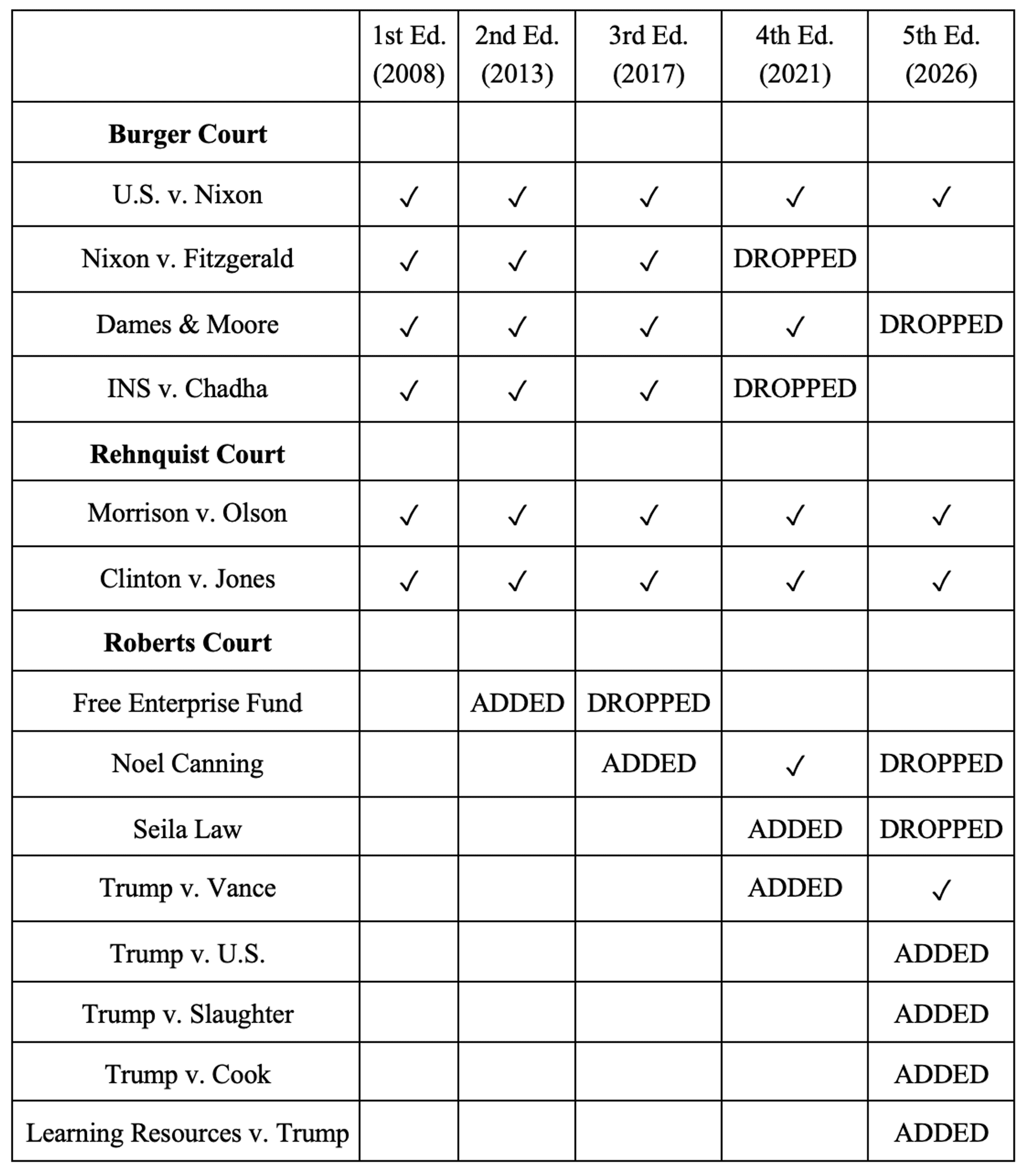
Nevertheless, the next two decades would vastly enlarge the president's powers as Congress' authority over the executive branch would be greatly diminished. asserted
authority → enlarge → branch
Here is a chart that shows the shift in cases: asserted
that → show → cases
Here is our conclusion: Up to the fourth edition of our casebook in 2022, constitutional law followed a somewhat predictable arc. asserted
followed → follow → arc
To be sure, there were shifts to the left and to the right, but the doctrine could be explained by a coherent narrative: the New Deal settlement on federal power was untouchable; the court would offer only modest protections for federalism; the administrative state was beyond reproach; attempts to single out unpopular groups would be halted; "benign" racial classifications were permitted; and church and state were strictly separated. uncertain
church → be → groups
Now, each aspect of this narrative has been reconceived. asserted
aspect → reconceive → narrative
The five years since that edition appeared have brought the most changes to constitutional law since the Warren court. asserted
edition → appear → court
We began this series by observing that lawyers tend to internalize the constitutional law that existed when they attended law school. asserted
they → begin → school
Virtually all law professors today came of age in a time of stasis. asserted
professors → come → stasis
They could safely assume that the trajectory of the Warren court would continue indefinitely. uncertain
trajectory → assume → court
But the jurisprudence of the Burger and Rehnquist courts was primed for a reversal, just as the Warren court reversed so many precedents from before. asserted
court → prim → precedents
Ultimately, the Roberts court continues to chip away at precedents from the 1970s and 1980s, even if the precedents from the 1960s and before remain. asserted
precedents → continue → 1960s
Many of these professors have struggled to cope with sudden changes in the doctrine. asserted
Many → struggle → doctrine
Some have voiced their despair of teaching constitutional law at all. asserted
Some → voice → law
Unsurprisingly, their students also struggle to cope with these developments. asserted
students → struggle → developments
Our role as casebook editors, and constitutional law professors, is to guide students through the entire corpus of constitutional law, from the framing to the present day, without any nostalgia for, or bias against, times gone by. asserted
role → guide → times
This is my last planned post with SCOTUSBlog. asserted
This → plan → SCOTUSBlog
I'm sure there will be more to come. asserted
I → come → ?

💬Give feedback
🕘History 🎫Support